On this page
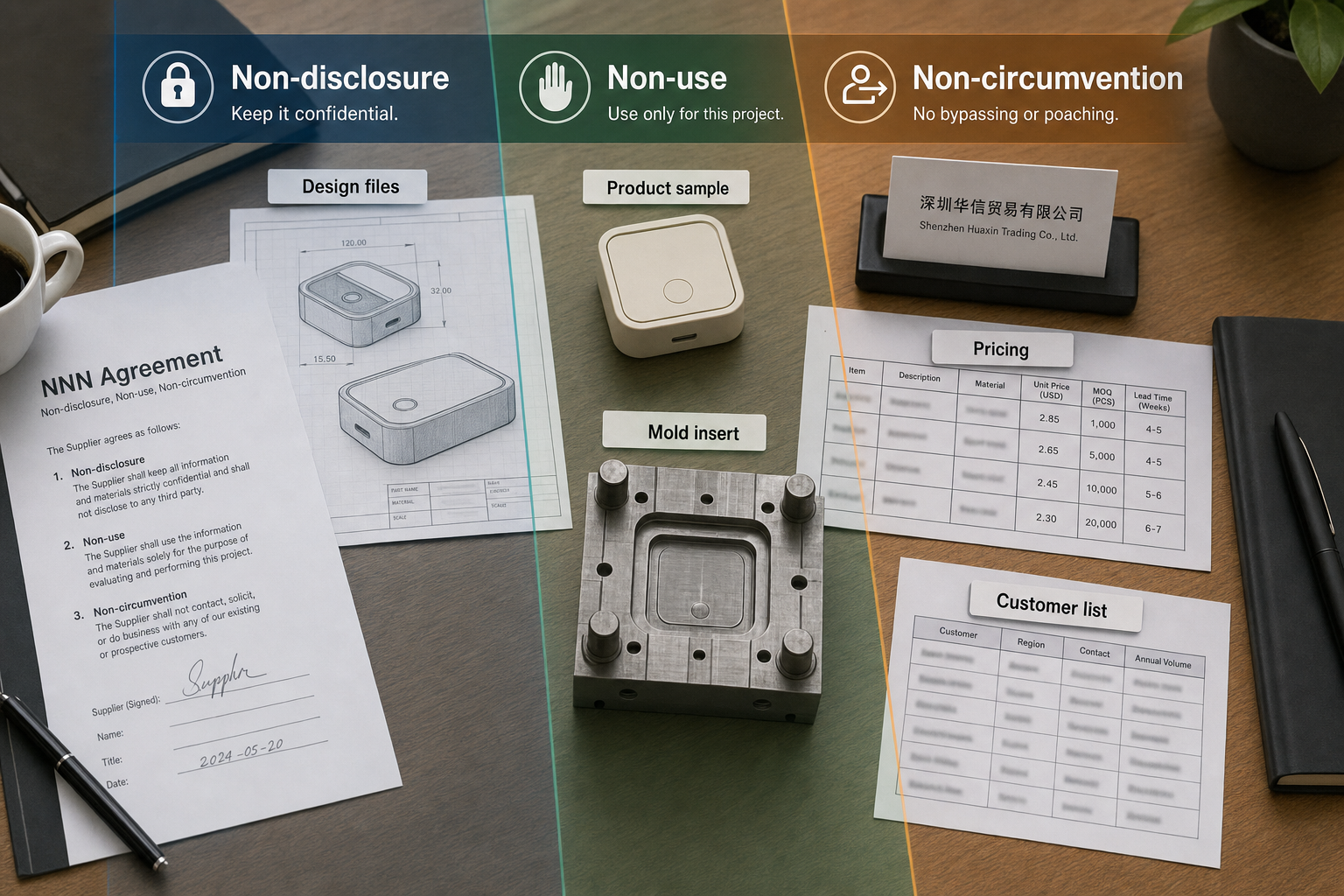
An NNN agreement in China is a contract that tries to stop three things: disclosure, use, and circumvention. It is broader than a standard NDA and is especially important before you share product designs, samples, molds, drawings, customer information, pricing, or platform plans with a Chinese supplier.
Foreign buyers often ask for an NDA. In China sourcing, that may be too narrow because the bigger risk is not only that the supplier tells someone else your idea. The bigger risk is that the supplier uses the information to make the product, sell it, register related IP, approach your customer, or bypass you.
The short definition
NNN means:
- Non-disclosure: do not reveal the protected information.
- Non-use: do not use the protected information for your own production, sale, registration, or competition.
- Non-circumvention: do not bypass the buyer to reach customers, distributors, platforms, factories, or other business relationships.
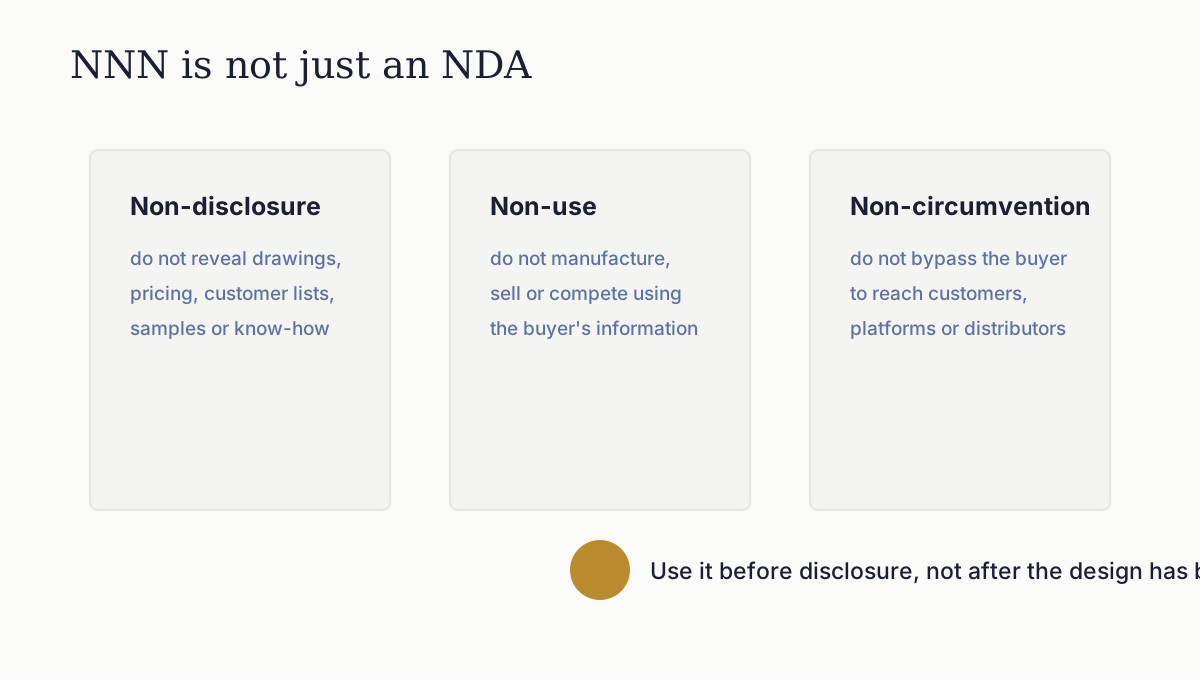
That third part is where many foreign templates are weak. A supplier may not “disclose” your design in the narrow sense. It may simply manufacture a competing version, contact your distributor, or sell through a different brand.
Why a normal NDA may not be enough
Many Western NDAs are built for information secrecy. They assume the main harm is leaking confidential information to outsiders. That is a real risk, but it is not the only risk in China manufacturing.
If a supplier receives your drawings and then uses them to make the same product for itself, the problem is use. If it contacts your Amazon seller, distributor, or end customer directly, the problem is circumvention. If it passes the files to an affiliated factory and says the affiliate is not bound, the problem is scope.
A China-focused NNN agreement should be written around those practical risks.
But changing the label from “NDA” to “NNN” does not make a generic form fit the deal. The parties, permitted purpose, recipients, timing, forum, and remedies still have to match the real transaction. Before relying on a downloaded form, work through the seven risks in a free NNN agreement template.
When to use it
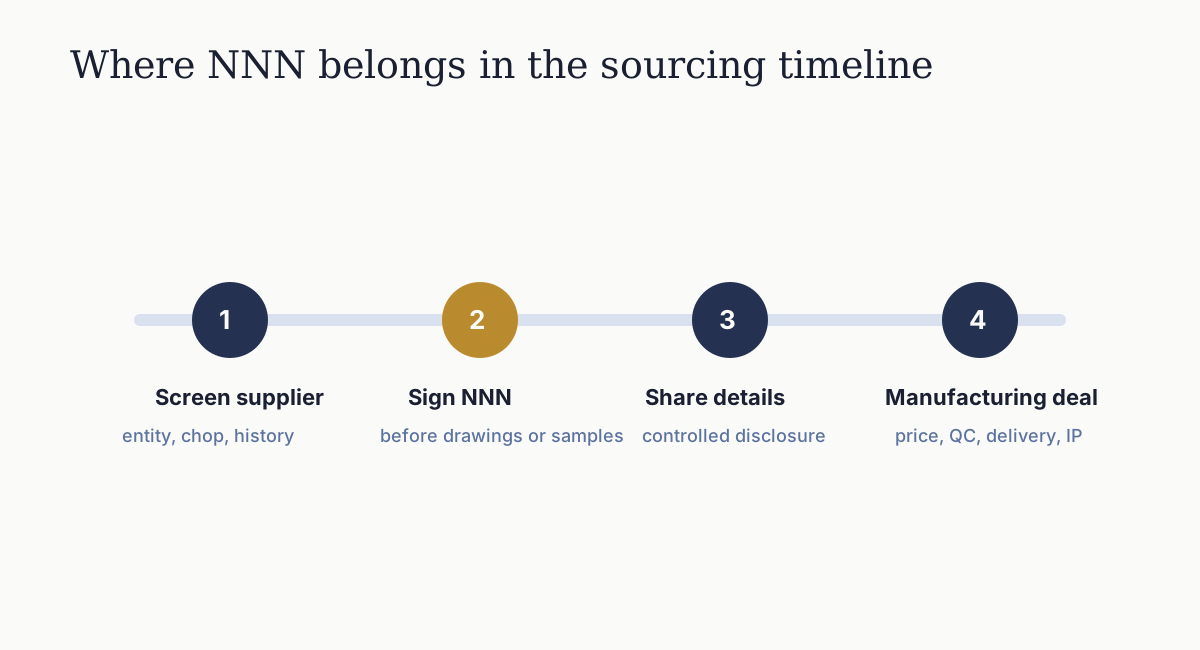
Use an NNN agreement before sharing:
- product drawings, CAD files, formulas, molds, or samples;
- packaging, branding, artwork, or platform strategy;
- customer lists, distributor names, or end-user information;
- pricing structure, supplier shortlist, or margin information;
- technical know-how not yet protected by registration.
It should be signed before disclosure , not after. Once the supplier has your information, the agreement becomes much harder to negotiate and much less useful as a deterrent.
What it should include
A China NNN agreement should identify the Chinese legal entity by its registered Chinese name. It should be signed or chopped by that entity. The English trade name on a website is not enough.
The agreement should define protected information clearly. It should cover documents, samples, oral disclosures, electronic files, chats, drawings, prototypes, customer names, pricing, tooling information, and any information derived from those materials.
It should also bind people who may actually receive the information: employees, affiliates, subcontractors, factories, related entities, engineers, sample makers, and sales staff. This is not always easy, but the issue should be addressed directly.
The agreement should include a realistic dispute-resolution clause. If the supplier and its assets are in China, a distant foreign court clause may look weak. Depending on the case, Chinese law, Chinese-language drafting, a Chinese arbitration clause, a Hong Kong arbitration clause, or another enforceable route may be more practical.
Finally, it should include a liquidated damages clause . Not because it guarantees the exact amount, but because it makes the breach concrete and gives the demand letter or arbitration claim a clearer number.
When a standard form is not enough
Deal-specific drafting becomes important when more than one entity will quote, sign, receive files, manufacture, or subcontract; the disclosure includes molds, source files, formulas, customer or channel data; information has already been sent; or the chosen law, language, forum, and remedy must reach evidence or assets in China. Those facts change who must be bound, what use is permitted, when duties begin, and what relief is realistic. A standard form cannot answer them without the actual transaction chain.
Common mistakes
The first mistake is signing with the wrong party. If the NNN is signed by a Hong Kong trading company but the Mainland factory receives the files, the buyer may have a gap.
The second mistake is using an English-only NDA written for a foreign legal system. It may be better than nothing, but it may not create the pressure you expect in China.
The third mistake is treating the NNN as a substitute for IP registration. China is first-to-file for trademarks and has its own design patent and copyright routes. If the design or brand matters, do not rely only on contract promises.
The fourth mistake is waiting until the relationship feels serious. By that point, the supplier may already have the information it needs.
How it connects to disputes
When a supplier copies a product, refuses to return molds, sells to your customer, or uses your design on another platform , the NNN agreement becomes the first document I look for. It can support a demand letter, evidence review, negotiation, arbitration, or litigation strategy. Tooling is a recurring failure point because confidentiality, permitted use, physical ownership, custody, and release are separate questions.
But only if it was signed properly and before the disclosure.
The bottom line
A China NNN agreement is not a ceremonial NDA. It is a front-end risk control tool. Its job is to make the supplier understand that it cannot disclose your information, use it for itself, or bypass you commercially.
An NNN protects the information side of the relationship; the manufacturing contract still needs separate terms for payment, quality, tooling, delivery, and disputes.
If you are about to send designs, samples, molds, pricing, or customer information to a Chinese supplier, review my China NNN agreement drafting service or contact me. I can assess whether an NNN agreement, manufacturing contract, IP filing, or dispute clause should be in place first.
References
- Supreme People’s Court, PRC Civil Code, including Articles 501 and 585: https://www.court.gov.cn/zixun/xiangqing/233181.htmlSupreme People's Court of ChinaCivil Code of the People's Republic of ChinaChinese-language text of the PRC Civil Code, published on the Supreme People's Court website.www.court.gov.cn
- National People’s Congress, PRC Anti-Unfair Competition Law (2025 Revision), including Article 10: http://www.npc.gov.cn/c2/c30834/202506/t20250627_446247.htmlwww.npc.gov.cn中华人民共和国反不正当竞争法_中国人大网www.npc.gov.cn
- China National Intellectual Property Administration, PRC Trademark Law (2019 Amendment), including Article 31: https://www.cnipa.gov.cn/art/2019/7/30/art_95_28179.htmlwww.cnipa.gov.cn国家知识产权局 法律 中华人民共和国商标法(2019年修正)(1982年8月23日第五届全国人民代表大会常务委员会第二十四次会议通过 根据1993年2月22日第七届全国人民代表大会常务委员会第三十次会议《关于修改〈中华人民共和国商标法〉的决定》第一次修正 根据2001年10月27日第九届全国人民代表大会常务委员会第二十四次会议《关于修改〈中华人民共和国商标法〉的决定》第二次修…www.cnipa.gov.cn
- State Administration for Market Regulation, National Enterprise Credit Information Publicity System: https://www.gsxt.gov.cn/index.htmlwww.gsxt.gov.cnwww.gsxt.gov.cn


This is Part 1 of the China NNN Agreements series. Continue with Why a Free NNN Agreement Template Can Harm Your Business and Who Owns the Mold You Paid For?.
Frequently Asked Questions
What does NNN mean in China?
NNN means non-disclosure, non-use, and non-circumvention. It is designed to stop a supplier from sharing, using, or bypassing you with your own information.
Is a China NNN agreement the same as an NDA?
No. A standard NDA usually focuses on disclosure. A China NNN agreement also targets unauthorized use and circumvention, which are often the bigger sourcing risks.
When should I sign a China NNN agreement?
Before sending designs, samples, drawings, customer lists, pricing, technical files, or other information a supplier could use against you.