On this page
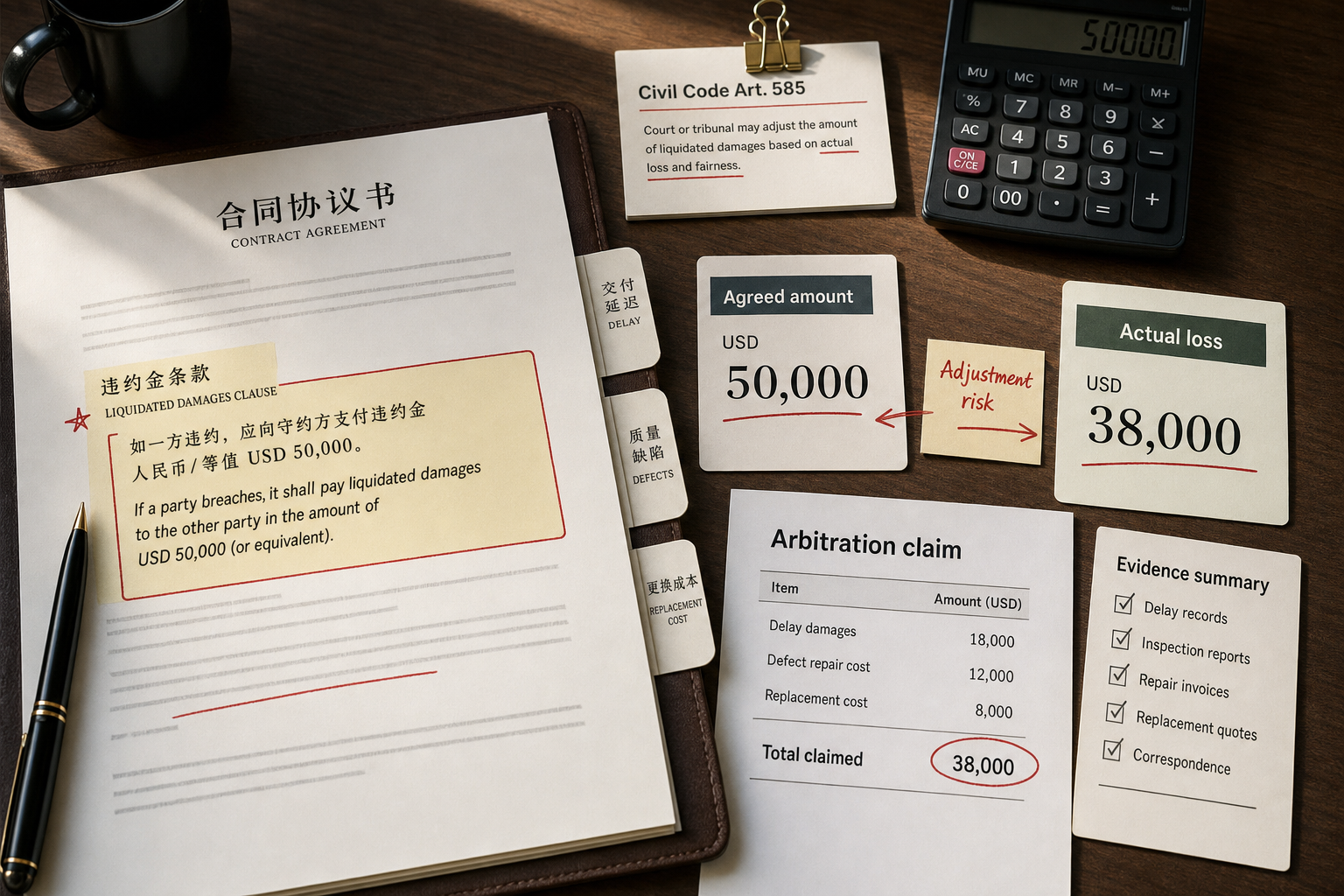
Liquidated damages in China are agreed damages for breach of contract . The Chinese term is 违约金. A contract may say, for example, that the supplier must pay a fixed amount for unauthorized disclosure, a daily amount for late delivery, or a percentage of the order value for certain breaches.
These clauses matter because they turn a vague breach into a number. But they are not untouchable. Under Article 585 of the PRC Civil Codeenglish.www.gov.cnenglish.www.gov.cn, a court or arbitral tribunal may adjust the agreed amount if it is too low or excessively high compared with the loss.

In supplier disputes, the clause is useful only if it supports the next move: negotiation, a China supplier demand letter, arbitration, or settlement pressure.
The short definition
Liquidated damages are damages agreed in advance. They can be a fixed sum, a daily rate, a percentage, or a calculation method.
They are common in:
- late-delivery clauses;
- quality and warranty clauses;
- payment-default clauses;
- NNN agreements;
- mold and tooling agreements;
- exclusivity or non-circumvention provisions;
- confidentiality and IP-related clauses.
The point is not only compensation. A good liquidated damages clause also creates leverage. It tells the supplier what a breach will cost and gives the demand letter a concrete number.
The Article 585 logic
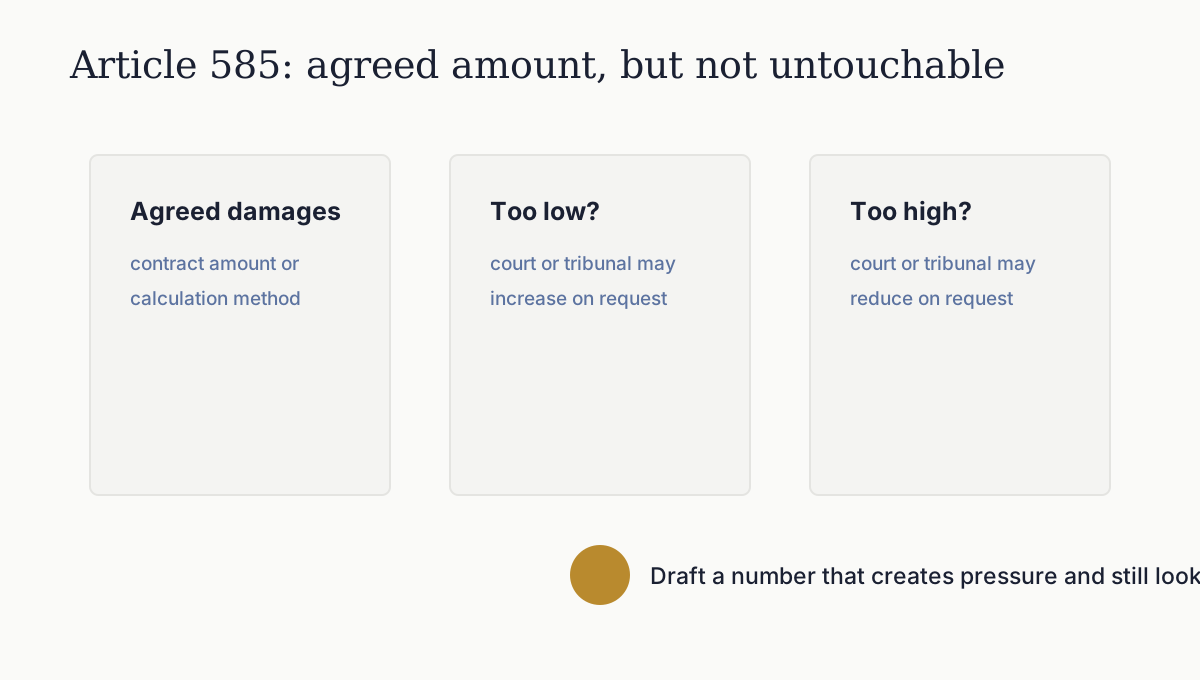
Article 585 of the Civil Code allows parties to agree on liquidated damages or a method of calculating damages . If the agreed amount is lower than the actual loss, the court or arbitral tribunal may increase it on request. If it is excessively higher than the loss, it may reduce it on request.
That means two things.
First, a liquidated damages clause is useful. It is not merely decorative.
Second, an absurd number can backfire. If the amount looks punitive and disconnected from any real commercial harm, the other side may ask for reduction . The clause still helps frame the dispute, but the final number may not survive unchanged.
How to draft a practical clause
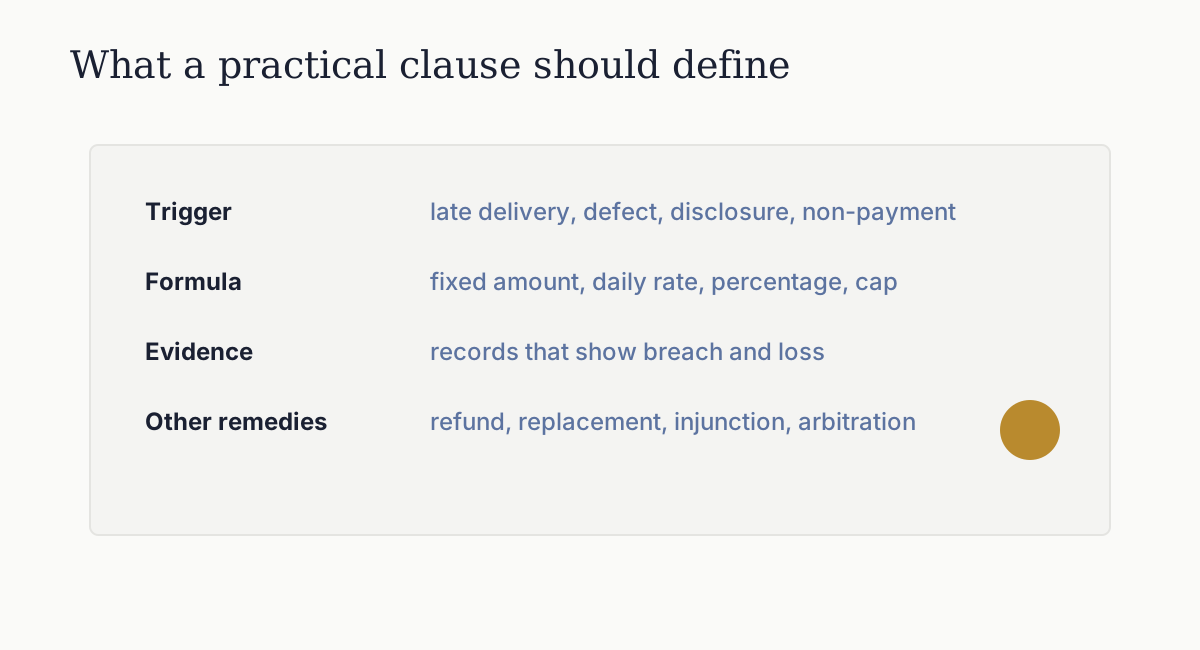
A practical clause should define the trigger. What exactly counts as breach? Late delivery by more than how many days? Failure to meet which specification? Disclosure to whom? Use of which drawing? Circumvention of which customer?
It should define the calculation. A fixed amount may be appropriate where loss is hard to prove, such as misuse of confidential information. A daily rate may work for late delivery. A percentage of order value may work for quality or delivery defaults, but the formula should be clear.
It should define whether other remedies remain available. Can the buyer still claim actual loss above liquidated damages? Can it seek refund, replacement, injunction-type relief, asset preservation, or arbitration costs? If the contract is silent, disputes may arise.
It should fit the dispute-resolution clause. A strong damages clause is less useful if the forum clause is weak.
Supplier-contract examples
For late delivery, a clause may use a daily percentage of the delayed goods’ value , with a cap and the buyer’s right to terminate after a certain delay. The daily rate should reflect real commercial harm: lost season, missed retail window, storage cost, customer penalties, or project delay.
For defective goods, a clause may connect damages to the defective batch, inspection cost, rework cost, replacement shipment, customer claim, or price reduction. The contract should still preserve the right to reject goods where the defect is serious.
For NNN breaches, a fixed amount may make sense because proving the exact loss from copying, unauthorized use, or customer circumvention can be difficult. But the amount should be tied to expected order value, development cost, market harm, or commercial sensitivity.
For mold or tooling disputes, the clause may cover failure to return molds, unauthorized use, delay in handover, or transfer to another factory.
How it helps a demand letter
A demand letter without numbers often sounds like frustration. A demand letter with a clear liquidated damages clause can be sharper:
The contract says late delivery triggers RMB X per day. The goods are Y days late. The current contractual damages are RMB Z. If the supplier does not ship, refund, or settle by the deadline, the buyer will claim that amount plus other remedies.
That structure is much harder to ignore than “you caused us serious loss.”
Common mistakes
The first mistake is using a huge penalty number with no commercial logic. It may scare the supplier during negotiation, but it may be reduced later.
The second mistake is failing to define the breach. If the trigger is vague, the damages formula becomes another dispute.
The third mistake is forgetting evidence. Even with liquidated damages, you still need to prove the contract, breach, dates, delivery terms, specifications, or prohibited use .
The fourth mistake is drafting liquidated damages while ignoring asset preservation and arbitration. A number on paper is not recovery. You still need a route to pressure or enforce.
The bottom line
Liquidated damages in China are enforceable in principle, but adjustable in practice. That is not a reason to avoid them. It is a reason to draft them carefully.
For supplier contracts, NNN agreements, and settlement schedules, a good liquidated damages clause can make the difference between a vague complaint and a credible legal claim.
If you want to review a China contract, NNN agreement, or supplier dispute before sending a demand letter, contact me. I can help test whether the damages clause is strong enough to support negotiation, arbitration, or litigation.
References
- Supreme People’s Court, PRC Civil Code, including Articles 584 and 585: https://www.court.gov.cn/zixun/xiangqing/233181.htmlSupreme People's Court of ChinaCivil Code of the People's Republic of ChinaChinese-language text of the PRC Civil Code, published on the Supreme People's Court website.www.court.gov.cn
- Supreme People’s Court, Interpretation on the General Provisions of the Contract Book of the Civil Code (Fa Shi [2023] No. 13), including Articles 64 and 65: https://www.court.gov.cn/fabu/xiangqing/419382.htmlwww.court.gov.cn权威发布 - 中华人民共和国最高人民法院最高人民法院政务网站,最高人民法院网,最高人民法院,最高人民法院网是人民群众了解和联系最高人民法院的重要窗口,承载着司法公开、法治宣传、服务群众、接受监督等重要使命。是最高人民法院的政务网站,是最高人民法院在互联网上唯一的正式身份。www.court.gov.cn
- PRC Civil Code, official English translation (gov.cn): https://english.www.gov.cn/atts/stream/files/5feda5b8c6d0cc300eea77acenglish.www.gov.cnenglish.www.gov.cn

This article is part of the China Legal Glossary series. Related reading: What Is an NNN Agreement in China?, That Contract Clause You Ignored Could Cost You Everything, and Before You Pay a Chinese Supplier, Check These 10 Things.
Frequently Asked Questions
What are liquidated damages in China?
Liquidated damages are agreed damages for breach of contract. In Chinese contracts, the term is usually 违约金.
Are liquidated damages enforceable in China?
They are enforceable in principle, but under Civil Code Article 585 a court or arbitral tribunal may increase them if too low or reduce them if excessively higher than the loss.
Why do liquidated damages matter in supplier contracts?
They make the consequence of breach concrete, support demand letters, and can simplify arbitration claims for late delivery, quality problems, NNN breaches, or non-circumvention.
What is liquidated damages in Chinese?
The common Chinese term is 违约金. It means agreed damages or an agreed payment for breach of contract.