On this page
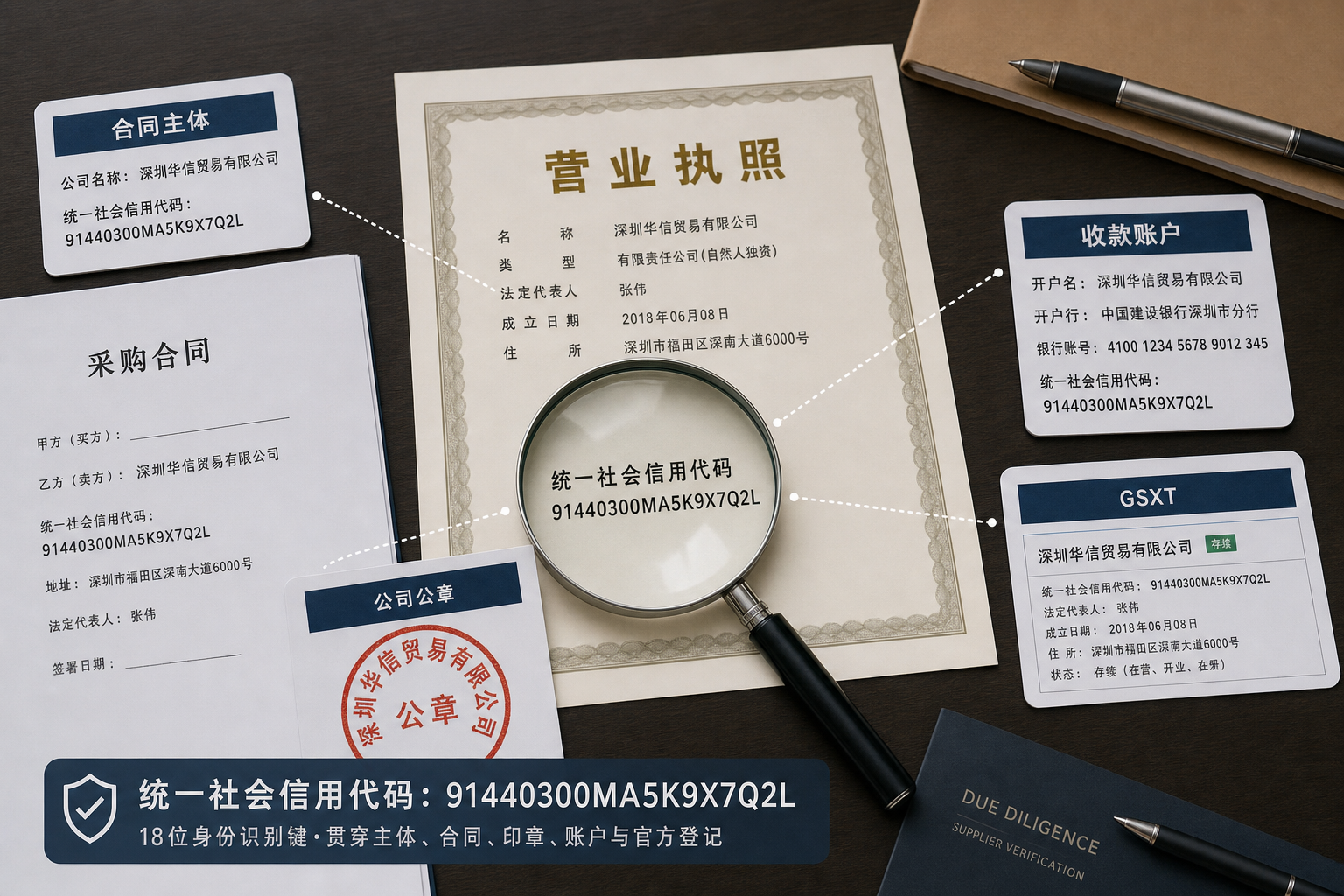
A China Social Credit Code usually means the Unified Social Credit Code. In Chinese, it is 统一社会信用代码. It is an 18-character identifier printed on the business license of a Chinese legal entity.
For foreign buyers, this code is one of the first things to check before signing a contract or paying a deposit. It helps answer the basic question: which Chinese legal person are you actually dealing with?
The short definition
The Unified Social Credit Code is an official identifier for Chinese companies and other organizations. It is not a brand name, not an English trading name, and not a website label.
The code appears on the Chinese business license. It can be used to search official and commercial databases, including the National Enterprise Credit Information Publicity System国家市场监督管理总局国家企业信用信息公示系统查询中国企业登记、行政处罚、经营异常等信用信息的官方系统。www.gsxt.gov.cn, often called GSXT.

Why it matters
Foreign buyers often know a supplier by an English name. That name may appear on Alibaba, Made-in-China, a website, a catalog, or an email signature. It may not be the legal name.
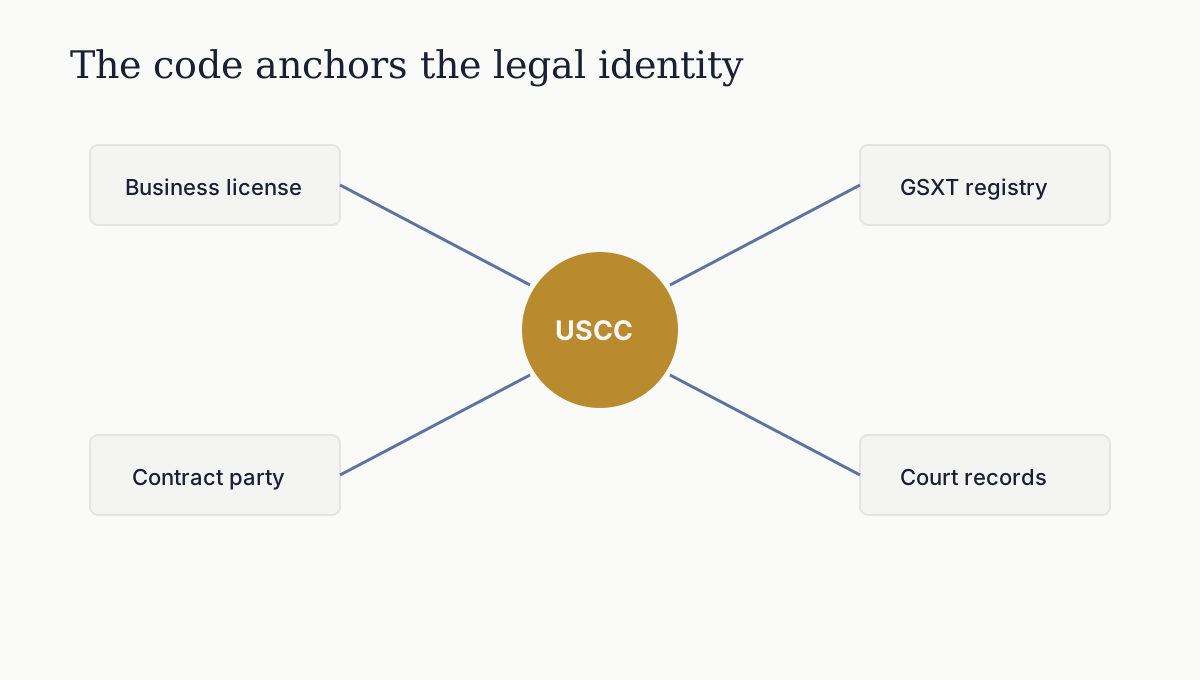
The legal identity is the registered Chinese company name plus the Unified Social Credit Code. Once you have those two pieces, you can check:
- whether the company exists;
- its registration status;
- its legal representative ;
- its business scope;
- registered capital and basic registration details;
- abnormal operation records where available;
- whether the same entity appears in contract, chop, invoice, payment, and litigation records.
The code does not prove that the company is honest, solvent, or able to manufacture your product. But it prevents a more basic error: sending money while not knowing the legal counterparty.
How to use it in supplier verification
Ask the supplier for its business license. Copy the Unified Social Credit Code. Search the code and the Chinese name in official or reliable databases . Then compare the result with every transaction document.
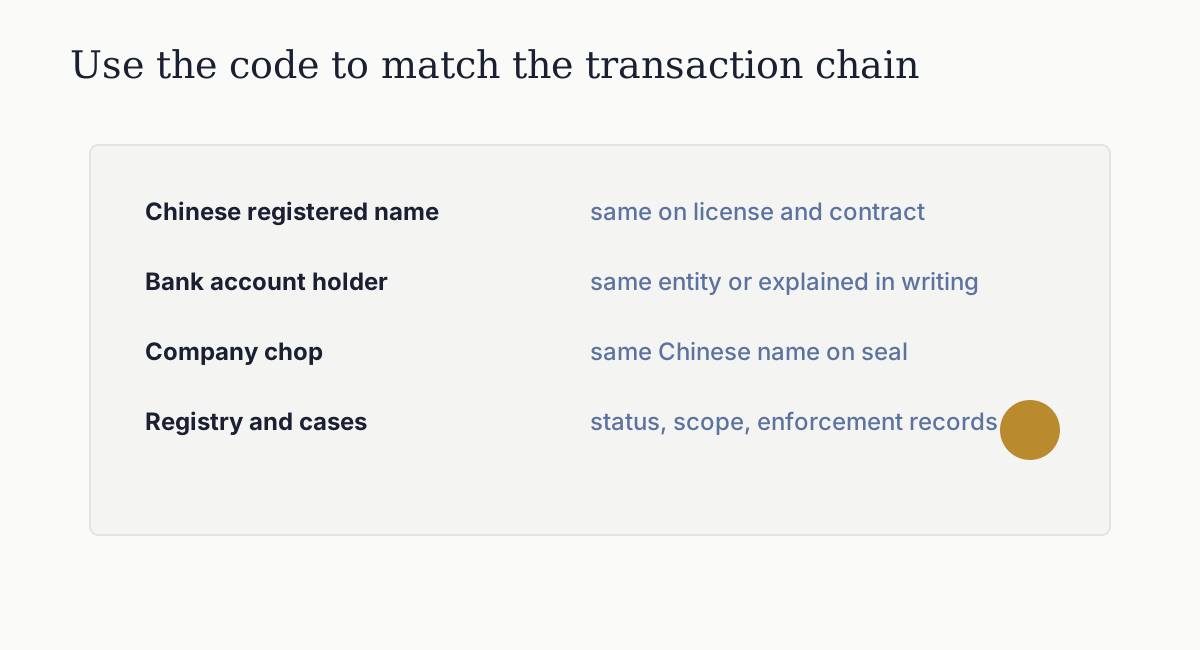
The best check is not isolated. The code should help you match:
- the business license;
- the Chinese legal name in the contract;
- the company chop;
- the bank account holder;
- the invoice issuer;
- court and enforcement searches;
- prior dispute records.
If the contract is with one company, the chop belongs to another, and the bank account holder is a third, do not rush to pay. There may be a reasonable group-company explanation, but it should be documented clearly.
Hong Kong companies are different
A Hong Kong company will not have a Mainland Unified Social Credit Code. It has its own company registration number in Hong Kong.
This matters because many China sourcing structures involve a Hong Kong trading company and a Mainland factory. That is not automatically wrong. But the buyer should know which company is responsible for production, warranty, refund, dispute resolution, and payment.
If the Mainland factory is only a background performer and the contract is with a Hong Kong company, the buyer may have a different enforcement problem later.
How it connects to demand letters and arbitration
A demand letter should identify the correct respondent. If the letter uses only the supplier’s English name, the recipient may ignore it or argue later that the wrong entity was named.
In arbitration or litigation, the correct legal name and code help prevent avoidable party-identity problems. They also support asset checks, preservation strategy, and enforcement planning.
The code also helps with evidence organization. A clean file will show that the same legal person appears in the license, contract, chop, invoice, bank account, and dispute records.
Common mistakes
The first mistake is trusting the English name. English names in China trade are often informal translations or marketing names.
The second mistake is accepting a business license screenshot without checking it. A screenshot can be old, altered, or unrelated to the actual counterparty.
The third mistake is ignoring the bank account. If the code and license identify a Mainland company but the supplier asks payment to a personal or offshore account , the buyer should stop and verify.
The fourth mistake is treating registered capital as cash in the bank. Registered capital is not a bank balance .
The bottom line
The Unified Social Credit Code is one of the simplest supplier checks, but many foreign buyers skip it. Do not. It is the anchor for identifying the real Chinese company, matching documents, and preparing any later demand letter, preservation step, arbitration, or litigation.
If you are about to pay a Chinese supplier and want to verify the legal entity first, contact me. I can review the license, code, chop, bank account, contract, and dispute clause before the money leaves.
References
- National Standard GB 32100-2015, Coding Rule of the Unified Social Credit Identifier for Legal Entities and Other Organizations: https://openstd.samr.gov.cn/bzgk/std/newGbInfo?hcno=24691C25985C1073D3A7C85629378AC0openstd.samr.gov.cn国家标准|GB 32100-2015openstd.samr.gov.cn
- State Council, Interim Regulation on Enterprise Information Disclosure (Order No. 654, amended 2024): https://www.gov.cn/zhengce/2014-08/23/content_2739774.htmwww.gov.cn企业信息公示暂行条例(国务院令第654号) _行政法规_中国政府网企业信息公示暂行条例(国务院令第654号)www.gov.cn
- Standing Committee of the National People’s Congress, PRC Company Law (2023 revision), including Articles 32-33 and 47: http://www.npc.gov.cn/npc/c2/c30834/202312/t20231229_433999.htmlwww.npc.gov.cn中华人民共和国公司法_中国人大网www.npc.gov.cn
- Supreme People’s Court, PRC Civil Code, including Article 61: https://www.court.gov.cn/zixun/xiangqing/233181.htmlSupreme People's Court of ChinaCivil Code of the People's Republic of ChinaChinese-language text of the PRC Civil Code, published on the Supreme People's Court website.www.court.gov.cn
- National Enterprise Credit Information Publicity System (GSXT): https://www.gsxt.gov.cn/国家市场监督管理总局国家企业信用信息公示系统查询中国企业登记、行政处罚、经营异常等信用信息的官方系统。www.gsxt.gov.cn


This article is part of the China Legal Glossary series. Related reading: What Is a China Company Chop?, Before You Pay a Chinese Supplier, Check These 10 Things, and What Is Asset Preservation in China?.
Frequently Asked Questions
What is a China Social Credit Code?
It usually refers to the Unified Social Credit Code, an 18-character identifier for Chinese legal entities that appears on the business license.
Is the code the same as the supplier's English name?
No. The code is tied to the registered Chinese legal entity. English names, platform names, and brand names can be inconsistent.
Why should foreign buyers check it?
It helps confirm the exact company, match the business license, contract, chop, bank account, registry record, and court or enforcement searches.