On this page
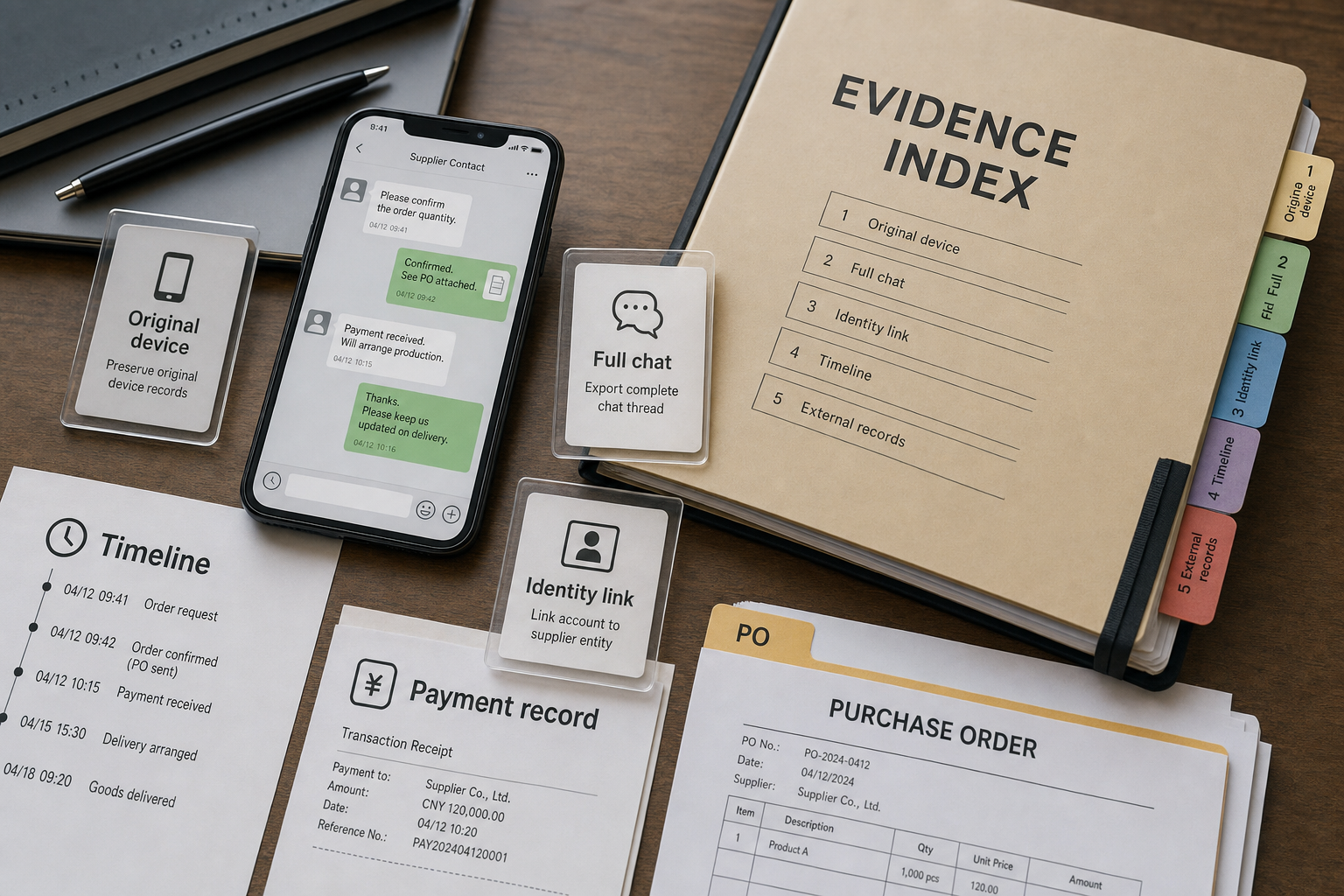
WeChat messages can be used as evidence in China. But that sentence is easy to misunderstand. A few screenshots are not the same thing as a strong evidence file.
In supplier disputes, WeChat often contains the most important admissions: delivery promises, quality discussions, refund offers, order changes, mold arrangements, bank account instructions, and excuses after delay. If the case later goes to arbitration or court, those messages may matter. The problem is proving them properly.
If the immediate problem is a supplier who has stopped replying or refuses a refund, the evidence review usually feeds into a China supplier demand letter or a broader China supply chain dispute strategy.
The short definition
WeChat evidence is usually treated as electronic data. The Supreme People’s Court civil procedure interpretation lists online chat records as a form of electronic data in its definition of electronic data evidenceipc.court.gov.cn最高人民法院关于适用《中华人民共和国民事诉讼法》的解释 - 最高人民法院知识产权法庭最高人民法院知识产权法庭网是人民群众了解和联系最高人民法院知识产权法庭的重要窗口,承载着司法公开、法治宣传、服务群众、接受监督等重要使命。是最高人民法院知识产权法庭的政务网站,是最高人民法院知识产权法庭在互联网上唯一的正式身份。ipc.court.gov.cn. That gives WeChat messages a recognized evidence category.

Recognition does not mean automatic acceptance. The court or tribunal will still care about authenticity, integrity, relevance , and whether the WeChat account can be connected to the supplier or relevant person.
Why screenshots are weak
Screenshots are easy to edit, crop, translate selectively, or take out of context. They can be useful for quick review, but they are often not enough by themselves.
The stronger approach is to preserve the source: the original phone, the account, the full conversation, attachments, voice messages, transfer records, files, photos, and surrounding context.
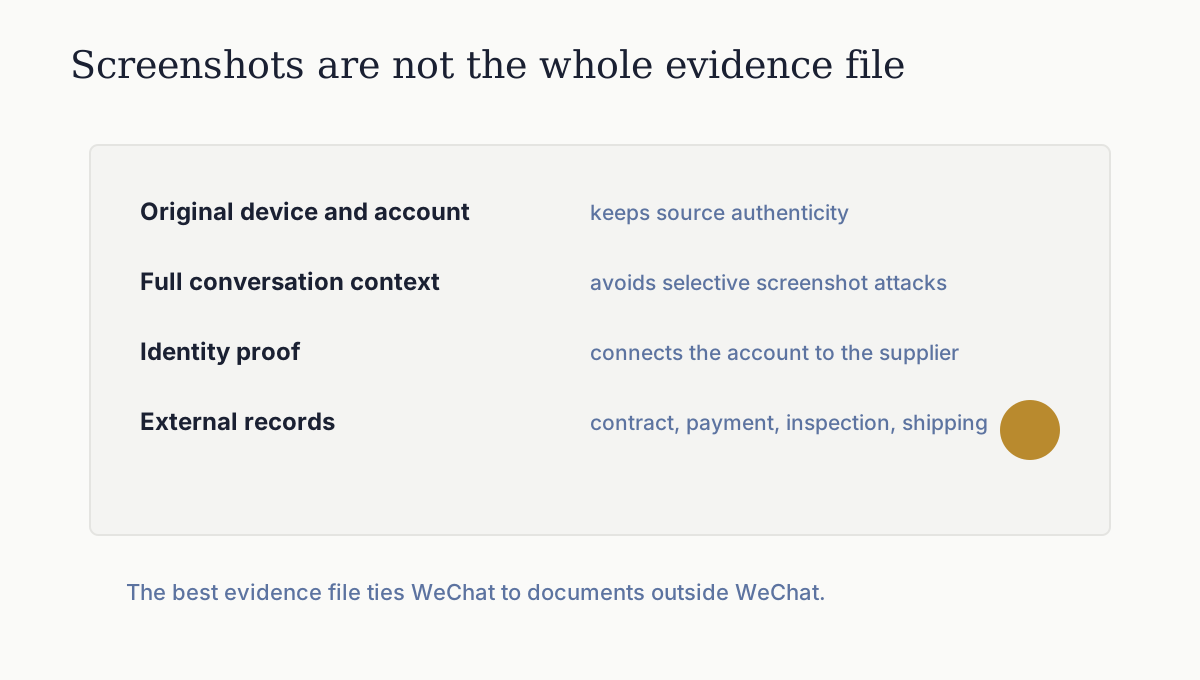
The identity issue is often overlooked. If the WeChat name says “Sunny Sales,” who is that? Is it the supplier’s employee? The legal representative? A trading agent? A subcontractor? The buyer should connect the account to emails, business cards, contracts, company email domains, payment instructions, invoices, prior dealings, or other records .
What to preserve
Preserve the full conversation. Do not delete “irrelevant” messages just because they look messy. Context helps prove authenticity, and selective records invite attack.
Preserve attachments. In supplier disputes, photos, videos, inspection files, voice messages, packing lists, and payment screenshots may be more important than the text.
Preserve the device and account. If possible, keep the original phone and logged-in WeChat account available . If a lawyer, notary, court, or tribunal later needs source verification, the original environment matters.
Preserve external records. WeChat becomes stronger when it matches the contract, purchase order, invoice, payment record, inspection report, shipping record, or email thread.
Timing matters
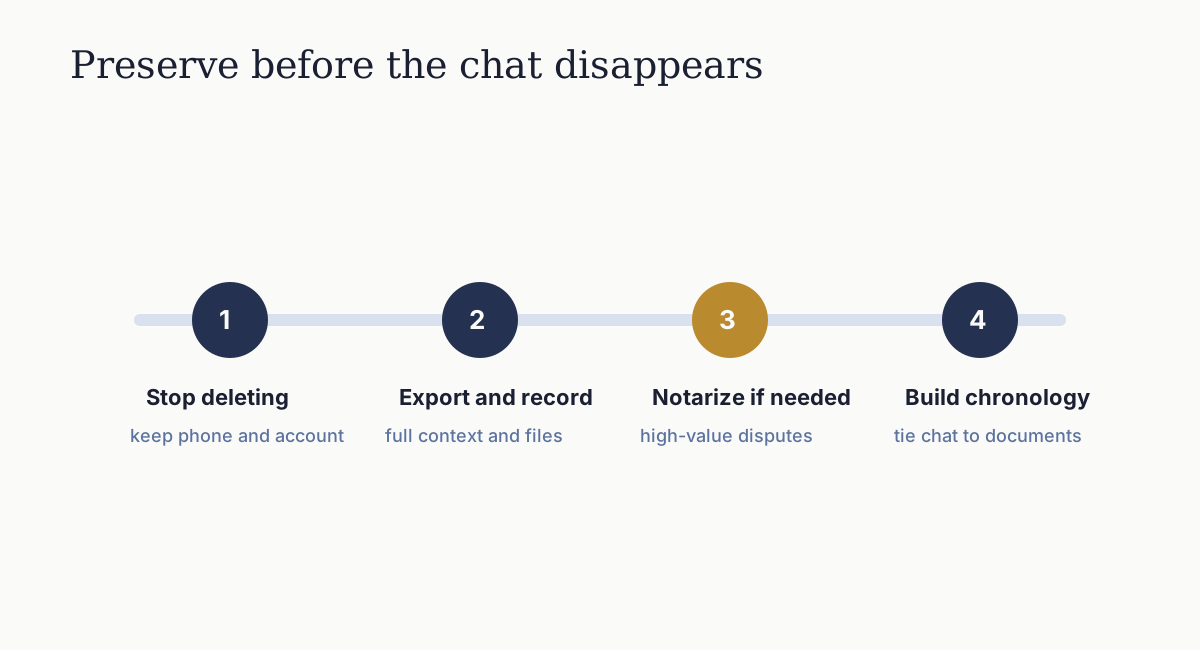
Preserve WeChat evidence as soon as the dispute becomes serious. Do not wait until the supplier blocks you, deletes the account, changes phones, or moves all communication to calls.
For high-value disputes, notarization or other formal preservation may be worth considering. The right method depends on the case value, forum, location, and urgency. In some disputes, a notarized extraction or formal evidence-preservation step can be much stronger than a folder of screenshots.
What WeChat can prove
WeChat may prove that the supplier accepted an order, changed delivery dates, admitted defects, promised a refund, confirmed a bank account, acknowledged payment, approved a sample, or offered a replacement shipment.
It may also prove facts that hurt the buyer. For example, the buyer may have approved a specification change, delayed sample confirmation, waived inspection, accepted late delivery, or agreed to a revised payment sequence.
That is why WeChat evidence should be reviewed as a complete chronology, not cherry-picked.
How it connects to demand letters and arbitration
A demand letter is much stronger when the factual timeline is backed by WeChat records and external documents. Instead of saying “you promised delivery,” the letter can cite the date, message, sender, and document that proves the promise.
In arbitration, WeChat can help fill gaps where the formal contract is thin. Many China supplier deals are documented through scattered purchase orders, invoices, chats, and payment records. A well-organized WeChat chronology can make the commercial story coherent.
Common mistakes
The first mistake is relying on translated screenshots only. The original Chinese, English, or mixed-language records must be preserved.
The second mistake is failing to identify the account user. A tribunal may ask why a chat with “Manager Chen” should bind the supplier company.
The third mistake is sending all evidence to the supplier in the first angry email. Do not teach the other side exactly what to deny before the evidence is organized.
The fourth mistake is waiting until filing to think about evidence preservation. By then, messages may already be gone.
The bottom line
WeChat evidence can be extremely useful in China disputes, but it must be preserved properly. Screenshots are a starting point, not the evidence strategy.
If your supplier dispute depends on WeChat messages, contact me. I can help review the chat history, build an evidence chronology, and decide whether a demand letter, preservation step, arbitration, or litigation route is realistic.
References
- Supreme People’s Court, Interpretation on the Application of the PRC Civil Procedure Law, Article 116 (online chat records as electronic data): https://ipc.court.gov.cn/zh-cn/news/view-392.htmlipc.court.gov.cn最高人民法院关于适用《中华人民共和国民事诉讼法》的解释 - 最高人民法院知识产权法庭最高人民法院知识产权法庭网是人民群众了解和联系最高人民法院知识产权法庭的重要窗口,承载着司法公开、法治宣传、服务群众、接受监督等重要使命。是最高人民法院知识产权法庭的政务网站,是最高人民法院知识产权法庭在互联网上唯一的正式身份。ipc.court.gov.cn
- Supreme People’s Court, Provisions on Evidence in Civil Proceedings (2019 revision), Articles 14, 15, 93, and 94: https://ipc.court.gov.cn/zh-cn/news/view-393.htmlipc.court.gov.cn最高人民法院关于民事诉讼证据的若干规定(2019修正) - 最高人民法院知识产权法庭最高人民法院知识产权法庭网是人民群众了解和联系最高人民法院知识产权法庭的重要窗口,承载着司法公开、法治宣传、服务群众、接受监督等重要使命。是最高人民法院知识产权法庭的政务网站,是最高人民法院知识产权法庭在互联网上唯一的正式身份。ipc.court.gov.cn
- Supreme People’s Court, Online Litigation Rules (2021), including Articles 11-13 and 16-19: https://www.court.gov.cn/zixun/xiangqing/309551.htmlwww.court.gov.cn人民法院在线诉讼规则 - 中华人民共和国最高人民法院最高人民法院政务网站,最高人民法院网,最高人民法院,最高人民法院网是人民群众了解和联系最高人民法院的重要窗口,承载着司法公开、法治宣传、服务群众、接受监督等重要使命。是最高人民法院的政务网站,是最高人民法院在互联网上唯一的正式身份。www.court.gov.cn

This article is part of the China Legal Glossary series. Related reading: How to Prepare Evidence That Actually Holds Up in Chinese Arbitration, Chinese Supplier Went Silent After Your Deposit? How to Recover Money, and When a China Demand Letter Works, and When It Backfires.
Frequently Asked Questions
Can WeChat messages be used as evidence in China?
Yes. WeChat messages are generally treated as electronic data, but the party relying on them must be ready to prove authenticity, integrity, relevance, and identity.
Are WeChat screenshots enough?
Screenshots may help, but they are often weak by themselves. The original device, account, full conversation context, metadata, identity proof, and external records are usually important.
When should I preserve WeChat evidence?
Immediately, especially before the supplier blocks you, deletes messages, changes accounts, or moves the discussion to phone calls.
Do I need the original phone for WeChat evidence?
The original device and logged-in account are often important because they help prove source, completeness, and authenticity. Keep them available if the dispute may escalate.