On this page

The message usually arrives with a familiar rhythm.
The buyer has paid a deposit to a Chinese supplier. The delivery date has passed. The salesperson still replies, but every answer is a variation of “next week.” Or the goods arrived, but the inspection report is bad and the supplier says the defects are “within tolerance.” Or the factory is holding molds, drawings, or finished inventory and will not release anything unless the buyer pays the balance.
The buyer asks one direct question: Can you send a lawyer letter?
Sometimes the answer is yes. Sometimes a tightly written Chinese lawyer letter is exactly the right first pressure step. It can force a real response, open a settlement channel, and create a written record for the next stage.
But sometimes the answer is no, or at least not yet. A demand letter is not magic. It works when it is backed by evidence, leverage, and a credible escalation path. It backfires when it is used as a substitute for them.
That distinction matters more in China supplier disputes than many foreign buyers expect.
A demand letter is not the strategy
A demand letter, legal notice, or lawyer letter is a formal communication sent on behalf of a buyer to a supplier. It usually states the factual background, identifies the supplier’s breach, demands a remedy, sets a deadline, and warns that further legal action may follow.
That sounds simple. The hard part is not the wording. The hard part is deciding whether the letter improves your position.
In a China supplier dispute, the supplier is usually asking itself four questions when it receives the letter:
- Do they know which Chinese company they are dealing with?
- Do they have documents that prove the claim?
- Can they realistically bring arbitration or litigation where it matters?
- Do I lose more by ignoring them than by negotiating now?
If the answer to those questions is yes, a letter can create pressure. If the answer is no, a letter may only announce that the buyer is angry, exposed, and not yet ready to act.
Before sending, run this triage
The first decision is not whether the letter should sound tough. The first decision is whether the factual and legal foundation is strong enough to support formal pressure.
If you need an initial assessment before sending anything formal, review the China supplier demand letter service. The assessment covers the same practical gaps: legal entity, payment proof, business license, written promises, WeChat/email records, and the realistic next step.
If you want a lawyer to review the evidence and pressure strategy, see the China supplier demand letter service.
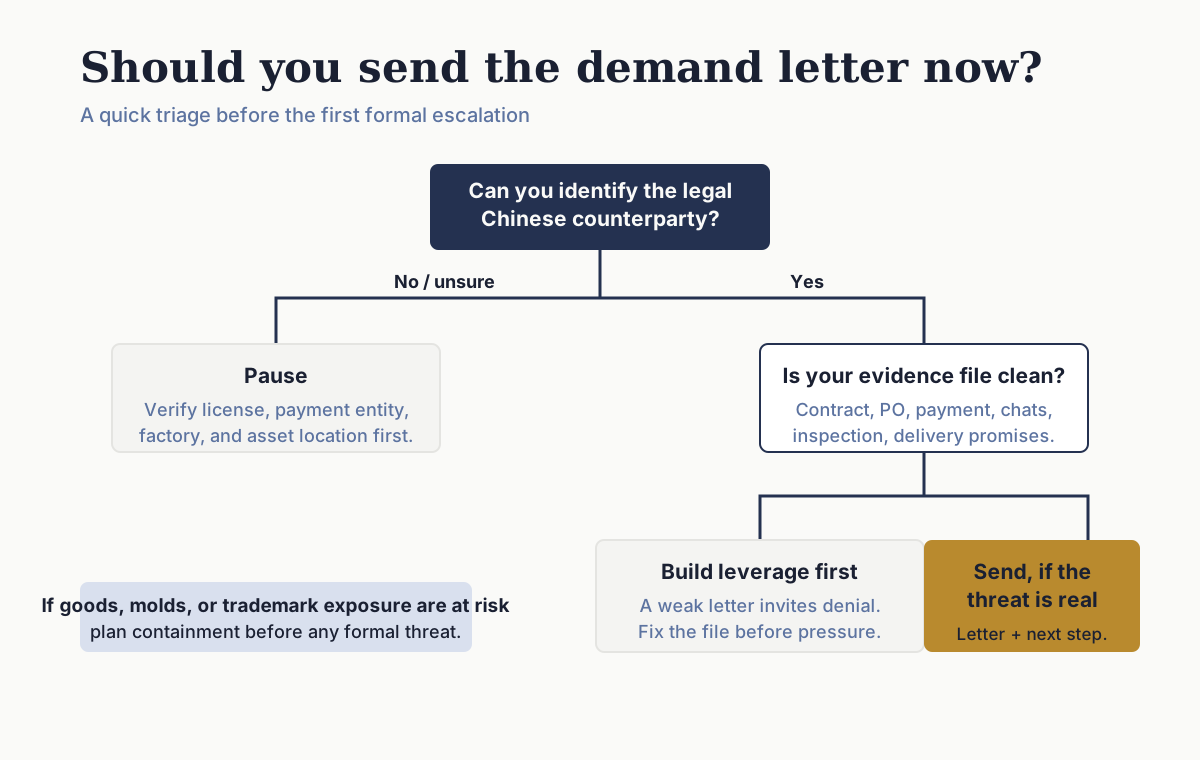
Start with identity. A buyer often knows the supplier’s English brand, Alibaba store name, or salesperson’s email domain. That is not enough. You need the registered Chinese name, the 18-digit Unified Social Credit Code where possible, and a match between the business license, the contract, and the bank account that received payment. If the contract is with one company, payment went to another, and production sits with a third factory, the demand letter has to be built around that problem instead of pretending it does not exist.
Then read the documents as a set. A supplier dispute is rarely proven by one perfect contract. It is usually proven through a chain: quotation, purchase order, stamped contract, pro forma invoice, payment record, specifications, inspection report, shipping record, and email or WeChat messages. If those documents tell a coherent story, the letter can be concise and confident. If they contradict each other, the lawyer’s first job is not to send the letter. It is to find the weak point before the supplier does.
Finally, test the next step. If the supplier ignores the letter, what happens? CIETAC arbitration? HKIAC arbitration? A mainland court claim? A platform complaint? A preservation application? A negotiated exit? The letter should be written with that next step in mind.
If there is no next step, the supplier may see the letter as noise.
When a demand letter works
A China demand letter is most useful when it gives the supplier a business reason to settle before the matter becomes more expensive.
The strongest cases tend to share several features.
The counterparty is clear. You know the supplier’s registered Chinese name and can connect it to the contract, payment, factory, or assets. This is basic, but it decides many cases. A demand letter addressed to the wrong entity will not scare the right one.
The breach is specific. “You acted in bad faith” is not a useful demand. “You received USD 42,000 on March 7, promised shipment by April 30, confirmed on May 6 that production had not started, and have refused refund requests on May 12 and May 20” is useful.
The evidence is organized. A supplier can deny broad accusations. It is harder to ignore a numbered chronology tied to payment records, product specifications, inspection photos, delivery promises, and contract terms.
The requested outcome is concrete. The letter should not ask the supplier to “resolve this matter immediately.” It should say what resolution means: refund USD 42,000, ship 3,000 units by a date, remake defective goods, release molds, compensate inspection and freight costs, or sign a settlement schedule.
The supplier believes escalation is realistic. This is the real pressure point. If the contract contains a workable arbitration clause, or if litigation in China is feasible, the letter has teeth. If the buyer chose a home-country court that is practically useless against a mainland supplier with no overseas assets, the letter may look less threatening than the buyer expects.
The commercial timing helps you. A letter sent before the balance is paid, before the next order is placed, or while the supplier still cares about future business can work. A letter sent after the supplier has full payment, no ongoing relationship to protect, and no reachable assets is much weaker.
One common example: the supplier shipped defective goods but still wants future orders. The buyer has inspection reports, photos, customer complaints, and a contract that contains specifications and warranty obligations. A letter that calmly sets out the evidence and proposes a replacement, refund, or credit structure may bring the supplier to the table. Not because the letter is intimidating by itself, but because it shows the buyer is organized and can escalate if needed.
When it backfires
A demand letter backfires when it changes the supplier’s incentives in the wrong direction.
The clearest case is the premature threat. The buyer has not confirmed the legal entity. The documents are scattered. The supplier controls the goods. The buyer still needs the molds. The buyer has not registered its brand in China. Then the buyer sends a broad letter accusing the supplier of fraud and threatening litigation in a foreign court.
That may feel strong. In practice, it may teach the supplier three things: the buyer is angry, the buyer is unprepared, and the buyer has assets or business needs that can still be pressured.
The risks are not theoretical.
If finished goods are still in the factory’s warehouse, a supplier may stop cooperating on release. If molds or tooling remain on site, the supplier may refuse access or claim unpaid charges. If the buyer’s trademark is not registered in China, a bad-faith supplier may try to file the mark or use IP leverage. If the letter threatens a forum that cannot realistically reach the supplier’s assets, it can make the buyer look less serious, not more.
There is also a subtler risk: the supplier may respond with a detailed denial. That denial may be longer and more organized than the buyer’s letter. It may point to inconsistent specifications, ambiguous acceptance standards, late buyer approvals, changed packaging instructions, or unpaid balance. If those points are real, the buyer has just invited the supplier to frame the dispute first.
This does not mean “never send a letter.” It means the letter should be sent after the case has been triaged.
What a useful letter should say
The best demand letters in China supplier disputes are usually shorter than clients expect. They are not essays. They are pressure documents.
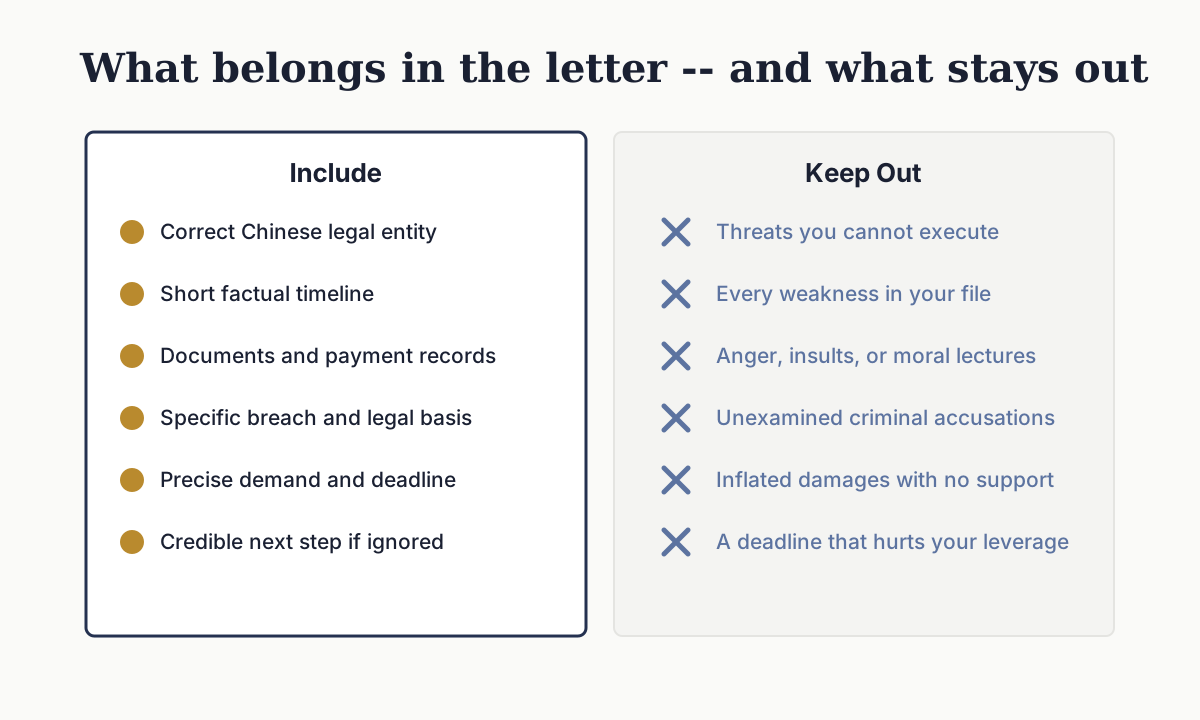
The structure I prefer is straightforward:
- Identify the parties using the correct legal names.
- State the transaction background in a short chronology.
- List the key documents and payment records.
- Identify the supplier’s breach with reference to those documents.
- State the buyer’s demand in numbers, dates, and actions.
- Set a response deadline.
- Reserve rights and identify the next legal route if no resolution is reached.
What stays out matters just as much. Do not threaten criminal complaints unless the facts have been reviewed through that lens. Do not threaten asset freezes unless there is a plausible preservation route. Do not threaten a US or European lawsuit if the supplier’s meaningful assets are in China and there is no realistic enforcement plan. Do not inflate damages just to look tougher.
Chinese suppliers are not intimidated by adjectives. They respond to consequences.
The letter should be bilingual, or Chinese-led
If the dispute may be resolved in China, the formal communication should be in Chinese or bilingual. A purely English letter may be fine for a commercial email chain, but when the purpose is legal pressure, language affects credibility.
The point is not only whether the salesperson can read it. The point is whether the supplier’s management, in-house legal staff, outside counsel, or local court-facing team can immediately see the claim. A letter grounded in Chinese legal and commercial reality carries more weight than a generic foreign-law demand that sounds impressive to the buyer but irrelevant to the supplier.
The same logic applies to attachments. If the key contract is bilingual, identify which language controls. If the purchase order is English but the chat confirmations are Chinese, organize both. If the supplier’s Chinese name appears only on the business license or company chop, use it correctly.
What happens after the letter
A good demand letter should be written with the next 30 days in mind.
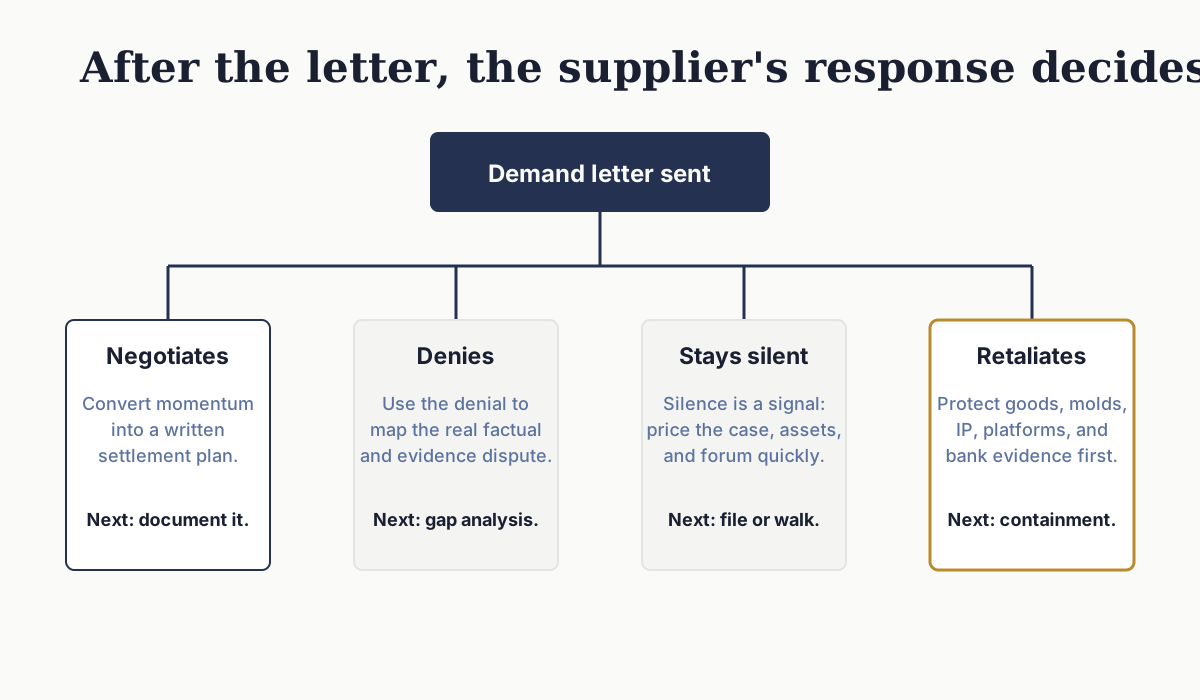
If the supplier negotiates, move quickly to a written settlement. Do not leave the result in WeChat fragments. If the supplier offers a refund schedule, replacement shipment, discount, or tooling release, reduce it to a short written agreement with names, dates, amounts, and default consequences.
If the supplier denies liability, do not treat that as failure. A denial can be useful. It tells you what the supplier will argue in arbitration or litigation. It may show whether the dispute is about facts, contract interpretation, quality standards, or payment sequence.
If the supplier stays silent, the next step is commercial math. Is the claim large enough to pursue? Is there a workable forum? Are there reachable assets? Do you have enough evidence? A silent supplier should not be chased with five more angry emails. At some point, the choice is to file, preserve, settle for less, or walk away.
If the supplier retaliates, containment comes first. Protect goods, molds, tooling, platform accounts, trademarks, payment evidence, and customer commitments. A dispute that started as a refund claim can become much larger if the supplier controls a bottleneck in your business.
Where arbitration and asset preservation fit
A demand letter has more weight when the supplier understands what can follow.
For many cross-border supply contracts, that next step is arbitration. CIETAC reported 5,736 new cases in 2025, including 806 foreign-related cases, and its published statistics show sustained use by international parties. HKIAC also remains important for China-related disputes, especially where a Hong Kong-seated institutional arbitration may allow a party to seek interim measures from mainland courts under the Mainland-Hong Kong arrangement.
This matters because a supplier dispute is not only about winning on paper. It is about whether pressure can be applied before assets disappear and whether the final result can be turned into money or performance.
In mainland China, property preservation can include freezing, sealing, or seizing assets under court procedures. That does not mean every supplier dispute can or should start with preservation. It does mean the first legal communication should not undermine a later preservation or arbitration strategy.
A poorly timed letter may warn the supplier before you are ready. A properly timed letter may be part of the sequence that leads to settlement, preservation, arbitration, or enforcement.
My triage before sending one
When I review a China supplier dispute for a possible lawyer letter, I do not start by drafting.
I start with six questions:
- Who is the exact Chinese legal counterparty?
- What documents actually bind that party?
- What money, goods, molds, IP, or future orders does each side control?
- What is the buyer’s real objective: refund, shipment, replacement, compensation, exit, or leverage for settlement?
- If the supplier ignores the letter, what forum and remedy are realistically available?
- What could the supplier do in response, and are we prepared for it?
Only after those questions are answered does the letter become useful.
For some cases, the right move is a formal Chinese lawyer letter with a short deadline. For others, it is a softer management-level letter while evidence is collected. For others, it is a preservation or arbitration plan before any threatening communication goes out. And for some lower-value cases, the honest advice is that the legal spend will exceed the recovery odds.
That is why a demand letter should be treated as a legal tool, not a product you buy off the shelf.
The bottom line
A China demand letter works when it tells the supplier: we know who you are, we can prove what happened, we know what we want, and we are ready to take the next step if you ignore this.
It backfires when it says: we are frustrated, we have not organized the case, but we hope a lawyer’s letter will scare you.
Before you send one, slow down long enough to test the leverage. A 30-minute case triage can often answer the question that matters most: should the first formal move be a demand letter, negotiation, asset preservation, arbitration, or no legal action at all?
If you are dealing with a Chinese supplier that has delayed shipment, refused refund, delivered defective goods, or stopped responding after payment, contact me. I can review the contract, payment records, evidence, and forum options before you decide whether a lawyer letter is the right first step.
References
- National Intellectual Property Administration (CNIPA), PRC Trademark Law (2019 Amendment), Articles 4 and 31: https://www.cnipa.gov.cn/art/2019/7/30/art_95_28179.htmlwww.cnipa.gov.cn国家知识产权局 法律 中华人民共和国商标法(2019年修正)(1982年8月23日第五届全国人民代表大会常务委员会第二十四次会议通过 根据1993年2月22日第七届全国人民代表大会常务委员会第三十次会议《关于修改〈中华人民共和国商标法〉的决定》第一次修正 根据2001年10月27日第九届全国人民代表大会常务委员会第二十四次会议《关于修改〈中华人民共和国商标法〉的决定》第二次修…www.cnipa.gov.cn
- National People’s Congress, PRC Civil Procedure Law (2023 Amendment), Articles 103-104: https://www.npc.gov.cn/npc/c2/c30834/202309/t20230901_431419.htmlNational People's Congress of ChinaDecision Amending the PRC Civil Procedure Law (2023)Chinese original. Item 20 addresses recognition and enforcement of foreign judgments.www.npc.gov.cn
- HKSAR Department of Justice, Arrangement Concerning Mutual Assistance in Court-ordered Interim Measures in Aid of Arbitral Proceedings (in operation since 1 October 2019): https://www.doj.gov.hk/en/community_engagement/press/20190930_pr1.htmlwww.doj.gov.hkDepartment of Justice - Community Engagement - Press Releases - Interim measures arrangement to take effect tomorrowwww.doj.gov.hk
- State Administration for Market Regulation, National Enterprise Credit Information Publicity System: https://www.gsxt.gov.cn/国家市场监督管理总局国家企业信用信息公示系统查询中国企业登记、行政处罚、经营异常等信用信息的官方系统。www.gsxt.gov.cn


This article is part of the “China Supply Chain Disputes — What Every Buyer Should Know” series. Related reading: Your Supplier Ghosted You After Taking the Deposit — What Are Your Options?, How to Prepare Evidence That Actually Holds Up in Chinese Arbitration, and Before You Pay a Chinese Supplier, Check These 10 Things.
Frequently Asked Questions
Does a demand letter work against a Chinese supplier?
Sometimes. A demand letter works when it is backed by a clean evidence file, the correct Chinese legal entity, a realistic legal route, and a consequence the supplier believes can actually follow. It often fails when it is used as a substitute for those things.
Should the demand letter be in English or Chinese?
If the dispute may end up in China, the formal version should be in Chinese or bilingual. A purely English letter from foreign counsel may look serious to the buyer, but it may not create pressure if the supplier does not believe the claim can be enforced where it operates.
What should I prepare before asking a lawyer to send a letter?
Prepare the supplier's Chinese legal name, business license if available, contract or purchase order, payment records, invoices, specifications, inspection reports, shipping documents, and the full email or WeChat chronology. The lawyer should first decide whether a letter helps or whether another step is safer.