On this page
Yes. A foreign buyer can sue or arbitrate against a Chinese supplier in many cases.
But that is not the most useful question.
The question that matters is this: Can you identify the right Chinese legal entity, prove the contract and payment trail, choose a forum that can reach the supplier’s assets, and turn the result into money or performance?
I would not start a China supplier dispute by asking, “Can I sue?” That question is too broad and too easy to answer in a way that sounds legally correct but commercially useless. A better first question is:
If the supplier failed to deliver, refused a refund, shipped defective goods, or withheld molds, should the first move be a demand letter, arbitration, litigation, asset preservation, or walking away?
That is the question this article answers.
Step 1: identify who you would actually sue
Many China supplier disputes go wrong before the legal analysis even begins.
The buyer knows the supplier’s English name, website, Alibaba store, salesperson email, and WhatsApp profile. But when it is time to file a claim, the buyer discovers that the contract names one company, the bank account belongs to another, the goods were produced by a third factory, and the website shows a fourth name.
In mainland China, a company’s practical legal identity starts with its registered Chinese name and its Unified Social Credit Code . An English trading name is often only a commercial label. A platform store name is not a defendant. A salesperson’s signature block is not a legal entity.
Before considering litigation or arbitration, identify at least four things:
- the Chinese name and Unified Social Credit Code on the business license;
- the party named in the contract, purchase order, or pro forma invoice;
- the holder and location of the bank account that received payment;
- the entity that actually produced the goods, shipped the goods, held the molds, or controls relevant assets.
If these point to the same company, the case is cleaner. If they do not, the legal strategy must first analyze the relationship among those entities: who promised performance, who received money, who controls goods or tooling, and who has assets.
This step is not glamorous. It decides everything that follows. Suing the wrong company is a fast way to turn a real dispute into an expensive procedural problem.
Step 2: read the dispute resolution clause first
Many foreign buyers instinctively say, “I want to sue this Chinese supplier in my home country.”
That reaction is understandable. A familiar court, language, and lawyer feel safer. But if the supplier’s real assets are in China, the key issue is whether a judgment from your home country can be enforced against those assets.
So start with the dispute resolution clause.
If the contract provides for CIETAC, SCIA, SHIAC, BAC, HKIAC, SIAC, ICC, or another arbitration institution, arbitration usually needs to be assessed first. A workable arbitration clause should identify the institution , seat or place of arbitration, rules, language, governing law, and whether court jurisdiction is excluded.
If there is no valid arbitration clause, litigation in a Chinese court may be available. Under China’s Civil Procedure Law, parties to a contract or property-rights dispute may choose by written agreement a people’s court connected with the dispute , such as the defendant’s domicile, place of contract performance, place of contract signing, plaintiff’s domicile, or location of the subject matter, subject to rules on level and exclusive jurisdiction. In supplier disputes, the defendant’s domicile is often the practical anchor.
If the clause is vague, the first issue may be validity. A clause that says disputes “may be submitted to arbitration or court,” or simply says “arbitration in China” without identifying the institution, can create avoidable uncertainty.
Many cases are not lost because the buyer had no claim. They are delayed because the forum clause was poorly written.
Step 3: do not push every case straight into litigation
Not every dispute is worth suing over. Not every dispute should begin with a demand letter either.
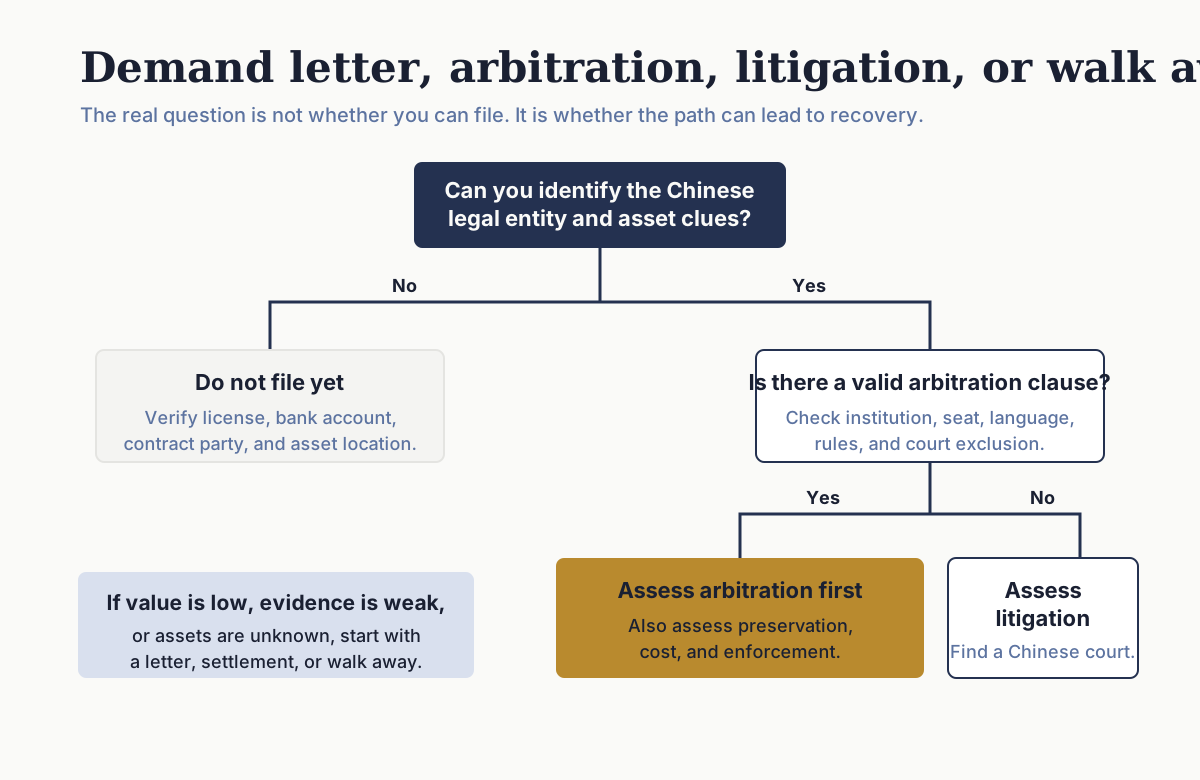
I usually sort cases into four buckets.
Small or medium claim, clean evidence. A deposit claim of several tens of thousands of dollars, with clear contract and payment records, may justify a lawyer letter and settlement push before filing. The goal is not to litigate for the sake of litigating. The goal is to use organized evidence and a credible next step to obtain refund, shipment, replacement, or a written settlement.
Larger claim with a valid arbitration clause. These cases should be assessed for arbitration quickly, and sometimes for property preservation at the same time. If the supplier may move assets, the timing of any demand letter must be coordinated with preservation strategy.
No arbitration clause, but China court jurisdiction exists. A Chinese court claim may be the right route. The focus shifts to pleadings, entity documents, authorization, translation, evidence formality, service, and preservation.
Unclear entity, weak evidence, unknown assets, low value. These cases may not be ready for formal proceedings. The honest advice may be to verify the counterparty, improve the evidence file, send a limited letter, or cut losses. Legal action is not better just because it is earlier. The wrong legal action only adds cost.
Step 4: ask whether the case is commercially worth pursuing
Clients often ask me, “Can we win?”
I usually ask a different question first: “If you win, is it worth it?”
A USD 15,000 dispute with unclear assets, no workable arbitration clause, and scattered evidence may not justify full arbitration or litigation. A USD 50,000 dispute with a clear counterparty, strong payment trail, and operating supplier may justify a lawyer letter and settlement push before escalation. A USD 200,000 dispute with solid documents and a valid forum clause deserves a serious look at arbitration, litigation, preservation, and enforcement. For million-dollar disputes, asset clues and preservation timing should be discussed from day one.
This does not mean smaller claims do not matter. A USD 30,000 loss can be serious for a small business. But the route must fit the claim value, evidence, assets, and time cost.
If legal fees, arbitration fees, translation, notarization, authentication, preservation security, and enforcement costs together approach the likely recovery, caution is needed. In many cases, the best outcome is not a final award. It is a cost-controlled settlement that gets the supplier back to the table.
Step 5: build an evidence file that answers six questions
Supplier disputes are not won by angry emails. They are not won by saying, “The supplier clearly acted in bad faith.” Courts and tribunals look for a verifiable chain of facts.
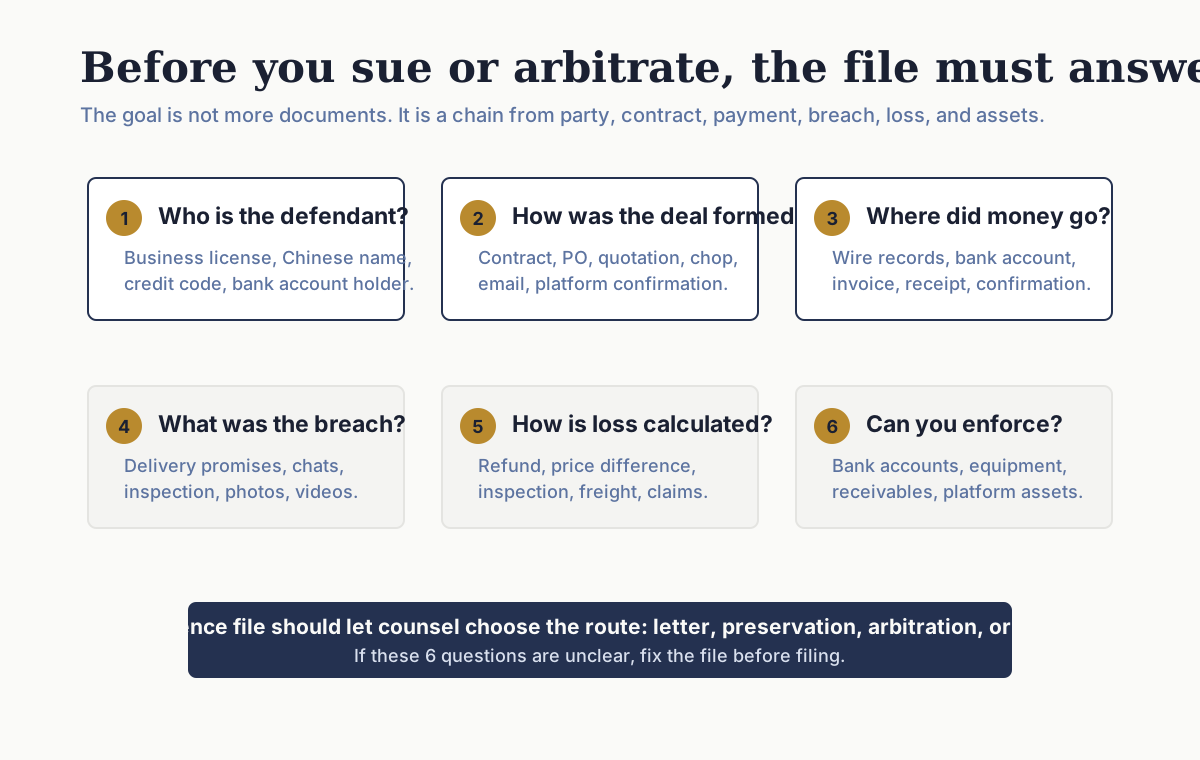
At minimum, the file should answer six questions.
Who is the defendant? Business license, Unified Social Credit Code, Chinese registered name, bank account holder, registered address, legal representative, and controller clues.
How was the deal formed? Stamped contract, purchase order, quotation, pro forma invoice, email confirmation, platform order, WeChat confirmation. No formal contract does not automatically defeat a claim, but it usually increases the proof burden.
Where did the money go? Wire records, bank statements, account holder, invoices, receipts, and supplier confirmations. The point is not merely “I paid.” The point is who received the money and how that payment connects to the order.
What was the breach? Delivery promises, production status, inspection reports, photos, videos, logistics records, customer complaints, and communication records. Quality disputes especially need objective material, ideally from a third-party inspection or testing provider.
How is loss calculated? Deposit, purchase price, price difference, inspection fees, storage, freight, customer claims, substitute procurement, and interest. Damages should be disciplined. Inflated numbers weaken both negotiation and pleadings.
Can the result be enforced? Bank accounts, factory equipment, inventory, receivables, platform proceeds, affiliated companies, prior litigation, and enforcement records. Without asset clues, the value of winning drops sharply.
Do this early. Many buyers start taking screenshots and downloading chats only after the supplier has gone silent. By then, platform records may have expired, chat histories may be incomplete, and salespeople may have changed accounts.
Step 6: asset preservation may matter more than the complaint
In supplier disputes, the problem is often not legal complexity. It is that assets move quickly.
If the supplier is delaying, refusing a refund, rerouting orders, closing stores, or using affiliates to keep receiving money, a demand letter alone may not be enough. You need to assess whether property preservation is available.
In China, property preservation can include freezing, sealing, or seizing assets . It usually requires a court application and, in many cases, security. The application normally needs to identify the parties, requested measure, factual basis, preservation amount or disputed subject matter, asset information or clues, and security arrangement.
That means “freeze the supplier’s account” is not a casual instruction. At minimum, you need to prepare:
- the amount to be preserved;
- bank account or other asset clues;
- security or guarantee arrangements;
- the filing or arbitration timetable;
- reasons why failure to preserve may make recovery difficult.
Timing matters. A premature demand letter may warn the supplier before preservation is ready. In a larger case, I would not send a threatening letter casually before discussing whether the supplier may move money, inventory, or receivables.
Step 7: choose arbitration or litigation based on enforceability
If the contract has a valid arbitration clause, arbitration is usually the first route to assess. For cross-border supply contracts, arbitral awards are often more enforceable internationally than foreign court judgments. China is a contracting state to the New York Convention , which provides a mature framework for recognition and enforcement of arbitral awards among contracting states.
CIETAC reported 5,736 new cases in 2025, including 806 foreign-related cases. Foreign-related arbitration before Chinese institutions is not unusual. For a supplier contract with a CIETAC clause, the question is usually not whether arbitration is possible. The question is whether the evidence, cost, preservation, and enforcement plan are ready.
Hong Kong arbitration may also matter. HKIAC’s 2025 statistics show a strongly international caseload, and the Mainland-Hong Kong interim measures arrangement may allow qualifying Hong Kong-seated institutional arbitrations to seek interim measures from Mainland courts. For China supplier disputes where Mainland assets matter, that can be strategically important.
If there is no arbitration clause, or the clause is invalid, litigation comes back into focus. The advantage of a Chinese court case is that it faces the Chinese defendant and Chinese assets directly. The difficulty is that language, document formality, jurisdiction, service, notarization or authentication, and enforcement all require China-procedure experience.
The choice is not “arbitration is sophisticated, court is crude,” or “foreign court is safe, Chinese court is dangerous.” The real questions are:
- What does the contract allow?
- Which route can reach the supplier’s assets?
- Which route creates pressure fastest?
- Which route matches the claim value?
- Which result can actually be enforced?
Step 8: filing is the beginning, enforcement is the end
Many buyers treat “suing” as the goal. It is only the beginning.
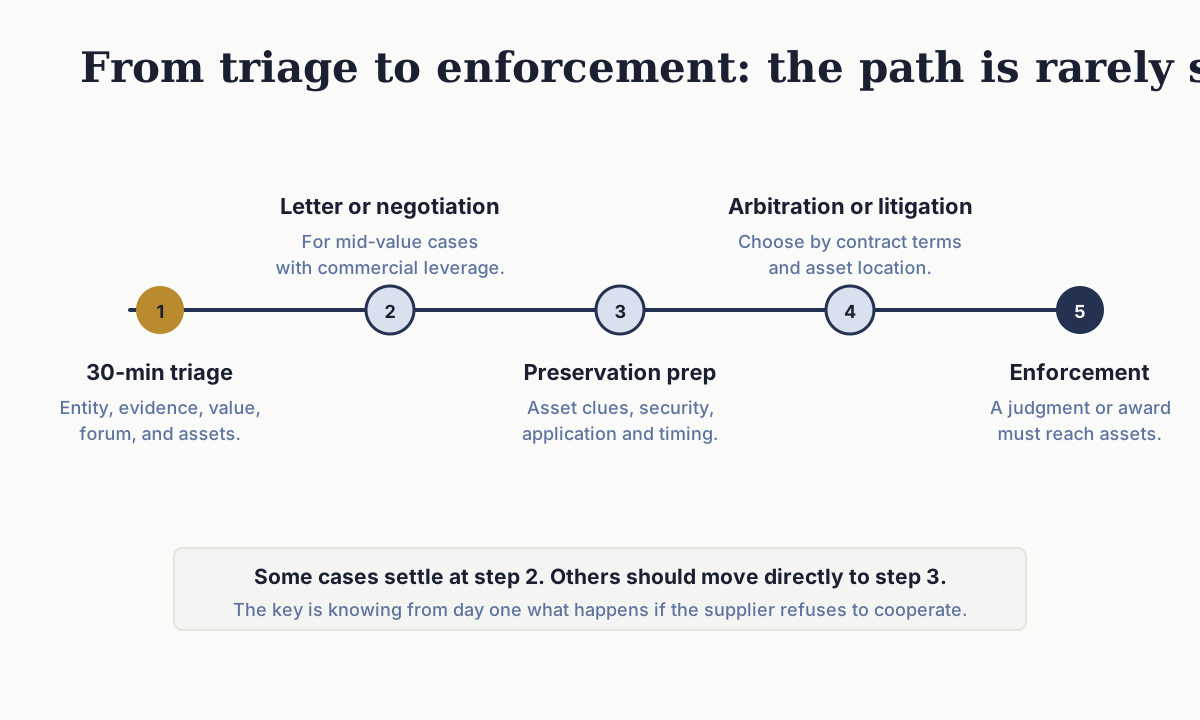
A complete path usually looks like this:
- Run a 30-minute case triage: entity, evidence, value, forum, and assets.
- For cases suited to settlement, send a lawyer letter or management-level letter.
- For higher-value cases with asset risk, prepare preservation.
- Choose arbitration or litigation based on the contract and asset location.
- After judgment, award, or settlement, move to enforcement and recovery.
Some cases settle at step two. If the supplier sees that the buyer’s file is organized, the legal route is real, and the next step is credible, it may refund, ship, replace, or sign a settlement. That is not a worse result than “winning.”
Some cases must proceed to arbitration or litigation. This is especially true where the supplier denies liability, the amount is large, assets still exist, or the buyer needs release of molds, tooling, or critical documents.
Some cases should be abandoned. If the value is low, the counterparty is unclear, the contract is missing, payment went to an offshore shell, or the supplier is cancelled or assetless, more legal spending may only increase the loss.
When to speak to a lawyer quickly
Do not keep sending exploratory emails if any of these are true:
- the supplier disappeared after receiving the deposit;
- the supplier refuses refund but is still operating;
- goods are finished but the supplier refuses to ship;
- there is a serious quality problem and the balance is still unpaid;
- the supplier is holding molds, drawings, design files, or brand assets;
- the contract names CIETAC, HKIAC, or another arbitration institution;
- you find enforcement records, mass litigation, asset transfers, or cancellation risk;
- the amount is high enough to consider arbitration, litigation, or preservation.
The earlier you triage, the more options remain. If you wait until full payment is made, goods are defective, molds are withheld, the supplier changes entities, and chat records are missing, many of the best levers are already gone.
The bottom line
Foreign buyers can pursue claims against Chinese suppliers. The question is not whether you can file. The question is whether the case makes commercial sense.
A viable case usually has several features: a clear defendant, evidence that connects, a claim value worth pursuing, a usable forum, assets or commercial pressure, and a path to enforcement.
If those elements are present, a demand letter, arbitration, litigation, and asset preservation can all be tools. If they are missing, the first step is not filing. It is fixing the evidence, verifying the entity, checking assets, or cutting losses.
If your Chinese supplier failed to deliver, refused refund, shipped defective goods, disappeared after payment, or withheld molds, start with the China supply chain dispute strategy, review the China supplier demand letter service, or contact me. I can run a 30-minute case triage and help you decide whether the first move should be a demand letter, negotiation, asset preservation, arbitration, litigation, or no further legal spend.
References
- National People’s Congress, PRC Civil Procedure Law (2023 Amendment), including Articles 35, 103, and 104: http://www.npc.gov.cn/npc/c2/c30834/202401/P020240108541839745616.pdfwww.npc.gov.cnwww.npc.gov.cn
- China International Commercial Court, Civil Procedure Law of the PRC (English translation materials): https://cicc.court.gov.cn/html/1/219/199/200/644.htmlcicc.court.gov.cn国际商事法庭 | CICC - Civil Procedure Law of the People's Republic of China (Revised in 2017)Civil Procedure Law of the Peoplecicc.court.gov.cn
- CIETAC, Arbitration Law of the People’s Republic of China, including Articles 16-18: https://www.cietac.org/en/articles/25219www.cietac.orgArbitration Law of the People's Republic of China-CIETACCHINA INTERNATIONAL ECONOMIC AND TRADE ARBITRATION COMMISSIONwww.cietac.org
- UNCITRAL, Status: Convention on the Recognition and Enforcement of Foreign Arbitral Awards (New York, 1958), 172 parties: https://uncitral.un.org/en/texts/arbitration/conventions/foreign_arbitral_awards/status2United Nations Commission on International Trade LawStatus: Convention on the Recognition and Enforcement of Foreign Arbitral Awards (New York, 1958) (the "New York Convention") | United Nations Commission on International Trade LawAuthoritative information on the status of the treaties deposited with the Secretary-General of the United Nations, including historical status information, ma…uncitral.un.org
- Supreme People’s Court and HKSAR Government, Arrangement Concerning Mutual Assistance in Court-ordered Interim Measures in Aid of Arbitral Proceedings (2019): https://cicc.court.gov.cn/html/1/219/208/210/1204.htmlcicc.court.gov.cn国际商事法庭 | CICC - Arrangement Concerning Mutual Assistance in Court-ordered Interim Measures in Aid of Arbitral Proceedings by the Courts of the Mainland and of the Hong Kong Special Administrative RegionArrangement Concerning Mutual Assistance in Court-ordered Interim Measures in Aid of Arbitral Proceedings by the Courts of the Mainland and of the Hong Kong Sp…cicc.court.gov.cn


This article is part of the “China Supply Chain Disputes — What Every Buyer Should Know” series. Related reading: When a China Demand Letter Works — And When It Backfires, Your Supplier Ghosted You After Taking the Deposit — What Are Your Options?, and How to Prepare Evidence That Actually Holds Up in Chinese Arbitration.
Frequently Asked Questions
Can a foreign buyer sue a Chinese supplier?
Yes, but the practical answer depends on the contract, arbitration clause, court jurisdiction, the correct Chinese legal entity, evidence, and whether the supplier has assets that can be reached. Filing a claim is not the same as recovering money.
Should I sue in China or start arbitration?
If the contract has a valid arbitration clause, arbitration should usually be assessed first. If there is no valid arbitration clause, a China court claim may be available if jurisdiction exists. The best route depends less on familiarity and more on enforceability, cost, evidence, and asset location.
Can I freeze a Chinese supplier's bank account before or during the case?
In suitable cases, property preservation may be available, including freezing, sealing, or seizing assets. It usually requires asset clues, a court application, and security. Timing matters because a premature demand letter may warn the supplier before preservation is ready.