On this page
The machine has arrived at your plant and been installed, yet it still cannot stably reach the contractually promised performance on the agreed materials and conditions. The Chinese supplier wants to keep adjusting parameters remotely; the buyer hesitates between continuing repairs, bringing in a local engineer, demanding a refund, and formal recovery. On the surface this looks like a technical question — “can the machine still be fixed?” — but what really decides the outcome is often every step that comes next: whether those steps make the evidence in the buyer’s hands steadily stronger, or make the whole matter steadily harder to explain.
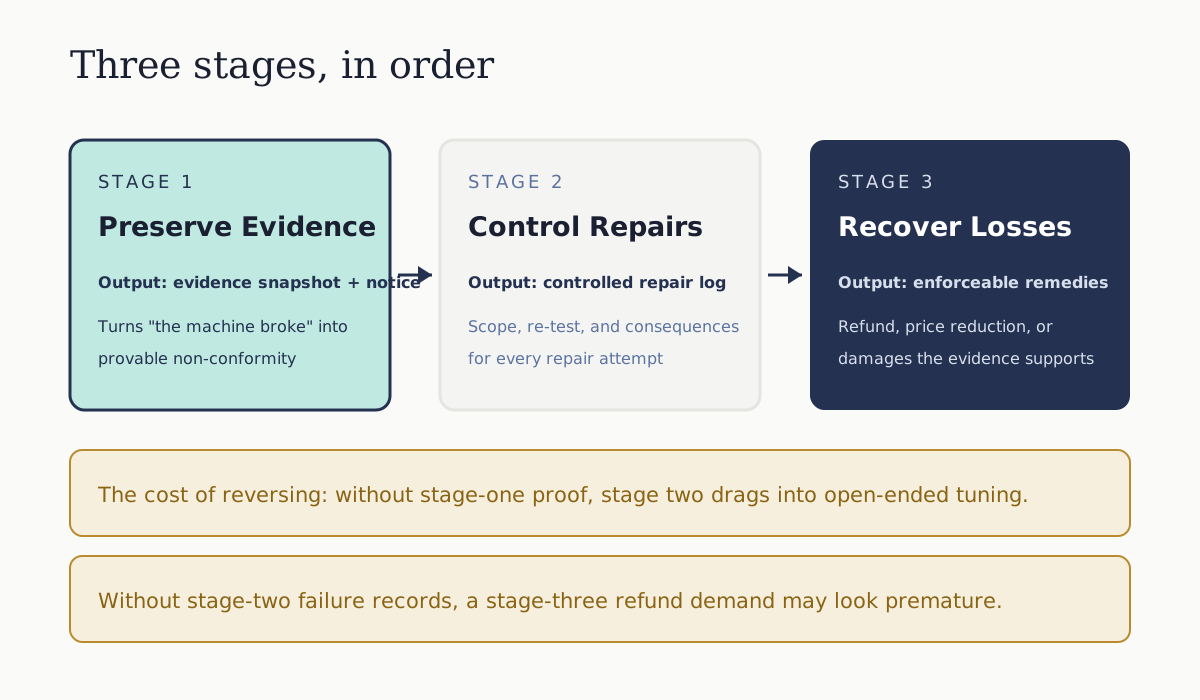
The matter can be split into three connected stages:
- Preserve the evidence: turn “the machine is broken” into provable non-conformity with the contract;
- Control the repairs: give every repair a scope, a re-test, and consequences for failure;
- Recover the losses: turn legal rights into a refund, price reduction, or damages you can actually collect.
These three stages cannot run in reverse: without stage one’s proof, stage two drags on as open-ended tuning; without stage two’s failure record, a stage-three refund demand may look premature.
So this article does not start with “can I get a refund”. It follows a more reliable main line: preserve evidence first, control repairs second, and only then talk about recovering losses. A machine that “does not work” is only the starting point; it does not mean the buyer has automatically earned a full-refund right.
Stage 1: Preserve the evidence — turn a breakdown into a provable breach
This stage answers only three questions: under what conditions did the machine fail, which promise did the failure depart from, and did the supplier receive a sufficiently specific notice in time. If any one of the three is missing, the toughest demand letter that follows may only amplify a conclusion that has not yet been proven.
Before the next repair, preserve the evidence as it is
Start with a scenario: the supplier stops replying tomorrow. With only the files you have saved today, could an independent engineer reproduce the failure? If the answer is no, the most important task right now is not to argue about who is right — it is to stop evidence from continuing to drain away. Safety always comes before evidence, of course: if the machine poses a risk to people or property, shut it down and isolate the hazard first, then talk about evidence. Once the risk is cleared, assemble an evidence snapshot that a third party can reproduce; that is far more useful than firing off a long, emotional email.
Preserve at least the following:
- The contract, purchase orders, PI , technical agreements, drawings, samples, and the performance figures both sides confirmed;
- Factory Acceptance Test (FAT) and Site Acceptance Test (SAT) reports, installation reports, punch lists, and signed reservations;
- Native alarm logs, PLC or controller parameters, configuration exports, remote login records, and software versions;
- Complete test videos shot with the date, operator, raw-material batch, ambient conditions, load, and duration noted;
- Actual output, yield, precision, energy consumption, or cycle-time data, plus conforming and non-conforming samples;
- A timeline of every tuning session, part replacement, and remote operation, together with the original emails, WeChat messages, and attachments;
- Removed failed parts, packaging labels, and their chain of custody.
Chinese court rules on electronic data treat emails, instant messages, login logs, images, audio and video, and program files as electronic data, and require submitting the original carrier — or output that can be treated as the original — wherever possible. Where specialized technical issues are involved, the court may also handle them through expert appraisal. Don’t save only chat screenshotsSPC Provisions on Evidence in Civil Litigation · Articles 14–15 and 30–41Emails, instant messages, login logs, programs, images, and audio/video can constitute electronic data; the integrity of original carriers, appraisal materials, and samples affects their probative force.Official text · SPC . A fuller approach is in our guide to evidence preservation in cross-border supply-chain disputes.

Industry standards can help an engineer design repeatable tests. IEC 62381:2024, for example, discusses factory and site acceptance testing of automation systems, and ISO 26303:2022 covers short-term capability evaluation of machine-tool machining processes. But unless the contract adopts these standards, or the applicable law provides otherwise, they do not automatically become your contractual targets. Find out what the parties agreed first; then decide how to test.
Until your engineer and lawyer confirm the preservation scope, do not casually dismantle the machine, flash firmware, overwrite parameters, ship it back, or scrap it. One uncontrolled “quick fix” can simultaneously change the cause of failure, the allocation of responsibility, and the conditions for returning the equipment. At this point you have only “frozen” the scene; the next step answers a harder question: can this data prove the supplier breached, or only that the machine once stopped?
What you must prove is “non-conformity”, not just “the machine stopped”
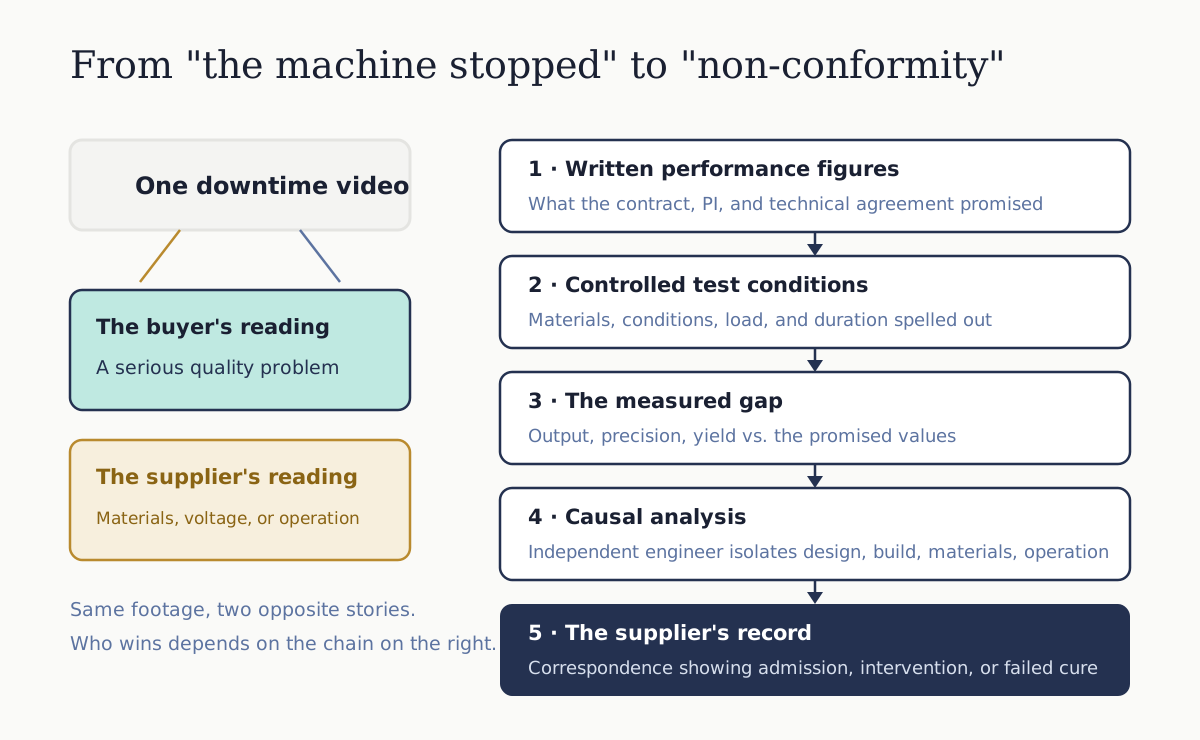
A downtime video is striking, but it can be told as two opposite stories: the buyer sees a serious quality problem; the supplier may see wrong materials, wrong voltage, or improper operation. That is why the core of an equipment dispute is usually not whether the machine stopped, but three questions: what did the supplier promise, what did testing actually show, and who caused the gap.
First classify the failure correctly: the machine never passed the agreed site acceptance; it passed acceptance but failed later; it can produce but chronically runs below the agreed capacity or precision; it works only with abnormally heavy manual intervention; or a critical module in a production line has failed, leaving the whole line unable to produce commercial output. Which category the failure belongs to directly affects acceptance, warranty, causation, and the refund threshold.
The supplier’s common defenses also need item-by-item testing, not blanket denial: the plant foundation, voltage, air pressure, temperature, or humidity did not comply; the buyer used the wrong raw materials; third-party integration failed; maintenance did not follow the manual; operators were untrained; the buyer repaired without authorization; or the parts are normal wear. What the buyer really needs to build is this chain of proof:
Written performance figures → controlled test conditions → the measured gap → causal analysis → records of the supplier’s admission, intervention, or failed cure.
If Chinese law applies and the contract’s quality terms are unclear, the analysis looks in turn at supplementary agreements, trade usage, recommended national or industry standards, ordinary standards, and the purpose of the contract; the seller’s delivery must also conform to the agreed quality. “It powers on” does not necessarily mean “it meets the contracted performance”PRC Civil Code · Articles 510–511 and 615–617Statutory gap-filling rules apply when quality terms are unclear; the seller must deliver at the agreed quality, and non-conforming quality triggers breach liability.Official text · SPC . If the sale is an international sale of goods, also assess whether the CISGUnited Nations Commission on International Trade LawUnited Nations Convention on Contracts for the International Sale of Goods (Vienna, 1980) (CISG) | United Nations Commission on International Trade LawDate of adoption: 11 April 1980 Entry into force: 1 January 1988 Purpose The purpose of the CISG is to provide a modern, uniform and fair regime for contracts …uncitral.un.org applies, based on the choice-of-law clause and the parties’ places of business; its Article 35 likewise puts quantity, quality, description, and particular purpose into the conformity analysis.

The publicly available C&J press-brake case illustrates the consequences of insufficient evidence. The buyer claimed the equipment developed an unrepairable quality problem after several months of use, but failed to adequately prove the failure came from the seller’s manufacturing quality, and the contract did not clearly define quality or fundamental-breach standards; the buyer also insisted on a refund and refused to switch to a repair request. The Supreme People’s Court ultimately declined to support its avoidance and refund claims. This case does not mean “machine disputes never get refunds”; what it really warns is: failure, seller responsibility, and the termination threshold are three things that must each be proven separately. Even if all three can be proven, without timely and specific notice to the supplier, the buyer may still lose the claim at the procedural entrance.
The quality notice must be specific, and it cannot wait
Technical evidence answers “what happened”; the notice of non-conformity turns those facts into “what the supplier was told, and what it was asked to do”. Neither can be missing. “The machine does not work” works as an alarm, but it is not yet a complete legal notice. A usable notice should include at least:
- The machine’s name, model, and serial number;
- The specification, output, precision, yield, or acceptance clause that was breached;
- The failure symptoms, test dates, and test conditions;
- The attached videos, logs, samples, and preliminary causal materials;
- The installations, production, or customer orders already affected;
- The investigation, repair, replacement, or other cure the supplier is required to complete;
- A response deadline, and the contract and legal rights the buyer reserves.
First check the contract’s inspection period, the effect of SAT sign-off, the warranty period, the claims procedure, and the notice address. If Chinese law applies, the buyer should notify within the agreed inspection period; absent agreement, within a reasonable time after discovering — or when it ought to have discovered — the non-conformity. The reasonable period considers the nature of the goods, installation and use, the nature of the defect, and the difficulty of inspection. The relationship between the warranty period and the maximum period also needs separate analysisPRC Civil Code · Articles 620–623The buyer bears timely inspection and notice duties; the notice period is shaped by the contract, a reasonable period, maximum periods, the warranty period, and the seller's knowledge.Official text · SPC .
The current judicial interpretation on sales contracts further requires courts to judge the reasonable period in light of the nature of the transaction, installation and use of the subject matter, and inspection difficulty; once the buyer objects within the period, mere payment or use of the equipment does not automatically equal a waiver of the objection. Repair discussions should not be mistaken for a pause on every deadlineSPC Interpretation on Sale Contract Disputes · Articles 12–16The reasonable notice period is judged with installation, use, and inspection difficulty; timely objections are not automatically waived by payment or use; where the seller fails to repair as required or the situation is urgent, reasonable third-party repair costs may be supported.Official text · CICC .
Under the CISG, Articles 38–40 likewise require examination and specific notice: notice must be given within a “reasonable time”, usually with a two-year outside limit. In the C&J case, the buyer’s failure to prove it had sent notice of a serious quality non-conformity within two years of delivery was one of the reasons it lost. Whether notice is timely changes with the contract, the facts, and the applicable law; do not wait until “talks break down” to describe the defect formally for the first time.
Completing this step finishes stage one in earnest: you have frozen the scene, mapped the deviation to the contract, and left a provable notice. The question ahead is no longer “is the machine actually broken”, but a more strategic choice: should the supplier keep touching this machine at all — and how do you keep repairs from dragging everything back to the start?
Stage 2: Control the repairs — give every repair a defined outcome
A repair is not a concession; an unbounded repair is. The supplier may genuinely be able to fix the machine, and the buyer may weaken part of its claims by refusing reasonable cure; but if every tuning session has no shared metrics, no completion date, and no failure consequences, time only works for the supplier.
Continuing repairs is fine — but end the open-ended tuning loop
So do not just ask “one more repair or not”. The law usually does not require the buyer to wait forever because the supplier proposed a first repair; nor does a certain number of failed repairs automatically create a full-refund right. The question that actually helps is: is the next cure attempt specific, reasonable, verifiable, and connected to the legal consequences of failure.
Before allowing another repair, put the following in writing:
- The defects to be repaired, the responsible engineers, and the parts needed;
- Remote-access rights, and who bears travel and local labor;
- How evidence will be preserved before changes, and the re-test procedure under identical conditions;
- A completion date, and which option the parties move to if it fails.
Also write down: this repair is not final acceptance, does not mean the buyer waives existing breaches, and does not mean acceptance of reduced performance.
If the CISG applies, the seller may have an opportunity to cure, provided it causes no unreasonable delay, inconvenience, or uncertainty of expense; a buyer who refuses effective cure without justification may weaken its avoidance or price-reduction position. Conversely, a supplier that refuses to repair, offers only a scopeless, dateless “let’s keep looking”, or still cannot pass the same test after promising to, all strengthen the buyer’s record. But note especially: for an already-delivered but defective machine, the mere expiry of an additional period set by the buyer does not necessarily create a right to avoid; you still need to examine fundamental breach , the contract’s purpose, or thresholds set in the contract.
If Chinese law applies, the breaching party may bear liability to continue performance, cure, or pay damages; where conditions are met, the cost of substitute performance by a third party, repair, rework, replacement, return, price reduction, and residual losses after cure may also become remedies. But these provisions are no guarantee of automatic reimbursement after self-authorized repairsPRC Civil Code · Articles 577 and 581–583Breach liability may include continued performance, cure, and damages; under specific conditions, third-party substitute-performance costs may be claimed, and repair, replacement, return, or price reduction reasonably chosen.Official text · SPC . Keep notice, the supplier’s opportunity to cure, urgency, repair necessity, and cost reasonableness together in the record.
A controlled repair plan can tell you “did this fix succeed” — but not necessarily another thing: if the machine can only recover part of its performance, is there another way to preserve its production value? That is exactly where ordinary repair guides stop, and exactly where high-value equipment disputes need to keep thinking.
Don’t jump from repair to litigation: design a measurable transition arrangement first
The law can tell you which remedies exist; it will not arrange a way forward for a production line that is down. Statutes list repair, price reduction, avoidance, and damages; high-value equipment disputes usually also need a more practical layer of work — writing the parties’ next technical moves into a new, measurable commercial arrangement.
The arrangements below are mostly not statutory rights the buyer can declare unilaterally; they are supplementary agreements designed around the rules on cure, mitigation, partial performance, price adjustment, and restitution after avoidance. Mark clearly when negotiating: which are rights under the original contract, which are remedies the applicable law may support, and which are concessions that take effect only if the supplier agrees.
-
Joint diagnostic and evidence protocol. Before either side modifies the machine further, jointly confirm test conditions, data-extraction methods, samples, custody of failed parts, the independent engineer’s authority, and how each side participates while reserving objections. It cannot pre-decide liability, but it reduces “your tests aren’t credible” fights.
-
Trigger agreement from cure to exit. Allow one clearly scoped repair with an agreed objective re-test; if it passes, sign acceptance and deal with residual losses; if it fails, automatically enter a pre-agreed price reduction, module replacement, buy-back negotiation, or dispute procedure. The “automatic” here comes from the new agreement, not from some magic number of repairs.
-
Authorized local-engineer takeover. The supplier authorizes in writing a local team to repair within a budget, and provides parts, PLC backups, administrator access, interface documentation, and remote support; the agreement also allocates costs and liability. Without written authorization, at least give the supplier a reasonable opportunity first, and fully document urgency, mitigation necessity, and the machine’s condition before and after.
-
Reset the price to performance and restart the warranty. If the machine runs stably at only 70% capacity but still has use value, reduce the price by the objective value difference or an agreed formula, and restart the warranty on specified components from the repair or new-acceptance date. CISG Article 50 and Chinese price-reduction rules supply the legal logic, but restarting the warranty usually requires a separate agreement.
-
Module-level exit. If a non-conforming module can be independently separated, replaced, and priced, replace or exit only that part while keeping the rest of the useful equipment. CISG Article 51 distinguishes partial non-conformity from avoiding the whole contract; Articles 631–633 of the Civil Code likewise address principal and accessory items, multiple items, and installment deliveries. But if one module’s failure defeats the purpose of the whole line, you still need to prove why local treatment is not enough.
-
Handover of operating materials. Turn PLC backups, administrator accounts, parameter tables, wiring diagrams, spare-parts lists, interface documentation, training, and local maintenance permissions into acceptance-ready deliverables. Article 599 of the Civil Code supports the seller’s duty to deliver related documents and materials, but it does not automatically transfer source code, IP, or un-agreed software licenses to the buyer; the scope must be written out.
-
A production bridge during repairs. Have the supplier bear or share the cost of renting substitute equipment, outsourced processing, expedited parts, or on-site engineers, so the buyer keeps mitigating. If the supplier wants one last chance, place new payments in escrow, require a partial refund, or ask for third-party security. The buyer has no automatic right to security; the value of this arrangement is trading risk control for time.
-
Staged buy-back or refund. A large machine cannot be boxed up and returned like a small parcel. The agreement should link the first refund installment, shutdown and disassembly, supplier pickup, title transfer, marine insurance, storage, damage risk, and release of the balance into interlocked steps, so the buyer does not lose both the machine and the evidence while the refund is still unpaid.
The common goal of these arrangements is not to “look friendly”; it is to make the next technical event produce provable commercial consequences. If the supplier refuses to put even testing, access, funds, or an exit mechanism into an agreement, more verbal tuning usually only consumes time. By this point stage two has in fact delivered its answer: the question is no longer whether to keep repairing, but whether the supplier will accept an arrangement that produces a defined outcome; if not, the case belongs in stage three.
Stage 3: Recover the losses — turn legal rights into money you actually receive
Many buyers make the same mistake here: treating “the supplier breached”, “what can I claim”, and “how much can I ultimately recover” as one question. In reality, even if the first two stages were done right, remedies that conflict with each other, distorted loss calculations, or a counterparty with no assets can still turn a legally strong case into an economically poor project.
After the transition talks collapse, choose one consistent remedy path
After negotiations fail, the easiest demand letter to write is “refund, repair costs, and downtime losses, all of it”; the hardest work is making those claims legally and economically consistent with each other. “Getting money back” can mean very different claims:
- Continued performance or a demand for repair;
- Substitute performance by a local engineer, then claiming reasonable costs;
- Replacement of the equipment or module;
- Price reduction based on delivered value;
- Avoidance of the contract with restitution of the price;
- Residual damages on top of an appropriate primary claim.
Do not pile every number into one demand letter. A full refund usually means you are claiming the contract has been validly avoided and are prepared to handle equipment return, use value, dismantling and shipping, and risk; a price reduction usually means keeping the equipment but adjusting the consideration; demanding a full refund while permanently keeping the equipment’s entire value creates obvious consistency and double-recovery problems. Repair costs, cover-purchase price differences, and downtime losses also need to be separated by causation — not double-counted just because they all involve the same machine.
If Chinese law applies, statutory termination generally requires an agreed or statutory ground, such as non-performance after demand following delay, or another breach that defeats the contract’s purpose. A termination notice takes effect only if the right to terminate actually exists; writing a “final deadline” into a letter does not create a refund right out of thin air. After termination, restoration, other remedies, and damages may follow. A court or tribunal examines the termination threshold, not just the notice’s headlinePRC Civil Code · Articles 563 and 565–566Termination requires a contractual or statutory basis; the effect of a notice depends on whether the termination right exists; restitution, remedies, and damages follow termination.Official text · SPC . Article 53 of the judicial interpretation on the General Part of the Contracts Book also makes clear that even if the recipient does not object in time, the court must still review whether the termination right existed.
Under the CISG, you likewise usually distinguish repair, replacement, price reduction, damages, and avoidance for fundamental breach, and consider the seller’s effective cure, the buyer’s notice, and the ability to return the equipment. First fix the applicable law and the contract terms, then choose the claims that best match the evidence you hold and are still commercially useful.
Naming the remedy does not finish the case. “Entitled to claim” only decides the categories of loss; what really moves negotiation and adjudication is whether each item can be calculated, connected to causation, and kept free of double counting.
Downtime losses are built from records, not guessed from revenue
A bigger claim number is not, by itself, more negotiating leverage. If the other side can puncture it with one “there is no basis for this calculation”, the inflated figure instead buries the items that could genuinely be recovered. Equipment disputes can involve large sums, but “our monthly revenue is USD 500,000, so the supplier owes three months” usually does not hold up. The more reliable approach is an itemized claim schedule:
- The price paid, or restitution after avoidance;
- Inspection and appraisal costs;
- Reasonable repair or rental costs;
- Substitute processing, return shipping, and storage costs;
- The price difference on cover purchases;
- Provable net downtime profits.
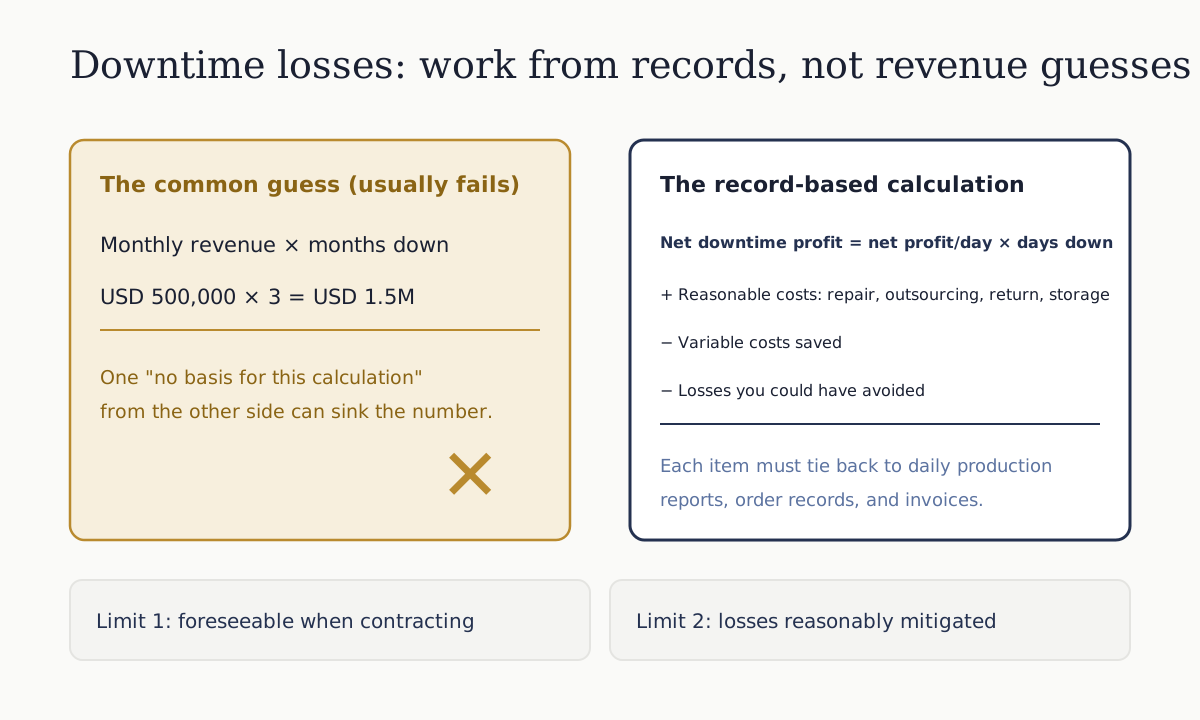
If Chinese law applies, breach losses may include the benefits obtainable after performance, but are limited by causation, foreseeability at contracting, the duty to mitigate, and the buyer’s own fault. The claim should start from net loss, not gross revenuePRC Civil Code · Articles 584 and 591–592Breach losses include qualifying lost benefits, limited by foreseeability, mitigation, and both parties' fault; reasonable mitigation costs are recoverable.Official text · SPC .
The SPC’s judicial interpretation on the General Part of the Contracts Book further requires deducting reasonable costs when calculating production, operating, or resale profits, and allows losses to be measured by a reasonable substitute transaction or the market difference; foreseeability is judged with the contract’s purpose, the transaction type, the negotiation history, and similar factors. A rough percentage estimate usually cannot substitute for operating records from the same periodSPC Interpretation on the General Part of the Civil Code Contracts Book · Articles 60–63Lost benefits are based on net profit and reasonable substitute transactions; the scope is also shaped by foreseeability, mitigation, both parties' fault, extra gains, and saved costs.Official text · SPC .
From the first day of failure, preserve each day’s planned and actual output , orders and cancellations, substitute capacity, outsourcing and rental invoices, extra labor, saved variable costs, and every mitigation decision. CISG Articles 74–77 adopt a similar framework on loss, foreseeability, and mitigation. Being able to explain “why this period, why this net figure, why mitigation was already reasonable” matters more than shouting the biggest number.
At this point what you hold is a net claim on paper; it is not yet a net recovery in reality. Between the two stands one last gate: the contracting entity, the dispute clause, procedure costs, and enforceable assets.
Only at the end, decide whether a demand letter, arbitration, and asset preservation are worth it
Even with liability clear and losses calculable, if the money was paid to the wrong entity, the contract places disputes in an unsuitable forum, or the supplier has no enforceable assets in its name, this can still be money you never recover. Legal odds only turn into commercial recovery probability after this gate. Before formally escalating, check these six items in order:
- The registered Chinese company name and Unified Social Credit Code matching the contract, receiving account, and invoices;
- The governing law, court jurisdiction or arbitration clause, and which signatories it covers;
- Which remedy the evidence currently supports, and the supplier’s strongest defense;
- The provable net claim, the procedure budget, the expected timeline, and the settlement range;
- Whether bank accounts, equipment, receivables, or other enforceable assets exist in mainland China;
- Whether to send a targeted demand letter first, or prepare arbitration, litigation, and necessary preservation directly.
The current Arbitration Law took effect on March 1, 2026. Article 39 allows applying for preservation where an award may become difficult to enforce or other damage may result, and in urgent cases even before filing for arbitration; but it must be handled by a competent court, and a wrongful application may create liability for compensation. Preservation is not a step every machine dispute should start by defaultPRC Arbitration Law · Articles 39 and 96Arbitration parties may apply for property or conduct preservation; in urgency, before filing; wrongful applications may incur compensation liability. The revised law took effect on March 1, 2026.Official text · NPC . Further reading: suing a Chinese supplier from overseas and what asset preservation in China is. Only after the entity, jurisdiction, assets, and cost checks is there enough information to answer the opening question: keep repairing, a structured exit, or formal recovery — which path actually gets more money back?
Conclusion: turn a “broken machine” into a managed process
Handling a machine bought from China that does not work is not about finding a magic number of repairs that unlocks a refund. It is about walking three stages in order: first build liability with evidence, then create defined outcomes with controlled repairs, and finally filter from the available remedies the claims actually worth pursuing. In concrete actions, that means a decision chain the next tuning session cannot break: freeze the scene, rebuild the contractual metrics, isolate the cause, notify in time, control the cure, and then write the failed outcomes into a price reduction, takeover, partial exit, buy-back, or formal recovery plan.
This main line also explains why you should not lead with a refund demand: stage one decides whether you can prove anything, stage two decides whether the supplier still has credible room to cure, and only stage three decides which remedy can land. The facts that genuinely change the answer are usually these few:
- Whether the machine ever passed the agreed acceptance;
- Whether the defect can be attributed to the supplier;
- Whether continued repair is still reasonable;
- Whether the whole line and the failed module can be separated;
- Whether notice was timely;
- What the applicable law and dispute clause are;
- Whether the supplier has enforceable assets.
Return shipping, dismantling, flashing programs, signing final acceptance, or accepting a “full settlement” can all be irreversible; review them before acting.
If the amount in dispute is large enough to support cross-border recovery, you can submit the machine’s contract value, the amounts paid, the equipment’s location, acceptance and test records, the repair timeline, the Chinese supplier’s entity, and the dispute-resolution clause on the contact page. I can then assess what should be preserved, what the next notice should demand, and which recovery path is most realistic.
References
- Supreme People’s Court, PRC Civil Code, including Articles 510–511, 563, 565–566, 577, 581–584, 591–592, 599, 615–617, 620–623, and 631–633: https://www.court.gov.cn/zixun/xiangqing/233181.htmlSupreme People's Court of ChinaCivil Code of the People's Republic of ChinaChinese-language text of the PRC Civil Code, published on the Supreme People's Court website.www.court.gov.cn
- Supreme People’s Court, Interpretation on Issues Concerning the Application of Law in the Trial of Sale Contract Disputes, including Articles 12–16: https://cicc.court.gov.cn/html/1/380/385/12840.htmlcicc.court.gov.cn国际商事法庭 | CICC - 最高人民法院关于审理买卖合同纠纷案件适用法律问题的解释最高人民法院关于审理买卖合同纠纷案件适用法律问题的解释cicc.court.gov.cn
- Supreme People’s Court, Interpretation on the General Part of the Contracts Book of the PRC Civil Code, including Articles 53 and 60–63: https://www.court.gov.cn/zixun/xiangqing/419382.htmlwww.court.gov.cn最高人民法院关于适用《中华人民共和国民法典》合同编通则若干问题的解释 - 中华人民共和国最高人民法院最高人民法院政务网站,最高人民法院网,最高人民法院,最高人民法院网是人民群众了解和联系最高人民法院的重要窗口,承载着司法公开、法治宣传、服务群众、接受监督等重要使命。是最高人民法院的政务网站,是最高人民法院在互联网上唯一的正式身份。www.court.gov.cn
- Supreme People’s Court, Provisions on Evidence in Civil Litigation, including Articles 14–15 and 30–41: https://www.court.gov.cn/zixun/xiangqing/212721.htmlwww.court.gov.cn最高人民法院关于民事诉讼证据的若干规定 - 中华人民共和国最高人民法院最高人民法院政务网站,最高人民法院网,最高人民法院,最高人民法院网是人民群众了解和联系最高人民法院的重要窗口,承载着司法公开、法治宣传、服务群众、接受监督等重要使命。是最高人民法院的政务网站,是最高人民法院在互联网上唯一的正式身份。www.court.gov.cn
- Standing Committee of the National People’s Congress, PRC Arbitration Law (2025 revision, effective March 1, 2026), including Articles 39 and 96: https://www.npc.gov.cn/npc/c2/c30834/202509/t20250912_447762.html全国人民代表大会中华人民共和国仲裁法全国人大发布的《仲裁法》官方文本(2026 年 3 月 1 日起施行)。www.npc.gov.cn
- UNCITRAL, United Nations Convention on Contracts for the International Sale of Goods (CISG), including Articles 25, 35, 38–40, 50, 51, and 74–77: https://uncitral.un.org/en/texts/salegoods/conventions/sale_of_goods/cisgUnited Nations Commission on International Trade LawUnited Nations Convention on Contracts for the International Sale of Goods (Vienna, 1980) (CISG) | United Nations Commission on International Trade LawDate of adoption: 11 April 1980 Entry into force: 1 January 1988 Purpose The purpose of the CISG is to provide a modern, uniform and fair regime for contracts …uncitral.un.org
- UNCITRAL, Digest of Case Law on the CISG (2016 edition): https://uncitral.un.org/sites/default/files/media-documents/uncitral/en/cisg_digest_2016.pdfuncitral.un.orguncitral.un.org
- China International Commercial Court, Supreme People’s Court: ruling in C&J Metal Sheet Co. v. Wenzhou Chenxing Machinery Co. and UNCITRAL CLOUT abstract: https://cicc.court.gov.cn/html/1/218/347/329/428/430/12754.htmlcicc.court.gov.cn国际商事法庭 | CICC - 【CLOUT案例第1775号】最高人民法院(2014)民申字第266号【CLOUT案例第1775号】最高人民法院(2014)民申字第266号cicc.court.gov.cn
- IEC 62381:2024 and ISO 26303:2022 (referenced for test structure only; applicability depends on the contract and the specific industry): https://webstore.iec.ch/en/publication/67572webstore.iec.chIEC 62381:2024 | IECwebstore.iec.ch and https://www.iso.org/standard/81229.htmlwww.iso.orgwww.iso.org


Frequently Asked Questions
The Chinese supplier says the machine failure was caused by our operators. What evidence should I collect?
Preserve training records, operating manuals, set parameters, login and remote-access logs, input materials, and water, power, and gas conditions, and arrange repeatable comparative tests under identical conditions. Ideally, have an independent engineer separate design, manufacturing, installation, material, operation, and maintenance causes. Do not submit only a video of the machine stopped, and do not let either side overwrite programs or remove failed parts before the cause is pinned down.
Can I hire a local engineer to repair the machine without losing my claim against the Chinese supplier?
Possibly, but do not assume the costs will necessarily be recovered. First notify the supplier in time under the contract and the applicable law, and give a reasonable opportunity to inspect or cure; document urgent safety or mitigation situations separately. Preserve evidence before and after the repair, define the local engineer's authority, budget, data access, part replacement, and causal opinions, and try to obtain the supplier's written authorization — or at least record its refusal or delay.
How many repair attempts are allowed before I can demand a refund?
There is no universal number. What matters is the severity of the defect, whether it is repairable, how specific each proposal is, the delay and inconvenience, whether agreed tests keep failing, and whether these facts meet the termination threshold under the contract or the applicable law. A single serious, unrepairable defect may be enough; multiple minor repairs may not necessarily create a right to a full refund.
Can I recover lost profits from production downtime from the Chinese supplier?
Legally possible, but usually harder to prove than the purchase price or reasonable repair costs. You need to connect the failure to the downtime period, show the supplier could have foreseen that type of loss when contracting, calculate net profit rather than revenue, and deduct saved costs, substitute capacity, and losses you could have avoided. Daily production reports, order cancellations, subcontracting invoices, and capacity records for the same period are usually more useful than rough percentage estimates.