On this page

To state the conclusion at the outset: a foreigner lawfully working in China generally must participate in China’s employee social insurance system.
This is not a company benefit that can be swapped for cash, nor something HR and the employee can erase with a one-page “voluntary waiver” during onboarding. The correct analytical sequence is straightforward, and far more useful: first, whether the foreign employee falls within China’s employee social insurance system; second, whether an effective bilateral treaty exempts specific schemes; third, what each of the five schemes actually covers; fourth, whether the employer is paying on the correct contribution base; fifth, what can be handled when the employee leaves China; and only then, what happens if a waiver has already been signed or the employer never paid.
The order matters, because many shebao disputes become confusing when everyone starts at the end: “Can I get a refund?” or “Is my waiver valid?” Those are consequences, not analytical starting points.
I. Coverage starts with lawful employment, not nationality
The basic framework sits in the PRC Social Insurance Lawfgk.chinatax.gov.cn国家税务总局政策法规库fgk.chinatax.gov.cn. Article 4 requires employers and individuals to pay social insurance premiums according to law and gives individuals the right to check contribution records. Articles 10, 23, 33, 44 and 53 cover employee pension, employee medical, work-injury, unemployment and maternity insurance. Article 58 requires the employer to complete social insurance registration for an employee within 30 days from employment , and Article 60 requires timely, full payment and monthly disclosure of payment details to the employee.

Foreign employees are brought into that system by the Interim Measures for Foreigners Employed in China Participating in Social Insurance, effective since October 15, 2011 and revised on December 23, 2024. The current textrlsbj.cq.gov.cn在中国境内就业的外国人参加社会保险暂行办法_重庆市人力资源和社会保障局在中国境内就业的外国人参加社会保险暂行办法rlsbj.cq.gov.cn covers non-Chinese nationals lawfully employed in China who hold a PRC Foreigner’s Work Permit, foreign resident journalist credential or other employment and residence documents, as well as holders of foreign permanent residence documents. Article 3 requires participation in the five employee schemes. Article 4 requires the employer to complete registration within 30 days after the employment certificate is processed. Foreigners dispatched to a Chinese branch or representative office by an overseas employer are registered by that Chinese branch or representative office.
From December 1, 2024, China began integrating foreigner work permits with social security cards. Work permit information is loaded onto the physical or electronic social security card; newly arrived foreigners no longer receive a separate physical work permit card, and applications, extensions, changes and cancellations are handled online (see the Shanghai International Services explanationenglish.shanghai.gov.cnJoin in CardChina has announced a new policy to integrate foreignerenglish.shanghai.gov.cn). That integration does not make social insurance optional; it simply brings lawful work status and social security services closer together.

Shanghai warrants separate treatment, as local practice has long been a source of confusion. A 2009 local document was long treated in practice as allowing agreed participation for foreign employees in Shanghai. That practice has ended. Shanghai’s 2021 notice, Hu Ren She Yang [2021] No. 358rsj.sh.gov.cn上海市人力资源和社会保障局 上海市医疗保障局关于外籍人员、获得境外永久(长期)居留权人员和香港澳门台湾居民在沪就业期间参加职工社会保险有关问题的通知_社会保险_上海市人力资源和社会保障局rsj.sh.gov.cn, states that foreigners working in Shanghai under an employment relationship and holding the required work documents must participate in employee social insurance under national rules.

So the first question is not “is this person Chinese?” but whether the person is lawfully employed in China under a covered employment relationship. If yes, participation is the default.
II. The five schemes protect different risks
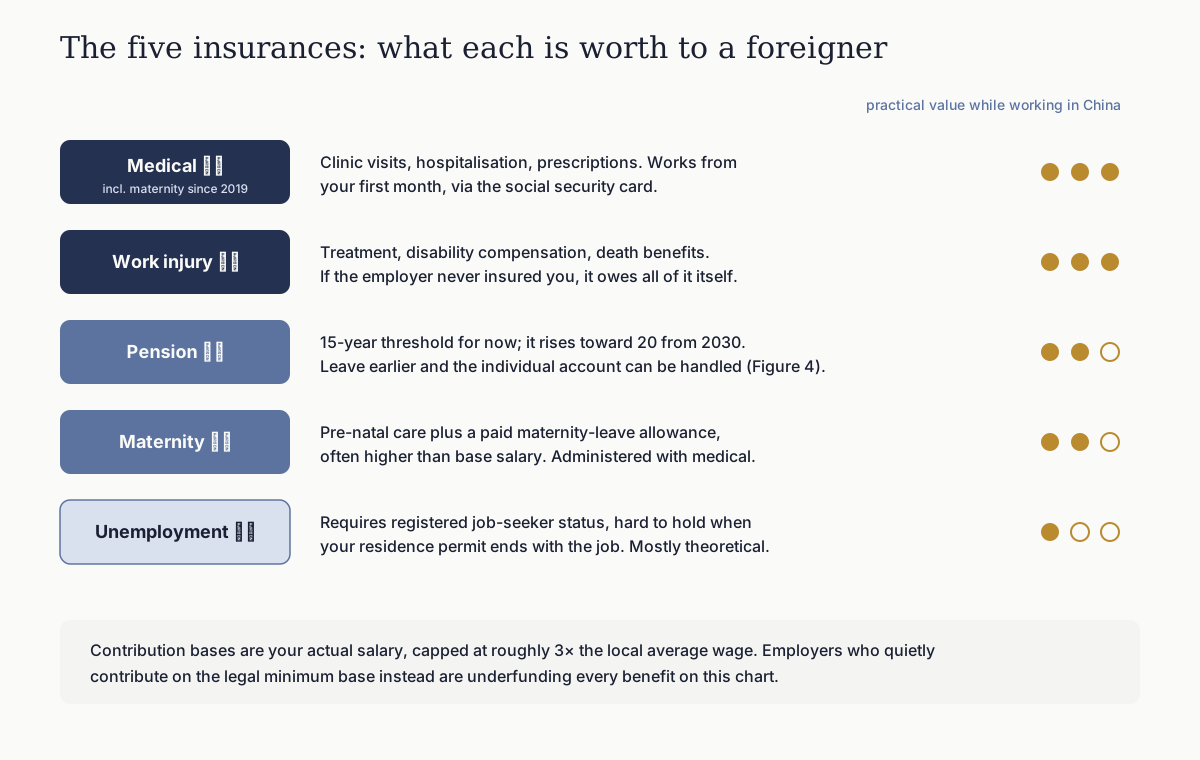
Many foreign employees see a contribution record for the first time and only notice the labels: pension, medical, work injury, unemployment, maternity. Grey boxes on a government screen. The real question is what each box does.
1. Pension insurance. Employee basic pension insurance is funded by both employer and employee. Article 12 of the Social Insurance Law separates the money: the employer’s contribution goes into the pooled fund, while the employee’s contribution goes into the individual account. Under the national rate-reduction framework, the employer rate for enterprise employee pension insurance is commonly 16%, while the employee rate is commonly 8% (see the 2019 MOF and MOHRSS policy explanationwww.mof.gov.cn关于贯彻落实《降低社会保险费率综合方案》的通知www.mof.gov.cn). The individual account matters for departure handling and retirement benefits. The pooled fund is not the employee’s private wallet.

2. Medical insurance. Employee basic medical insurance covers eligible clinic visits, hospitalisation, prescriptions and related expenses under local rules. Article 30 of the Social Insurance Law excludes costs that should be paid by work-injury insurance, a third party, public health funds or overseas medical treatment. In Shanghai, the employee medical insurance year runs from July 1 to June 30, and settlement generally uses medical insurance credentials at designated hospitals, clinics and pharmacies (see the Shanghai employee medical insurance ruleswww.shanghai.gov.cn关于印发《上海市职工基本医疗保险办法实施细则》的通知www.shanghai.gov.cn). Shanghai’s 2025 personal medical account measuresybj.sh.gov.cn关于印发《上海市职工基本医疗保险个人医疗账户管理办法》的通知ybj.sh.gov.cn also provide for interest on year-end personal-account balances at the benchmark one-year fixed deposit rate. For many foreign employees, this is the first part of the system they actually use.

3. Work-injury insurance. Work-injury insurance is employer-funded. The employee does not pay. Article 33 and Article 36 of the Social Insurance Law, together with the Work-Injury Insurance Regulationfgk.chinatax.gov.cn国家税务总局政策法规库fgk.chinatax.gov.cn, create a hard protection: once a work accident injury or occupational disease is recognised as a work injury, medical benefits apply; if work capacity is impaired after assessment, disability benefits apply. During the suspension-with-pay period, original wages and benefits generally continue. For grade 7 to 10 disability, the one-time disability subsidy is 13, 11, 9 and 7 months of the employee’s own wage. If the employer did not insure the employee, the employee does not lose the statutory items. The employer pays.
4. Unemployment insurance. Unemployment insurance applies to employees in law. Article 45 of the Social Insurance Law requires at least one year of contributions, non-voluntary interruption of employment, unemployment registration and a job-seeking requirement. Article 46 caps the benefit period at 12, 18 or 24 months depending on contribution years. The Unemployment Insurance Regulationxzfg.moj.gov.cn国家行政法规库xzfg.moj.gov.cn also stops benefits when the person relocates overseas. For many foreign employees, the friction is not the statute; it is immigration status. A work-type residence permit often depends on employment, so remaining lawfully in China, registering as unemployed and continuing to seek work may be difficult. On paper, the benefit exists. In practice, it is often less useful than medical or work-injury insurance.

5. Maternity insurance. Maternity insurance is employer-funded. Articles 53 and 54 of the Social Insurance Law confirm participation and benefits. The 2019 State Council Office opinionwww.nhsa.gov.cn国家医疗保障局 政策法规 国务院办公厅关于全面推进生育保险和职工基本医疗保险合并实施的意见www.nhsa.gov.cn on merging maternity insurance administration with employee medical insurance used the formula of retaining the insurance type, preserving benefits and unifying administration. It did not abolish maternity benefits. Shanghai implemented the merger from January 1, 2020, with synchronized enrollment, merged fund operation and unified collection (see the Shanghai Healthcare Security Bureau noticeybj.sh.gov.cn关于本市落实生育保险和职工基本医疗保险合并实施有关事项的通知ybj.sh.gov.cn). For employees planning to give birth in China, this is not a footnote.
III. Enrollment is not enough. Check the contribution base
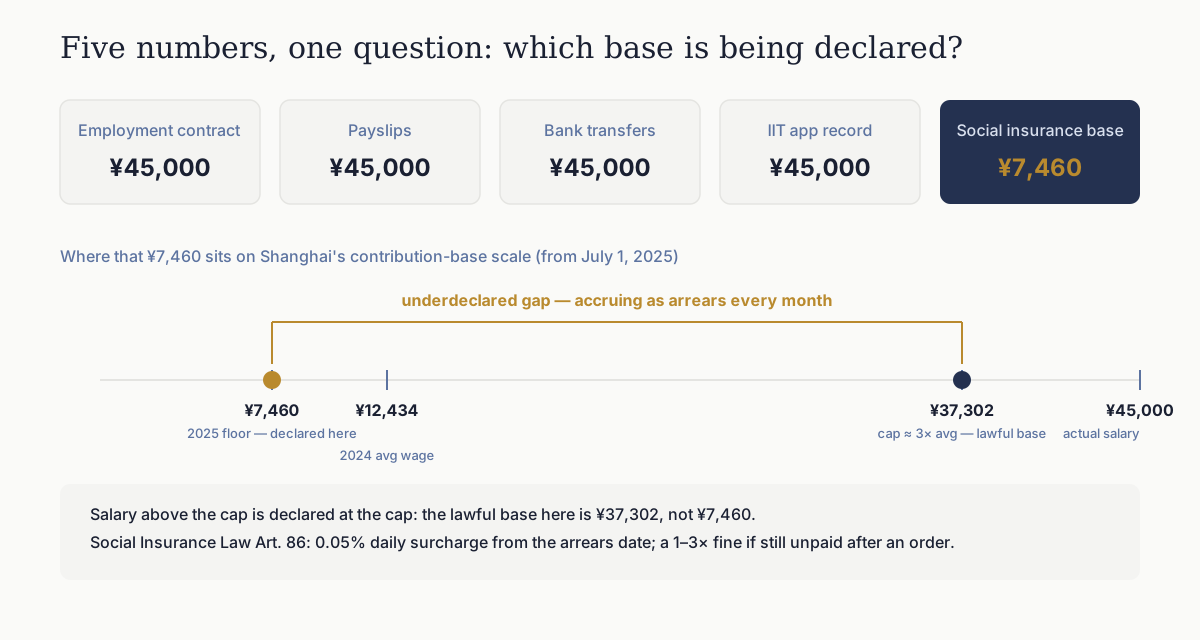
Social insurance records need two checks. Was a payment made for each month? On what base?
Article 60 of the Social Insurance Law requires employers to declare and pay fully and on time. Article 63 allows the collection authority to order payment or supplementation. Article 86 imposes a daily late-payment surcharge of 0.05% from the date of arrears and, if the employer still fails to pay after an order, a fine of one to three times the unpaid amount. Opening an account for a foreign employee is therefore not the end of the analysis; paying for years on the local minimum base can still create arrears.
Shanghai’s 2025 numbers make the point concrete. From July 1, 2025, the monthly social insurance contribution base is capped at RMB 37,302 and floored at RMB 7,460, calculated from the 2024 citywide average monthly wage of RMB 12,434 for urban employees (see the Shanghai 2025 contribution-base noticersj.sh.gov.cn本市调整2025年度社保缴费基数上下限_公示公告_上海市人力资源和社会保障局rsj.sh.gov.cn). Shanghai also continued a 1% total unemployment insurance rate in 2025, split 0.5% employer and 0.5% employee, and restored national baseline work-injury rates of 0.2%, 0.4%, 0.7%, 0.9%, 1.1%, 1.3%, 1.6% and 1.9% across eight industry categories (see the Shanghai HRSS Q&Arsj.sh.gov.cn关于2025年本市阶段性降低社会保险费率的政策问答_政策解读_上海市人力资源和社会保障局rsj.sh.gov.cn).
If a foreign employee earns RMB 45,000 per month but the social insurance record sits at RMB 7,460 month after month, the issue is not simply whether the employer “bought social insurance.” The pension individual account, medical treatment mechanics, unemployment record and some work-injury calculations may all be affected by the declared base. The declared contribution base frequently proves a more reliable indicator than the terms stated in the employment contract.
In practice, compare five documents: the employment contract, payslips, bank transfers, individual income tax app records and the social insurance contribution base. The five figures do not need to match every month. If they are wildly apart for a long time, ask why.
IV. The lawful non-payment route is a treaty route
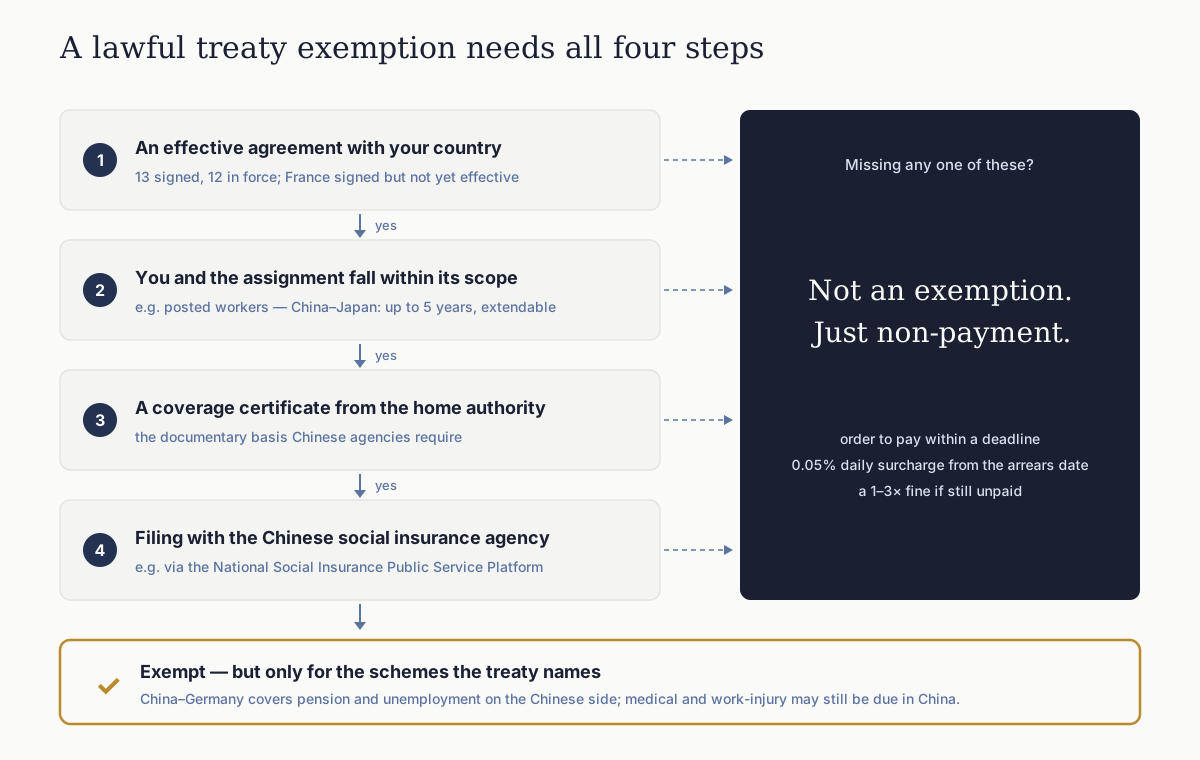
Some foreigners can avoid specific Chinese social insurance premiums, but the exemption comes from a treaty, a certificate and a filing, not from HR saying “foreigners here do not pay.”
Article 9 of the Interim Measures says that where China has a bilateral or multilateral social insurance agreement with the foreigner’s country of nationality, participation follows the agreement. Shanghai’s International Services portal, updated on May 26, 2026 and sourced to MOHRSS, lists 13 countriesenglish.shanghai.gov.cnChina's social insurance policy for expats_InsuranceUnder Chinese law, foreign nationals employed by employers registered or established in China, or those assigned to work at their foreign employersenglish.shanghai.gov.cn with signed bilateral social security agreements: Japan, Luxembourg, Spain, the Netherlands, Switzerland, South Korea, Germany, Finland, Canada, Kyrgyzstan, France, Denmark and Serbia. Twelve are in force. France is signed but not yet effective.
These agreements usually exempt only named schemes, not all five schemes. The China-Germany agreement covers statutory pension insurance and unemployment insurance on the Chinese side (see the MFA treaty texttreaty.mfa.gov.cntreaty.mfa.gov.cn). Under the China-Japan agreement, posted workers may receive an initial exemption of up to five years, with possible extension if competent institutions agree; applications can be made through the National Social Insurance Public Service Platform (see the MOHRSS explanation reposted by Liaoning HRSSrst.ln.gov.cn人力资源社会保障部国际合作司和社保中心负责人就中日社保协定生效答记者问rst.ln.gov.cn). Medical and work-injury insurance may still be due in China depending on the treaty and local handling.
At a minimum, a lawful exemption needs four things: an effective agreement with the employee’s nationality country, a covered person and assignment status, a coverage certificate from the home-country authority, and filing with the Chinese social insurance agency. A Suzhou government Q&Awww.suzhou.gov.cn社保民政 - 苏州市人民政府www.suzhou.gov.cn on the China-Japan agreement also treats the coverage certificate as the documentary basis for exemption. No certificate, no filing, no treaty coverage. That is not exemption. It is non-payment.
V. Departure means account handling, not a full refund
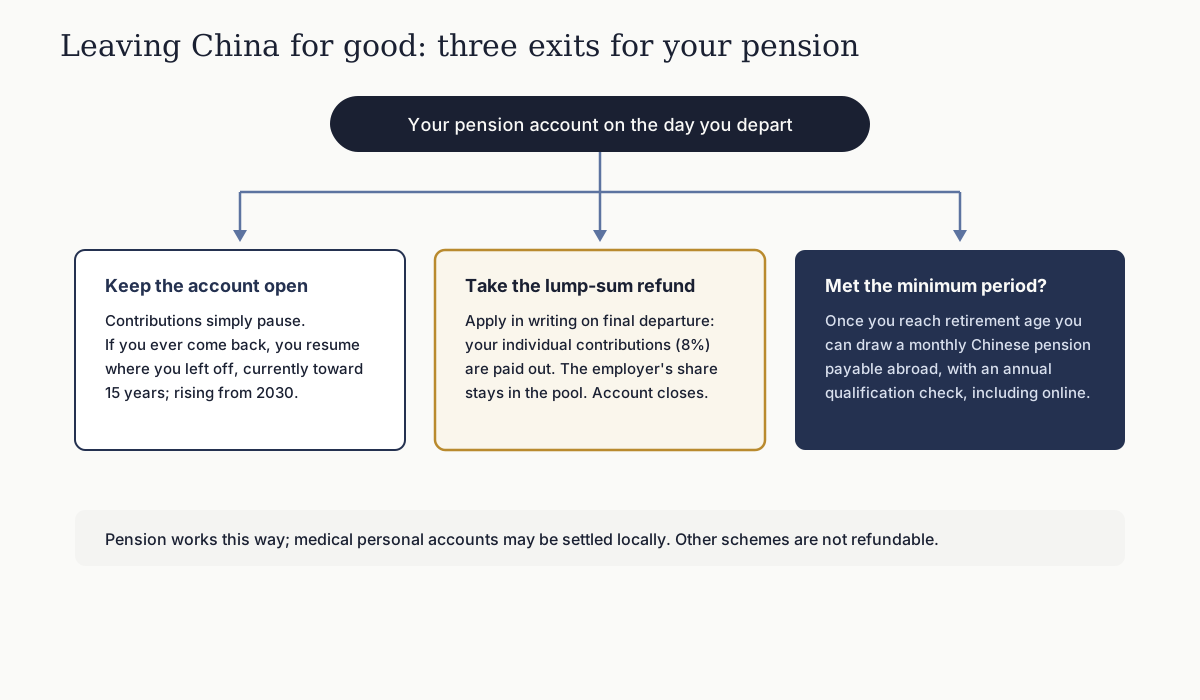
“Can I get my social insurance back when I leave China?” is too broad. The better question is which account, which portion and which procedure.
Pension insurance starts with the split between the individual account and the pooled fund. Article 5 of the Interim Measures says that if a foreigner leaves China before reaching the prescribed pension age, the individual account may be retained, and contribution years will accumulate if the person returns to China for employment. If the foreigner applies in writing to terminate the social insurance relationship, the individual-account balance may be paid out in a lump sum. If the foreigner dies, the individual-account balance can be inherited according to law. The employer’s pooled contribution is outside that payout.
If the foreign employee has already qualified for monthly benefits and lives outside China, Article 7 requires annual benefit-eligibility verification. The current wording permits internet self-service verification. A Chinese pension does not disappear merely because the retiree lives abroad.
The minimum contribution period also needs dates. China’s delayed-retirement decision, effective January 1, 2025, did not immediately change the threshold from 15 years to 20 years. It provides that from January 1, 2030, the minimum contribution period for monthly basic pension benefits will gradually rise from 15 years to 20 years, increasing by six months each year (see the decision textwww.spp.gov.cn全国人民代表大会常务委员会关于实施渐进式延迟法定退休年龄的决定_中华人民共和国最高人民检察院,2024-09-13www.spp.gov.cn). A foreign employee who may return to China should think carefully before closing the pension account.

Medical personal accounts are separate. Shanghai’s English FAQenglish.shanghai.gov.cnHow can I withdraw social security contributions?_FAQsenglish.shanghai.gov.cn treats settlement of the medical personal account after termination of the social insurance relationship as a separate matter, and Shanghai’s 2025 personal medical account measures provide for clearing account funds when an account is transferred or cancelled. That is not a refund of all medical premiums. It is settlement of the personal-account balance.
Work-injury, unemployment and maternity insurance usually do not have a departure-refund mechanism. Work-injury insurance covers work accidents and occupational disease during employment. Unemployment insurance covers statutory unemployment periods. Maternity insurance covers maternity medical expenses and allowances. If the insured risk never happens, the premium is not returned; that may seem counterintuitive, but it reflects the fundamental nature of insurance.
VI. A voluntary waiver gets turned back into arrears
The waiver issue belongs here because the system is now visible. What the employee is “waiving” is not a vague benefit but medical coverage, work-injury protection, pension individual-account value, unemployment records, maternity benefits and the correct contribution base.
Article 19 of the Supreme People’s Court’s labor-dispute interpretation IIwww.court.gov.cn权威发布 - 中华人民共和国最高人民法院最高人民法院政务网站,最高人民法院网,最高人民法院,最高人民法院网是人民群众了解和联系最高人民法院的重要窗口,承载着司法公开、法治宣传、服务群众、接受监督等重要使命。是最高人民法院的政务网站,是最高人民法院在互联网上唯一的正式身份。www.court.gov.cn, effective September 1, 2025, is direct. An agreement between employer and employee, or a promise by the employee, that social insurance premiums do not need to be paid is invalid . If the employer failed to pay social insurance lawfully and the employee terminates under Article 38 of the Labor Contract Law and claims severance, the court should support the claim. If the employer lawfully makes the back-payment and then asks the employee to return the social insurance compensation already paid, the court should also support that claim.

Taken together, the legal position is clear and strict. The employer cannot use the employee’s signature as a shield. The employee also should not assume they can keep every monthly “social insurance allowance” and still force the employer to back-pay years of contributions. That sum was not a gratuitous benefit; it was a statutory obligation presented as a payroll allowance.
In practice, the most dangerous waiver documents are not the ones drafted in aggressive terms, but those phrased courteously, typed on A4 paper, stamped with a blue HR seal and accompanied by the English offer letter. They read as though the company is helping the employee save money; in reality, both parties are assuming significant legal exposure.
VII. If the employer did not pay, split the routes
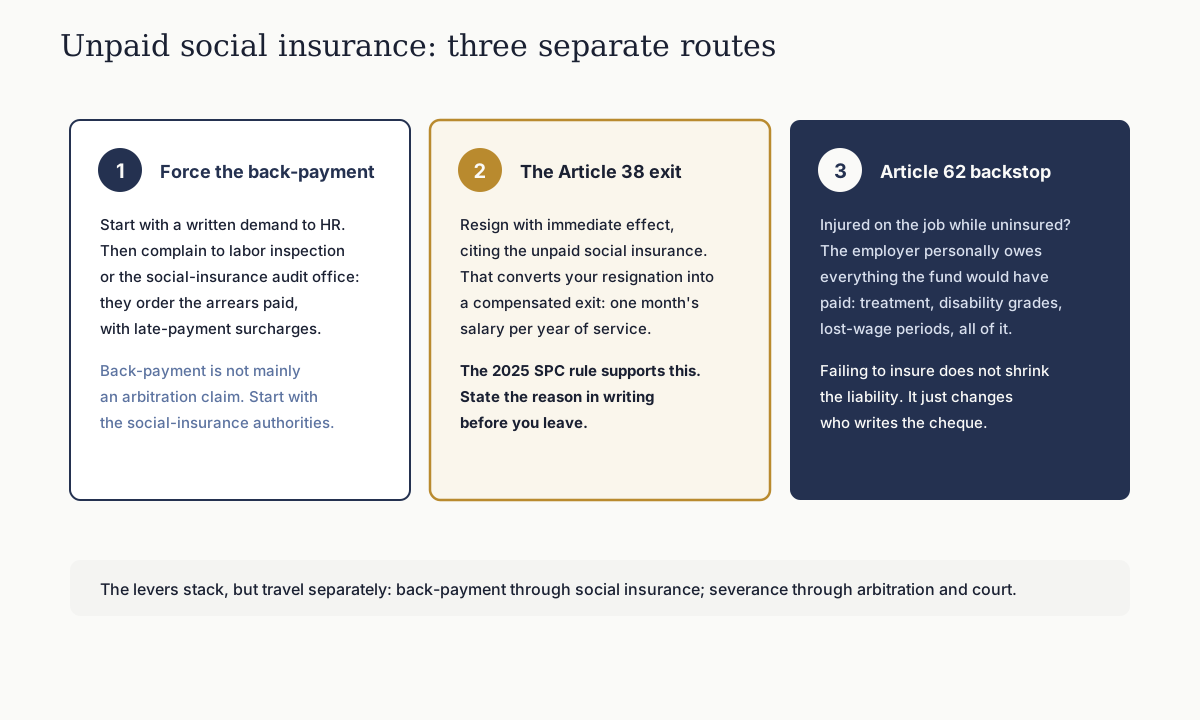
Once non-payment, underpayment or a depressed contribution base is discovered, do not rush to throw every request into one labor arbitration filing. Back-payment follows an administrative enforcement path. Severance follows the labor arbitration path. Work-injury benefits are governed by a separate regime.
First, back-payment. Social insurance back-payment is not ordinary wage debt. Articles 63 and 86 of the Social Insurance Law use an administrative collection model : order payment or supplementation, add a daily surcharge of 0.05% from the arrears date, and if the employer still does not pay, fine it one to three times the unpaid amount. In Shanghai, enterprise employee social insurance premiums have been collected by the tax authority since November 1, 2020 (see the Shanghai Tax topic pageshanghai.chinatax.gov.cn国家税务总局上海市税务局shanghai.chinatax.gov.cn). Shanghai HRSS also said in a March 2025 public replyrsj.sh.gov.cn补缴养老等社会保险事项可以申请劳动仲裁吗?依据是什么?_上海市人力资源和社会保障局rsj.sh.gov.cn that local arbitration commissions have not accepted social insurance contribution disputes since July 2014; parties should complain to labor security supervision or ask the social insurance agency to handle the matter. Local windows differ, but for back-payment, start with the social insurance administration and collection side.
Second, termination and severance. If the employer failed to pay social insurance lawfully, the employee may terminate under Article 38 of the Labor Contract Lawwww.gjxfj.gov.cn中华人民共和国劳动合同法-(2007年6月29日第十届全国人民代表大会常务委员会第二十八次会议通过2007年6月29日中华人民共和国主席令第六十五号公布)目录第一章总则第二章劳动合同的订立第三章劳动合同的履行和变更第四章劳动合同的解除和终止第五章特别规定 第一节集体合同 第二节劳务派遣 第三节非全日制用工第六章监督检查第七章法律责任第八章附则…www.gjxfj.gov.cn. Article 46 then brings in severance, and Article 47 calculates it as one month’s salary for each full year of service, six months or more counted as one year, and less than six months paid as half a month. The 2025 SPC interpretation closes the “but the employee signed a waiver” escape route. Put the unpaid-social-insurance reason in the termination notice at the time, because a reason supplied after the fact invites scrutiny.
Third, work injury. Article 62 of the Work-Injury Insurance Regulation中华人民共和国司法部工伤保险条例司法部发布的《工伤保险条例》官方文本。www.moj.gov.cn says that if an employer should have participated in work-injury insurance but did not, the labor security authority orders participation and back-payment; if a work injury occurs during the uninsured period, the employer pays the statutory work-injury benefits according to the regulation’s items and standards. A commercial accident policy may help the employer pay the bill, but it does not replace work-injury insurance and it does not rewrite the statutory duty.
Conclusion: Periodically review your contribution record — focus on two key metrics
Social insurance for foreigners in China is not a small payroll deduction issue. It connects medical reimbursement, work-injury protection, pension individual accounts, departure settlement, treaty exemptions and severance when employment ends. Treating it as a cash allowance eventually turns into legal and financial losses for both parties.
Check the contribution record once a year. First, whether every month was paid. Second, whether the contribution base is close to real salary or stuck at the local floor. Before resigning, changing cities, leaving China or signing any waiver, put treaty exemption, individual accounts, back-payment routes and Article 38 termination on the same sheet of paper.
Social insurance follows an internal logic, and routine verification is not especially difficult. What the system truly punishes is sustained neglect and wishful thinking.
References
- Standing Committee of the National People’s Congress, PRC Social Insurance Law (2018 revision), including Articles 4, 12, 58, 60, 63, 86, and 97: https://fgk.chinatax.gov.cn/zcfgk/c100009/c5192937/content.htmlfgk.chinatax.gov.cn国家税务总局政策法规库fgk.chinatax.gov.cn
- Ministry of Human Resources and Social Security, Interim Measures for the Participation in Social Insurance of Foreigners Employed in China (Order No. 16, effective October 15, 2011), including Articles 3-5, 7, and 9: https://www.gov.cn/zhengce/2022-08/31/content_5711299.htmwww.gov.cn在中国境内就业的外国人参加社会保险暂行办法_人力资源和社会保障部_中国政府网(2011年9月6日人力资源社会保障部令第16号公布 自2011年10月15日起施行)www.gov.cn
- Ministry of Human Resources and Social Security, Decision on Revising the Interim Measures for the Participation in Social Insurance of Foreigners Employed in China (Order No. 54, December 23, 2024): https://www.gov.cn/gongbao/2025/issue_11806/202501/content_6999379.htmlwww.gov.cn中华人民共和国人力资源和社会保障部令(第54号) 人力资源社会保障部关于修改《在中国境内就业的外国人参加社会保险暂行办法》的决定__2025年第2号国务院公报_中国政府网为了履行我国加入《取消外国公文书认证要求的公约》义务,并结合外国人参加社会保险相关证件名称和编码规则的变化,现决定对《在中国境内就业的外国人参加社会保险暂行办法》(人力资源社会保障部令第16号)有关条款进行修改。www.gov.cn
- Supreme People’s Court, Interpretation (II) on the Application of Law in the Trial of Labor Dispute Cases, including Article 19: https://www.court.gov.cn/fabu/xiangqing/472691.htmlwww.court.gov.cn权威发布 - 中华人民共和国最高人民法院最高人民法院政务网站,最高人民法院网,最高人民法院,最高人民法院网是人民群众了解和联系最高人民法院的重要窗口,承载着司法公开、法治宣传、服务群众、接受监督等重要使命。是最高人民法院的政务网站,是最高人民法院在互联网上唯一的正式身份。www.court.gov.cn
- State Council, Work-Injury Insurance Regulation, including Article 62: https://www.moj.gov.cn/pub/sfbgw/flfggz/flfggzxzfg/200305/t20030507_350409.html中华人民共和国司法部工伤保险条例司法部发布的《工伤保险条例》官方文本。www.moj.gov.cn
- Shanghai International Services Portal (sourced to MOHRSS), list of bilateral social security agreements signed by China: https://english.shanghai.gov.cn/en-Insurance/20240816/7033860ec212442dac2c4f44a09d6b98.htmlenglish.shanghai.gov.cnChina's social insurance policy for expats_InsuranceUnder Chinese law, foreign nationals employed by employers registered or established in China, or those assigned to work at their foreign employersenglish.shanghai.gov.cn

This article is part of the series “Employment Disputes for Foreigners in China - Know Your Rights.” Previous: That Employment Contract Is Full of Traps - What Every Foreigner Should Check Before Signing.
Frequently Asked Questions
Do foreigners working in China have to participate in social insurance?
Generally, yes. A foreigner lawfully employed in China with a Foreigner's Work Permit, foreign resident journalist credential or other qualifying employment/residence document falls within the Interim Measures for foreigners. Article 3 requires participation in employee pension, medical, work-injury, unemployment and maternity insurance. The main exception is a treaty-based exemption for specific schemes.
Can a foreign employee recover all social insurance contributions when leaving China?
No. The pension individual account may be preserved, or the employee may apply in writing to terminate the relationship and receive the individual-account balance. The employer's pooled contribution is not paid out. A medical personal-account balance is handled under local rules. Work-injury, unemployment and maternity insurance are not departure-refund schemes.
Is a voluntary social insurance waiver valid for a foreign employee?
No. Article 19 of the Supreme People's Court's labor-dispute interpretation II, effective September 1, 2025, says an agreement or promise not to pay social insurance is invalid. The employee may still terminate under Article 38 of the Labor Contract Law and claim severance if the employer failed to pay lawfully, while the employer may claim return of a social insurance allowance after lawful back-payment.