On this page

The sequence is familiar to almost every foreigner who has taken a job in China. A polished offer letter arrives from the regional headquarters — Singapore, perhaps, or Hong Kong — setting out the salary, the title, the relocation package. You accept. You relocate. And somewhere in the first week, HR slides a different document across the table: a Chinese-language employment contract with the local subsidiary, on the company’s standard template, with numbers that often do not quite match the offer. “It’s just a formality for the work permit,” they say. “Sign here.”
It is not a formality. That document is the one a labor arbitration commission will read if anything goes wrong over the next several years — and the standard template on which it sits is, in my experience, rarely neutral. Some provisions are unenforceable boilerplate that cause no real harm. Others will quietly cost you money. The difficulty lies in distinguishing the two — ideally before you sign, not three years later in a hearing room.
This article covers the six traps I encounter most frequently, and what the law actually says about each.
Trap 1: Your offer letter is not an employment contract
Begin with the structural issue, because everything else depends on it. Your employment relationship in China is with the Chinese entity that sponsors your work permit — not with the parent company that recruited you. PRC labor law governs that relationship mandatorily: a clause selecting New York law or Singapore law will not alter the substantive rules a Chinese arbitration commission applies.
Three practical consequences:
- Where the offer letter and the Chinese contract conflict, the Chinese contract controls — at least for any proceeding in China. Before signing, compare the two documents line by line — salary, bonus mechanics, notice period, severance — and insist that the Chinese contract reflects the true terms of the deal. A bilingual contract should state which language prevails; if it does not, expect the Chinese text to be treated as controlling in practice.
- The contracting entity determines recoverability. Severance, unpaid wages and arbitration awards are claims against the local subsidiary. If the subsidiary is thinly capitalised and the parent is in Delaware, an award obtained in Shanghai may be worth considerably less than the offer letter implied. Pursuing recovery against the parent in its home jurisdiction is sometimes possible — but that is a separate, significantly more expensive action.
- Foreign employees are subject to distinct rules. Certain protections that local employees take for granted do not apply identically to foreign nationals, and regional practice varies. The most prominent example is the open-ended employment contract : Shanghai courts have long held that a foreign employee is not automatically entitled to one after two consecutive fixed terms unless the contract expressly provides for it; Beijing’s approach is somewhat more generous. Do not assume; consult the text.
Trap 2: Probation is strictly tied to contract length
Probation is the area in which standard templates most routinely disregard the statute. The caps in Article 19 of the Labor Contract Law are mandatory and strictly tied to the contract term:
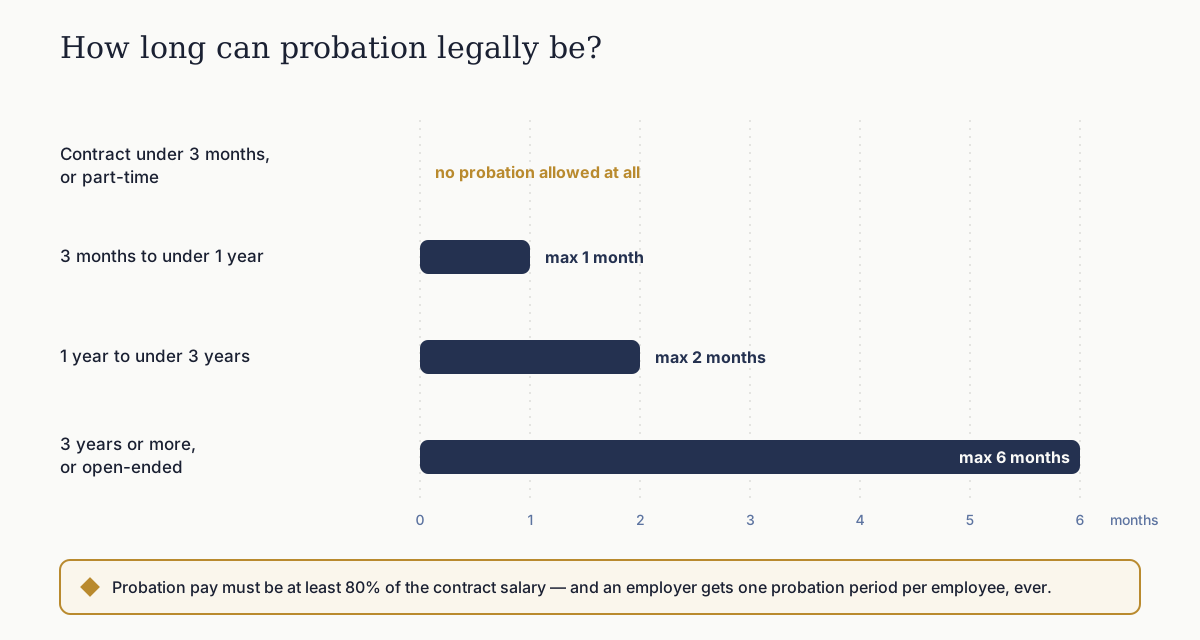
The archetypal trap for foreign employees is the two-year contract with a six-month probation — widespread because six months is treated as standard within many multinationals, and work-permit cycles lead employers to favour two-year terms. It exceeds the statutory maximum by four full months. The legal consequences are favourable to the employee: the excess period is treated as regular employment at full salary, and Article 83 provides an additional right to claim compensation for each month of unlawful probation already served.
Two ancillary rules are worth noting: probation pay may not fall below 80% of the contractual salary (nor below the local minimum wage), and an employer may impose only one probation period on the same employee — ever. A “new probation” attached to a promotion or a contract renewal is void, regardless of how reasonable HR may make it sound.
Trap 3: Only two types of employee penalty are enforceable
Contracts drafted in a multinational context display a strong preference for penalty clauses; PRC law voids most of them. Article 25 of the Labor Contract Law permits an employment contract to impose liquidated damages on an employee in exactly two situations:
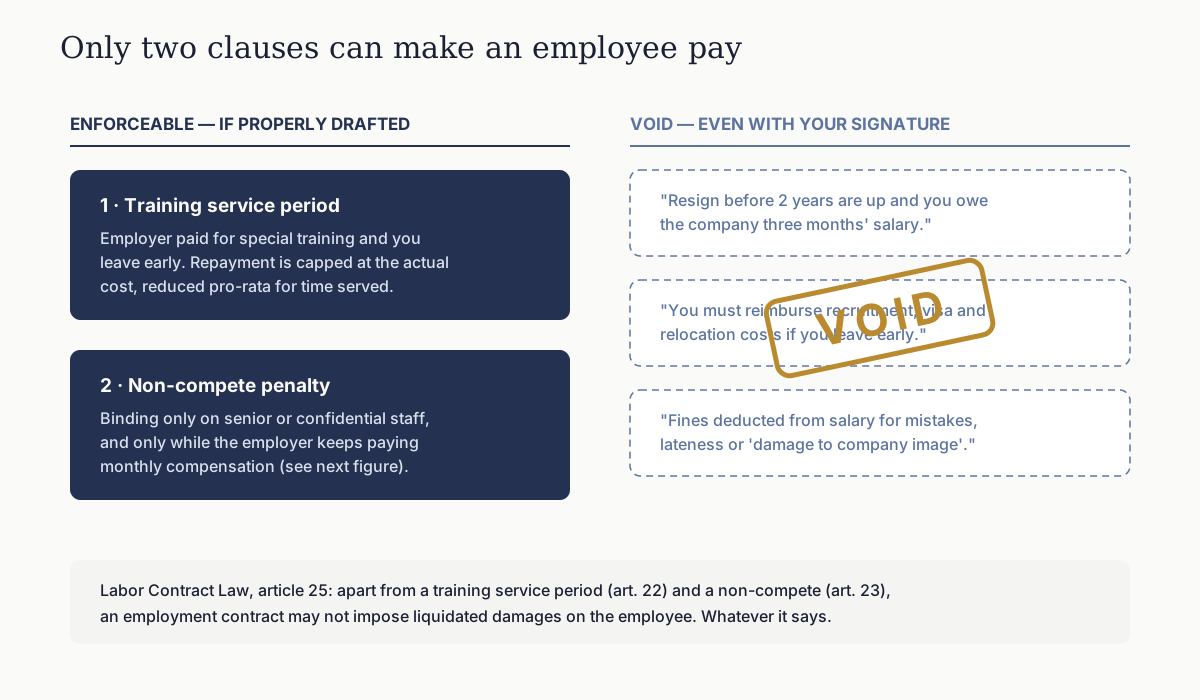
The three categories on the right merit separate attention because the clauses are drafted with enough formality that people comply with them voluntarily. I have handled cases in which a foreign employee surrendered a month’s salary upon resignation solely because the contract stated that departure within two years triggered repayment of “training costs” — where no training of any kind had been provided, no invoices existed, and no course records were available. A valid training service-period clause requires the employer to have funded specialised training at its own expense — a certification course abroad, not an onboarding programme — with repayment capped at the documented actual cost and reduced pro-rata for the period of service already rendered.
The symmetry operates in both directions, however: the invalidity of the employer’s penalty clause does not relieve you of procedural obligations. Resignation still requires 30 days’ written notice (3 days during probation). Submit it in writing, retain proof of delivery, and the void clauses have nothing to which they can attach.
Trap 4: Non-compete obligations survive your resignation
Non-compete annexes are now near-universal in the contracts offered to foreign hires, irrespective of seniority. The statute is considerably narrower than the standard-form language suggests — as a matter of law the obligation may only bind senior management, senior technical personnel and others with genuine confidentiality obligations — but it would be a mistake to treat a signed covenant as merely decorative. What matters is how the mechanism operates in practice, and particularly at the point of departure:
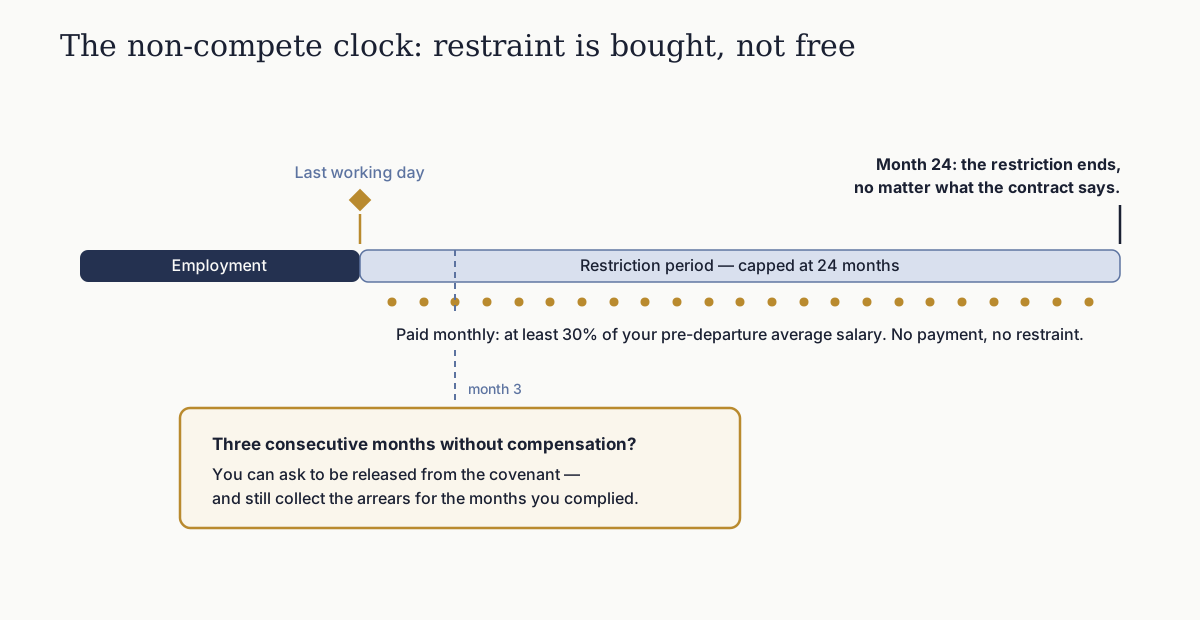
Three figures to retain: 24 / 30 / 3. The restriction period may not exceed 24 months. Where the clause is silent on the amount of compensation, courts read in a monthly payment of 30% of your average monthly salary over the twelve months preceding departure (not below the local minimum wage), covering the months of actual compliance. And if the employer fails, through its own fault, to pay for 3 consecutive months, you may petition to be released from the restriction — while still recovering the arrears.
The practical approach at signing: do not expend negotiating capital on removing the annex (that negotiation you are unlikely to win). Invest it instead in narrowing the scope. A defined list of named competitors is immeasurably better than “any business competing anywhere in the world.” And at the point of departure, secure the company’s position in writing — if it wishes to enforce the restraint, it must pay monthly; if it does not, request a written waiver so that you are free to accept the next role.
Trap 5: Splitting your salary weakens every claim you will ever bring
The salary clause rarely understates the headline number; what it does is restructure it. A package of RMB 60,000 per month is recharacterised as “base salary 25,000 + housing allowance + discretionary bonus.” In its more problematic form, the arrangement is split across two documents: a Chinese contract recording the onshore component, and a separate side agreement with the parent company covering the remainder, typically presented as “tax-efficient structuring.”
Why this matters: arbitration claims are calculated by reference to what the Chinese employer demonstrably paid — the base figure for severance, for overtime, for sick pay. Money that arrived offshore from an affiliate entity is, in the best case, an evidentiary contest and, in the worst, entirely invisible to the tribunal. A bonus described in the contract as “discretionary” is genuinely difficult to pursue when the employer determines, in your final year of employment, that its discretion yields zero.
Trap 6: Waiving social insurance is legally impossible
Standard-form contracts occasionally contain a waiver: the employee “voluntarily declines” social insurance contributions in return for a cash supplement to salary. These waivers are void. Foreign nationals working in China have been covered by the mandatory social insurance regime since 2011 , and the once well-known Shanghai exemption practice was formally closed in August 2021. Where a bilateral social security totalisation agreement exists between China and your country of nationality (Germany, Japan, South Korea and approximately a dozen others), specific schemes may be lawfully exempted — but the basis for the exemption is a certificate of coverage, not a contractual clause. The reason any of this matters: maternity benefits, medical reimbursements, work-injury compensation and, for some, a lump-sum refund of the personal pension account upon final departure from China all depend on contribution records that a void waiver will not have generated. And a void waiver is invariably discovered at the precise moment one of those benefits is needed.
Before you sign: a five-minute checklist
- Identify the employer entity named in the contract and confirm it is the entity sponsoring your work permit.
- Reconcile every figure — salary, bonus mechanics, allowances, notice period, severance — against the offer letter. Discrepancies are negotiations to have now, not after relocation.
- Verify the probation period against Figure 1 and the probation salary against the 80% floor.
- Locate every clause that requires you to pay money and test each against the framework in Figure 2. Anything that is not a genuine training service period or a non-compete is void; knowing that fundamentally changes how you respond to demands made at the point of departure.
- Review the non-compete annex as if you were resigning two years from today: scope, territory, named competitors, compensation formula. Narrow everything you can.
- Refuse dual-contract structures where possible; where refusal is not an option, document everything from the first day of employment.
None of the above requires engaging a lawyer at the point of signing — an afternoon and this checklist will identify most risks. The truly expensive problems are those discovered only at termination, by which time the template contract you signed in your first week has had years to harden. The articles that follow in this series address what happens then.
References
- Ministry of Human Resources and Social Security, PRC Labor Contract Law (2012 amendment), including Articles 14, 19-20, 22-25, and 83: https://www.mohrss.gov.cn/xxgk2020/fdzdgknr/zcfg/fl/202011/t20201102_394622.htmlwww.mohrss.gov.cnwww.mohrss.gov.cn
- Supreme People’s Court, Judicial Interpretation on the Application of Law in the Trial of Labor Dispute Cases (I) (2021), including Articles 36-40: https://www.court.gov.cn/fabu/xiangqing/282121.htmlwww.court.gov.cn权威发布 - 中华人民共和国最高人民法院最高人民法院政务网站,最高人民法院网,最高人民法院,最高人民法院网是人民群众了解和联系最高人民法院的重要窗口,承载着司法公开、法治宣传、服务群众、接受监督等重要使命。是最高人民法院的政务网站,是最高人民法院在互联网上唯一的正式身份。www.court.gov.cn
- Supreme People’s Court, Judicial Interpretation on the Application of Law in the Trial of Labor Dispute Cases (II) (2025), including Articles 13-15 and 19: https://www.court.gov.cn/fabu/xiangqing/472691.htmlwww.court.gov.cn权威发布 - 中华人民共和国最高人民法院最高人民法院政务网站,最高人民法院网,最高人民法院,最高人民法院网是人民群众了解和联系最高人民法院的重要窗口,承载着司法公开、法治宣传、服务群众、接受监督等重要使命。是最高人民法院的政务网站,是最高人民法院在互联网上唯一的正式身份。www.court.gov.cn
- Ministry of Human Resources and Social Security, Interim Measures for the Participation in Social Insurance of Foreigners Employed in China (Order No. 16, 2011): https://www.mohrss.gov.cn/SYrlzyhshbzb/shehuibaozhang/zcwj/SHBZzonghe/201109/t20110921_86912.htmlwww.mohrss.gov.cnwww.mohrss.gov.cn

This article is part of the series “Employment Disputes for Foreigners in China — Know Your Rights.” Previous: Your Company Hasn’t Paid You in Months — Can Foreigners File Labor Arbitration in China?. Next: Social Insurance for Foreigners in China: the “Opt-Out” That Isn’t.
Frequently Asked Questions
My offer letter is from the overseas headquarters, but I signed a Chinese contract with the local subsidiary. Which one governs?
For everything that happens in China — termination, severance, arbitration — the contract with the Chinese entity governs, and PRC labor law applies mandatorily regardless of any choice-of-law clause. The offer letter is not worthless: it can support claims against the parent in its own jurisdiction. But the document a Chinese labor arbitration commission will read is the Chinese contract, so make sure its numbers match what you were actually promised.
My contract is for two years with a six-month probation. Is that legal?
No. For a contract of one year or more but under three years, probation is capped at two months. The excess four months count as regular employment: you are entitled to full salary for that period, and under Article 83 of the Labor Contract Law you can claim additional compensation for each month of unlawful probation already served.
Can my employer fine me or make me pay for resigning early?
Generally no. Under Article 25 of the Labor Contract Law, an employment contract may impose liquidated damages on an employee in only two situations: breach of a training service period and breach of a non-compete obligation. Clauses requiring you to pay for resigning early, to reimburse recruitment or visa costs, or accepting 'fines' for mistakes are void. You do still owe 30 days' written notice (3 days during probation) when resigning.