Entity & account check
Verify the supplier's registered Chinese name, credit code, payee account, and court records before making contact.
I recover supplier refunds in two stages: pre-suit legal pressure first, and formal litigation or arbitration in China if the factory still refuses to pay.

You wired a deposit or full payment, delivery passed, and the factory stalled or demanded extra fees.
Repeated delays or post-deposit price hikes forced an exit, yet the supplier refuses to refund.
Goods missed agreed specs or certifications such as CE or UL, yet the seller insists on keeping payment.
The container arrived short, or the supplier pushes future-order credits instead of returning cash owed.
A stalled refund is not always a management decision.
Sometimes, the bottleneck sits with your sales contact.
Verify the supplier's registered Chinese name, credit code, payee account, and court records before making contact.
A China-licensed dispute lawyer opens talks with decision-makers, signaling that credible PRC dispute counsel is on the file.
Convert promises into a signed refund schedule or affiliate guarantee, while avoiding credit memos that waive claims.
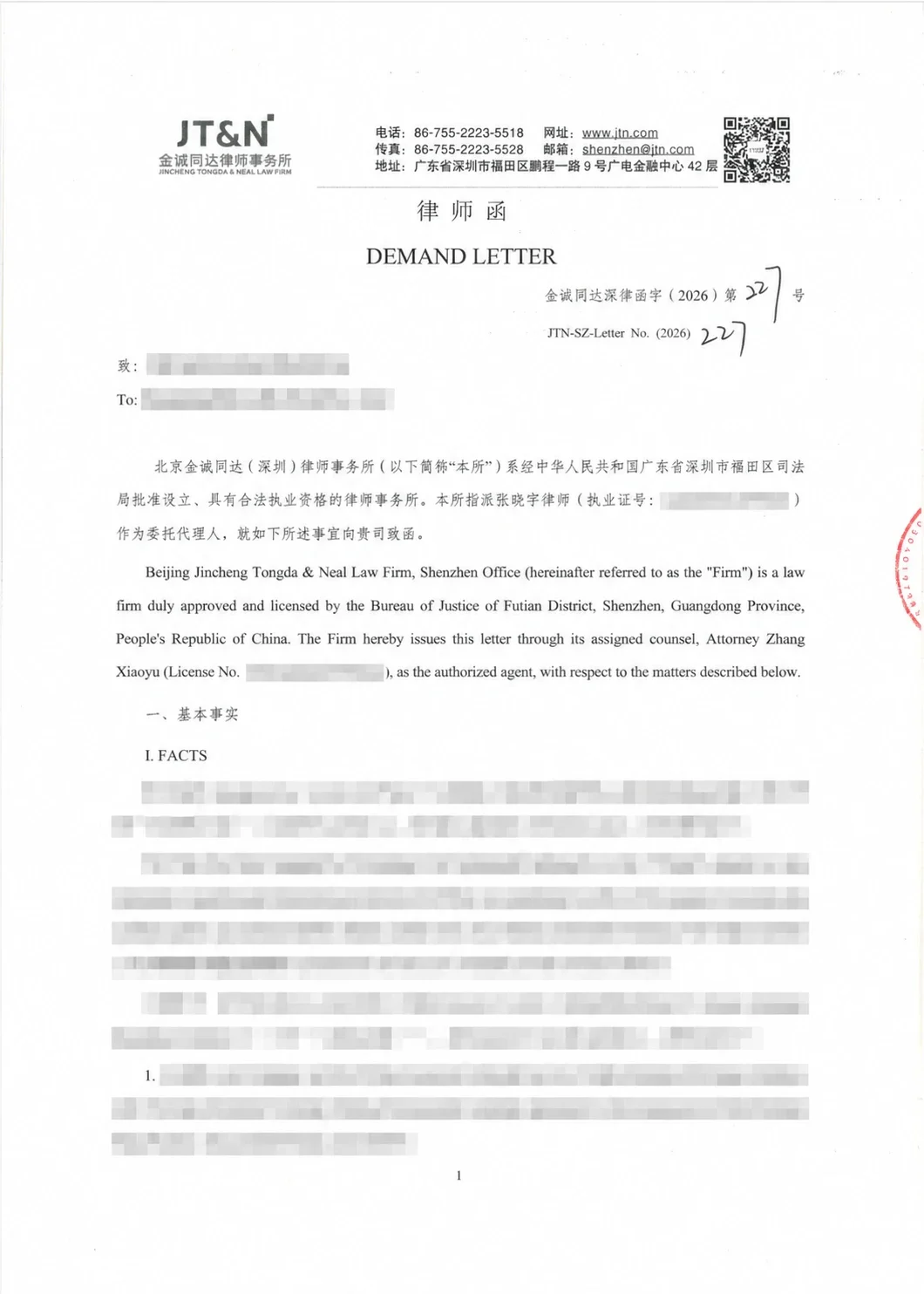
When negotiation fails or goes unanswered, serve a formal Chinese demand letter stating the breach and refund deadline.
Review the strategy and wording in English before the letter is sent.
Send by email and courier or EMS to build a clear notice record if the case escalates.
Map court versus arbitration jurisdiction, CISG or PRC governing law, and recoverable principal, damages, or fees.
Identify what already holds up in court and what must be translated, apostilled, or supplemented before filing.
Assess onshore assets, shareholder-liability angles, and litigation math so you sue only with a clear plan.
When the supplier still refuses to pay, nothing in Stage 1 goes to waste.
Your verified entity check, organized evidence, and legal opinion roll straight into Stage 2.
Where no arbitration clause blocks the court, we file in the competent mainland People's Court. Where your contract names CIETAC, SCIA, HKIAC, or SIAC, we initiate arbitration so the award is enforceable in China.
We prepare corporate authorization documents, Apostille or legalization checks, certified Chinese translations, and organized evidence packages so your filing clears PRC procedural review.
We represent you through evidence exchange, court hearings, judicial settlement talks, and any appeal under PRC procedure.
Once an effective judgment or award issues, we pursue enforcement within the statutory two-year window, including claims against one-person-company shareholders who mixed funds.
Many overseas buyers assume Chinese courts protect local factories or let cases drag on indefinitely. Across 134 finalized sale-of-goods judgments (2016 to 2025), non-delivery refund claims succeeded overwhelmingly when the paper trail was clean, though checking solvency before filing remains critical.
Normally we start with Stage 1, though urgent cases can go straight to Stage 2. Stage 1 resolves many disputes faster and without court fees through lawyer-led negotiation and a formal demand letter. However, if the supplier has already cut off contact, ignored prior legal notices, or faces an approaching limitation deadline, we recommend filing Stage 2 directly.
This service covers the full recovery path, not just a single letter. A standalone Demand Letter focuses on reviewing your file and serving a formal Chinese lawyer letter. Supplier Refunds starts with active lawyer negotiation, escalates to a demand letter if talks stall, delivers a pre-suit legal opinion if needed, and transitions straight into Stage 2 court or arbitration.
They are scoped and quoted separately, so you only pay for the stage you use. You commit first to Stage 1 based on claim size, document volume, and urgency; if negotiation or a demand letter settles the refund, you never pay Stage 2 fees. If formal filing becomes necessary, the Stage 1 legal opinion maps expected court fees, translation and authentication costs, and counsel fees before you decide.
An arbitration clause routes Stage 2 into arbitration instead of a Chinese court, while Stage 1 stays the same. Where a valid clause names CIETAC, SCIA, HKIAC, SIAC, or another institution, Chinese courts will decline jurisdiction. We still handle entity checks, negotiation, a demand letter, and a legal opinion in Stage 1, then file with the designated tribunal in Stage 2 so any award stays enforceable in China.
Stage 1 typically takes two to four weeks, while Stage 2 court cases average around six to twelve months. Pre-suit entity checks, outreach, and a demand letter depend mainly on how quickly the supplier responds. For Stage 2 litigation, our 2016–2025 dataset of 76 timed foreign-buyer cases showed a median of 231 days to a first-instance judgment (191 days for paid-never-shipped claims versus 371 days for quality disputes).

I am Kelly Zhang, a China-licensed lawyer at JT&N in Shenzhen. Before private practice, I spent seven years at CIETAC administering more than 400 commercial arbitration disputes. Every Stage 1 negotiation, demand letter, and legal opinion is built so it works both at the settlement table and in front of a Chinese judge if Stage 2 becomes necessary.
More about Kelly →Send your contract, wire receipts, and supplier details so we can review the dispute. We will advise candidly whether Stage 1 negotiation and a demand letter can recover the funds, or whether moving straight into Stage 2 filing is the better option.
Discuss Your Refund Claim