The factory is engineering your product. Who owns what it builds?
Unless a written contract says otherwise, Chinese law lets the factory that develops your product apply for the patents, keep the copyright in its drawings and code, and reuse the know-how. I help overseas buyers put ownership, file handover, NRE and exit terms into an enforceable bilingual development agreement before the first prototype is built.
China-licensed lawyer · Bilingual practice · Shenzhen
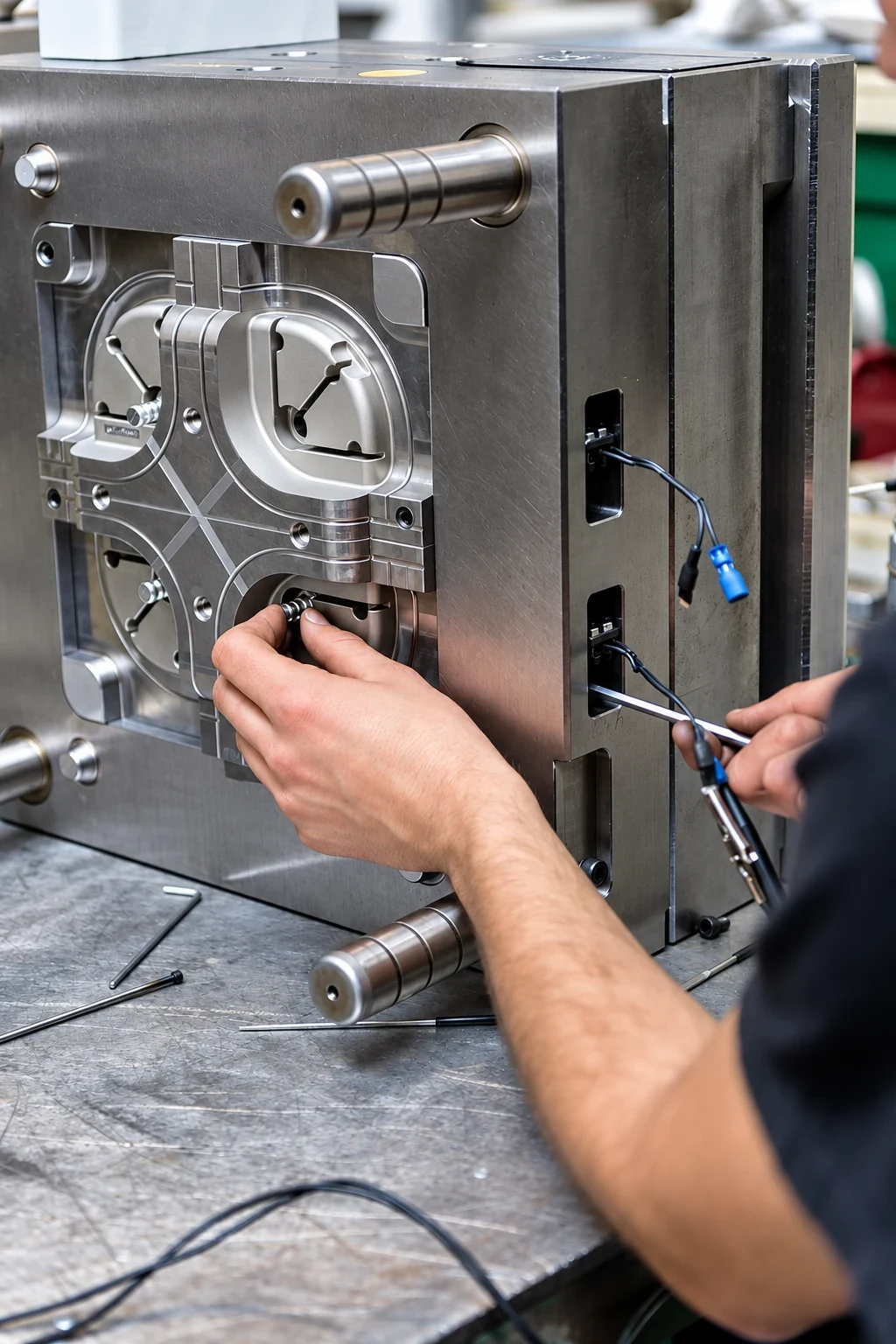
A toolmaker fitting a mold cut during product development.
How we settle ownership before engineering starts.
Buyer meeting 1: development briefing
We map what you bring (drawings, brand, patents, a working sample), what the factory will engineer, and whether it starts from its own platform. We also go through what has already been sent, promised or paid, including any “free” development offer.
Factory background check
We verify the supplier’s registered Chinese entity and court records, and whether the engineering is done in-house or subcontracted. We search its existing Chinese patents in your product category: a factory that already holds a utility model on the platform will claim your product sits on it.
Ownership & deliverables map
We list every output of the project — CAD, PCB and Gerber files, BOM, firmware source, test data, mold drawings — and decide who owns each and when it is handed over. The factory’s background technology is separated from the custom work you pay for.
Buyer meeting 2: milestones & money
We lock down the stage gates, the acceptance tests and what triggers each payment. If the factory waives NRE against production, we price that trade in writing: the volume commitment, the exclusivity window and the buy-out price for the files if you walk away.
Drafting & negotiation
I draft your bilingual development agreement under Chinese law, with a tooling annex where molds are cut during development. When the factory asks for joint ownership or open-ended exclusivity, I explain what each concession costs and where you can safely give ground.
Signing & handover discipline
I check the signed agreement, company seal and signing authority, then give your team a per-milestone handover checklist and a China patent-filing plan, so disclosure and first-to-file are sequenced correctly.
A standing development agreement that ends in a clean handover to production.
Negotiate ownership, deliverables and money once, before engineering starts. Then sign off each milestone with a one-page acceptance record that lists exactly which files and prototypes you received.
Without stage records, “the product is done” becomes an argument at the moment you owe the last payment and the factory holds every native file. A milestone trail settles what was delivered and what is still owed.
01
Product development agreement
The master contract: assignment of patents, copyright and technical secrets, the deliverables list, NRE and milestone payments, failure and exit rules, and your right to manufacture elsewhere.
02
Milestone acceptance & handover record
A repeatable sign-off for each stage — what was tested, what passed, which files and samples changed hands. It fixes the state of the project before the next payment goes out.
Five critical terms in a China product development agreement.
Turn “we can develop that for you” into obligations that survive the switch from prototype to production.
01
Ownership of the development output
Who owns what the factory creates?
The default runs against you: For commissioned development, Chinese law gives the right to apply for patents to the developer, and the copyright in commissioned drawings and code to the party that made them, unless the contract says otherwise. The agreement must assign patent application rights, copyright and technical secrets to you in terms a Chinese court will read.
Background vs. foreground: The factory’s pre-existing platform stays its own. Everything engineered for your project, including improvements the factory proposes, is yours. Where you build on its platform, you take a licence wide enough to manufacture elsewhere.
No factory filings: Bar the factory and its staff from filing patents, utility models or design patents on the product anywhere, with a duty to transfer any filing made and pre-agreed damages. China grants patents to whoever files first.
02
Deliverables & source files
What exactly must be handed over, and when?
Name the files: Native CAD, 2D drawings, PCB and Gerber files, BOM with approved vendors, firmware source with its build environment, test protocols and reports, mold drawings. “Design documents” is not a deliverable.
Deliver by stage: Files transfer at each milestone, not at the end. The law obliges a developer to hand over technical materials, but only the materials the contract defines.
Subcontracted engineering: Firmware, mold design and industrial design are often farmed out. The factory must be bound to obtain and pass on source files from every subcontractor it uses.
03
Milestones, acceptance & payment
When is development “done”, and what are you paying for?
Objective gates: Concept, engineering prototype, design-validation build, pre-production run: each with written pass/fail tests. Acceptance is a test result, not a video call.
Payment follows acceptance: NRE and tooling instalments are released against accepted milestones and received files, never against calendar dates or a notice that the sample is ready.
Free development, priced: If NRE is waived against production, write the exchange down: the order volume, the time limit, the unit-price premium, and what you pay for the files if the volume is never reached.
04
Failure, delay & exit
What if it doesn’t work, or you decide to stop?
Allocate the risk of failure: Chinese law leaves the risk of technical failure to the contract and, absent agreement, to “reasonable sharing”. Set who absorbs sunk NRE at each stage and when either side may end the project.
Delay remedies: Milestone deadlines with liquidated damages tied to real losses, and a right to terminate after a grace period, so a slipping project does not consume your launch window.
Exit with your files: Whatever the reason for ending, the factory hands over all work to date, prototypes and tooling. Replace the statutory lien over work results with a defined exit payment, so nothing is held hostage.
05
Transition to production
Are you locked into this factory once the product works?
No production obligation: Accepting the final prototype does not commit you to place orders. Production terms live in a separate manufacturing agreement, signed once the product is proven.
Freedom to manufacture elsewhere: You may build the product at any factory. If the factory needs exclusivity to justify waived NRE, cap it by volume and time, and make it conditional on price and delivery performance.
Carry-over terms: NNN obligations, tooling ownership and the handover record survive into the manufacturing agreement, so nothing negotiated during development is lost at the switch.
Free engineering is paid for elsewhere: in exclusivity, minimum volumes, unit price or ownership of the result. Send me the quotation, the chat history and whatever has been shared so far. We will find what can still be fixed before the first prototype is approved.
I already have an NNN with the factory. Do I still need a development agreement?+
Yes. An NNN controls what the factory may do with the information you disclose. It says nothing about who owns what the factory creates, what it must hand over, or what you owe if the project stops. Under Chinese law those questions default in the developer’s favour unless a written contract answers them.
Can a foreign buyer own IP that a Chinese factory develops?+
Yes, if the contract says so. The Civil Code and the Patent Law let the parties agree who holds the right to apply for patents on commissioned development, and the Copyright Law does the same for commissioned drawings and code. The assignment must reach the factory’s engineers and subcontractors, and should be paired with your own Chinese filings, because China grants patents to whoever files first.
The factory is developing the product for free. What is the catch?+
The factory expects to recover its cost through production, and without a contract it owns the result by default, so it sets the production terms. Write the exchange down: what NRE is waived, what volume or exclusivity you commit to, and what you pay for the files if you never reach it. A free development that ends with the factory holding every native file is the most expensive version.
The factory starts from its own platform (ODM). What can I own?+
Not the platform. Separate the factory’s background technology from the customisation you pay for. You own the custom layer, and you take either a licence to the base wide enough to manufacture elsewhere, or an exclusivity window during which the factory may not sell the customised product to anyone else.
What if development fails, or I want to stop halfway?+
Chinese law leaves the risk of technical failure to the contract, and lets a client stop commissioned work at any time against compensation. The agreement should fix what you pay at each exit point and what you receive regardless: all files to date, prototypes and any tooling. Without that, the factory may withhold the work until its claimed losses are paid.
Is the manufacturing agreement included?+
No. The development agreement ends at final acceptance and handover. Production pricing, quality standards, delivery and reorders belong in a manufacturing agreement, drafted once the product is proven. I plan the transition so tooling ownership and confidentiality carry across; the two documents are scoped and quoted separately.
Drafted by a lawyer who knows how ownership disputes end.
I am Kelly Zhang, a China-licensed attorney at JT&N in Shenzhen. Prior to private practice, I spent seven years at CIETAC administering over 400 complex commercial arbitration disputes.
That institutional experience informs every development agreement I draft: ownership must be assigned in words a Chinese tribunal will enforce, deliverables must be provable, and exit terms must leave you holding your own files.