On this page
I have taken some variation of this call more than a dozen times since 2018, and far more often since the tariff rounds of 2025. The fact pattern is remarkably consistent: A US buyer signed a purchase order for $480,000 of goods in January, FOB Ningbo, 30% deposit paid, and production is underway. In April, a new round of tariffs adds 25 percentage points to the duty rate for that HS code. By June, the goods have reached Long Beach and the customs broker’s invoice is six figures above budget.
The buyer’s first email to the supplier is usually measured: “Given the new tariffs, we need to discuss how we share this cost.” The supplier’s reply, with varying degrees of courtesy, says some version of: “The price is FOB. Import duties are your side.”
Who is right? In nine cases out of ten, the supplier is. But “legally right” marks the beginning of this conversation, not its conclusion. The overwhelming majority of these disputes are not resolved through legal argument at all — they are resolved through a renegotiation bounded and shaped by the legal framework. Both layers matter.
The default answer is written in three letters on your PO
When a new tariff emerges mid-order, the threshold question is not “what is fair” but “who is the importer of record.” Customs collects duty from whoever clears the goods, and the trade term you chose — a three-letter Incoterm printed on your purchase order — has already determined who that is.
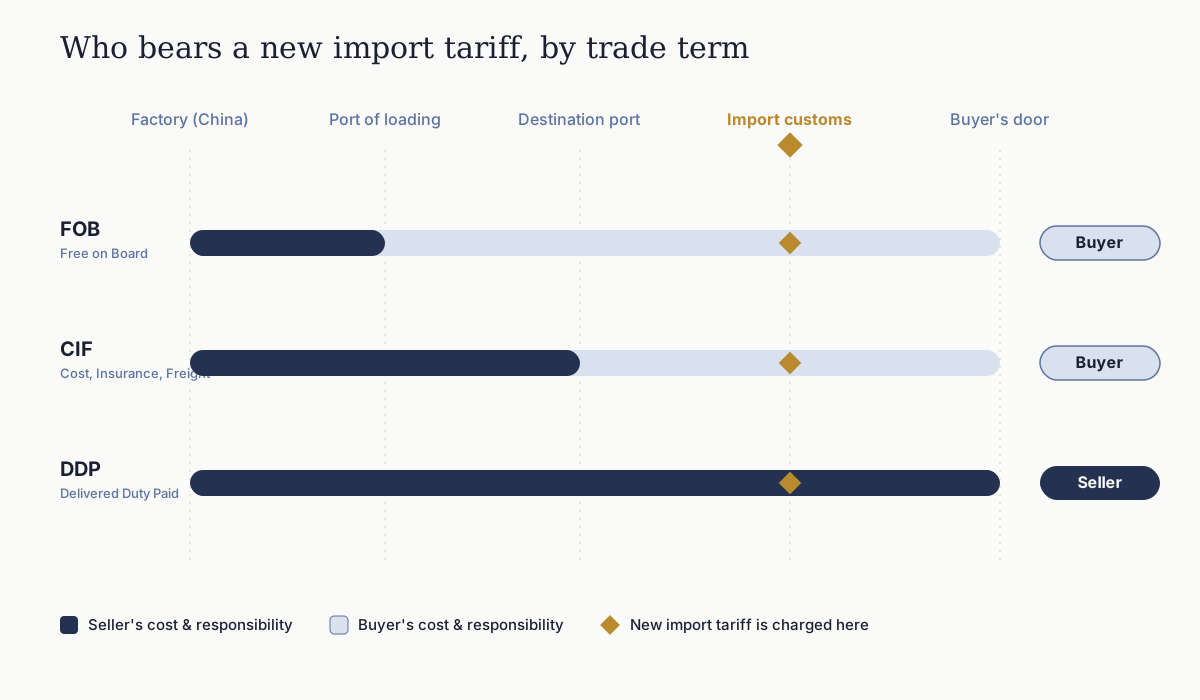
The overwhelming majority of China supply contracts I see use FOB or CIF. Under both, the buyer is the importer of record in the destination country, and any duty — however old, new, or suddenly 25 points higher — is the buyer’s cost by default. The seller priced the goods for delivery to a ship’s rail in China. What your own government charges at your own border is, in contractual terms, not the seller’s concern.
DDP reverses this entirely: the seller undertook to deliver “duty paid,” so the seller absorbs the increase. A buyer holding a DDP order should expect the roles to be reversed — it will be your supplier requesting relief, and everything that follows applies in mirror image.
A point many buyers struggle to accept: the fact that the tariff did not exist when the order was signed is legally irrelevant. A fixed price combined with a fixed trade term is a risk allocation. The contract’s silence on tariffs is not a gap waiting to be filled — it is the answer the parties already gave.
Force majeure and the limits of change of circumstances
The party on the losing side of the trade term — buyers under FOB/CIF, sellers under DDP — typically reaches next for force majeure . Under the PRC Civil Code, force majeure excuses performance that has become impossible due to an event that is unforeseeable, unavoidable and insurmountable. A tariff increase does not make performance impossible: the goods can still be produced, shipped and cleared — they simply cost more. Chinese courts maintained this line consistently through the 2018–2020 tariff rounds, and the arbitral tribunals before which I have appeared take the same view. Higher cost is commercial risk, not impossibility.
The doctrine that better fits the scenario is change of circumstances (情势变更, Civil Code Article 533): where, after contract formation, a fundamental condition underlying the contract undergoes a material change that was unforeseeable at the time of contracting and is not ordinary commercial risk, and continuing performance on the original terms would be manifestly unfair, the adversely affected party may petition a court or arbitral tribunal to adjust or terminate the contract — provided it has first attempted renegotiation with the counterparty .
It sounds as though it was drafted precisely for a 25-point tariff jump. In practice, the bar is considerably higher than it first appears:
- Foreseeability is assessed with increasing strictness. After nearly a decade of tariff volatility on the China–US trade lane, tribunals are increasingly inclined to find that a rational trader in this market should have priced the risk or contracted around it. What could arguably be called unforeseeable in 2018 is far harder to characterise that way today.
- The change must undermine the transaction’s commercial foundation, not merely erode its margin. Reported cases in which change-of-circumstances claims succeeded involved cost shifts that destroyed the economic basis of the contract. A hit the business can absorb — however painfully — ordinarily remains where the original contract placed it.
- Renegotiation is a statutory prerequisite. Article 533 expressly requires the parties to attempt renegotiation before either may approach a court or tribunal. A party that refuses to engage and then petitions for relief on grounds of unfairness makes an unfavourable impression on any adjudicator.
The honest legal assessment, therefore, is this: the trade term governs the default allocation; force majeure is almost never available; and change of circumstances is a narrow safety valve, not a general-purpose fairness clause.
What actually happens: five-minute triage, then a negotiation
When a case of this kind reaches me, the analysis follows a fixed sequence:
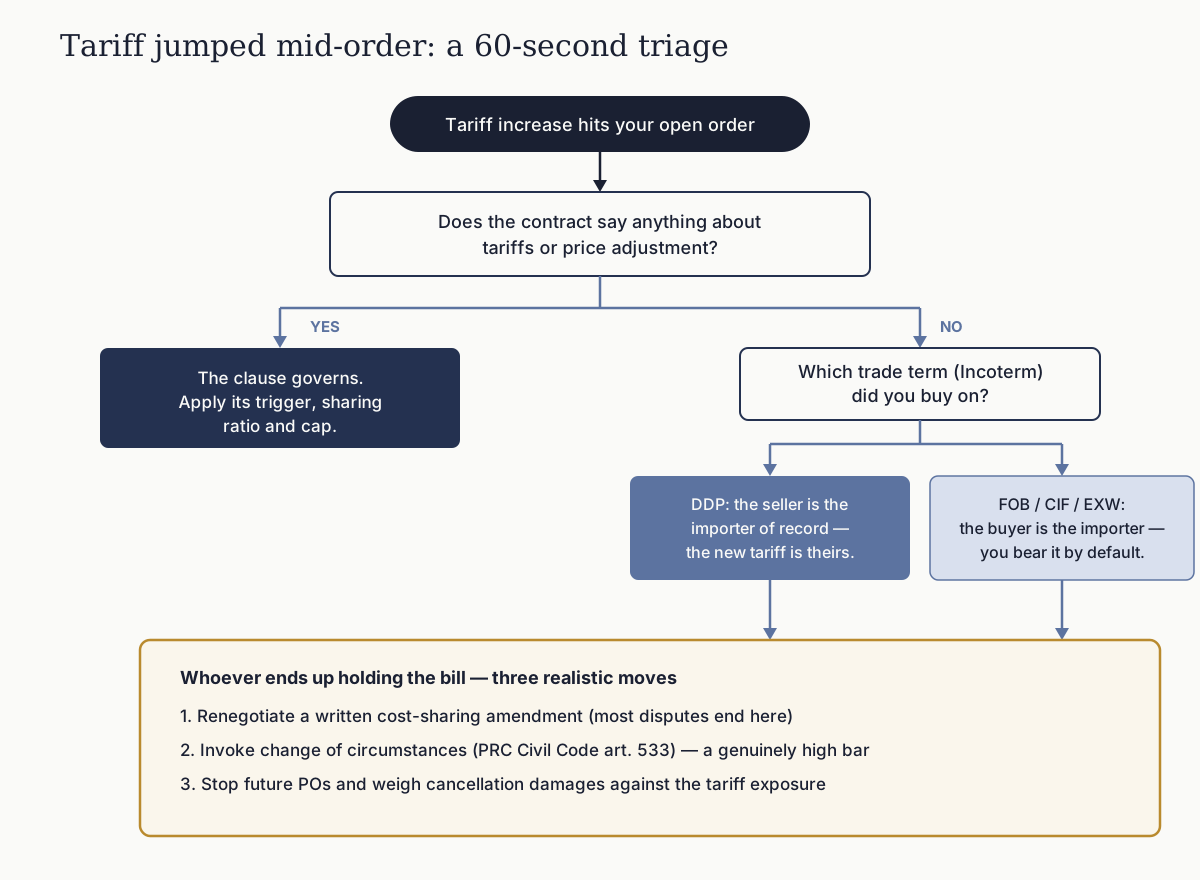
Why would a supplier agree to share a cost that is, as a matter of law, the buyer’s to bear? The answer is the same reason parties continue doing business with counterparties who are legally in the wrong in countless other supply chain disputes: the ongoing relationship is worth more than the individual transaction. In 2025, I saw sharing arrangements that ranged from the symbolic — the supplier takes 3% off the next purchase order — to the materially significant — a 50/50 split of any increase above an agreed threshold, applied retroactively to goods already in transit. What determined the outcome was rarely the quality of the legal argument. It was:
- The forward order book on the table. A buyer who can credibly commit two or three quarters of future purchasing has leverage that a one-off buyer simply does not possess.
- The timing of the approach. Asking for relief while the supplier still holds your goods or tooling is a weak position. Asking while holding the deposit for the next order is a strong one.
- Whether the buyer comes with a concrete, operable proposal. “Let’s share the pain” produces no movement. “We propose: any increase exceeding 10 percentage points is split 50/50, capped at 8% of order value, applicable to all outstanding POs” — that elicits a counteroffer.
One lesson worth carrying forward from the contract-clause article: whatever arrangement is reached, it must be recorded in a written amendment — executed with the same formality as the original contract and bearing the company seal . A WeChat message along the lines of “ok, we will help you with the tariff” carries precisely the evidentiary weight in a subsequent arbitration that you suspect it does.
Future-proofing: the clause you will wish you had already written
The least expensive moment to resolve a tariff dispute is before it arises. For contracts signed from this point forward, I recommend a tariff adjustment clause built around four elements:
If the rate of import duty, additional tariff or equivalent border charge applicable to the Goods in the country of import changes by more than [5] percentage points between the date of this Order and the date of customs clearance, the increase (or decrease) beyond that threshold shall be borne [50/50] by the Parties, up to a maximum adjustment of [8]% of the Order value. If the change exceeds [20] percentage points, either Party may request renegotiation of the price; if no agreement is reached within [30] days, either Party may cancel undelivered quantities without penalty.
The purpose of each element:
- A trigger threshold (±5 percentage points) — routine fluctuations should not generate adjustment claims.
- A sharing ratio (50/50 is the most common formulation but is itself a matter for negotiation) — a policy-driven shock should not fall on one party alone.
- A cap on liability — the seller is not issuing an open-ended commitment; no rational supplier would sign a clause without an upper limit.
- A renegotiation-then-exit mechanism for extreme changes — when the tariff increase renders the commercial basis of the transaction untenable, a structured exit is far less costly than litigation or arbitration.
Two lower-cost practices also repay the modest effort they require. Keep quote validity periods short. In the current environment, a price held open for 90 days is effectively a free option you are granting to the counterparty. And, where it makes commercial sense, request dual FOB and DDP quotes. The spread between the two prices is the supplier’s own internal pricing of duty and logistics risk — valuable intelligence even if you never purchase on DDP terms.
Tariff volatility is structural, not cyclical. The buyers who emerge from it intact are not the ones who deploy the most sophisticated legal arguments after the fact. They are the ones whose contracts had already answered the question before customs ever asked it.
For the broader contract, supplier-verification, evidence, and dispute sequence, use the China supply chain legal services overview.
References
- Supreme People’s Court, PRC Civil Code, including Articles 180, 490, 533, and 590: https://www.court.gov.cn/zixun/xiangqing/233181.htmlSupreme People's Court of ChinaCivil Code of the People's Republic of ChinaChinese-language text of the PRC Civil Code, published on the Supreme People's Court website.www.court.gov.cn
- International Chamber of Commerce, Incoterms 2020 rules: https://iccwbo.org/business-solutions/incoterms-rules/ICC - International Chamber of CommerceIncoterms® rules - ICC - International Chamber of CommerceFirst published by ICC in 1936, Incoterms® rules are a set of eleven three-letter trade terms, reflecting business-to-business practice in contracts for the sa…iccwbo.org
- US Customs and Border Protection, 19 CFR 134.35, Articles substantially changed by manufacture: https://www.ecfr.gov/current/title-19/chapter-I/part-134/subpart-E/section-134.35www.ecfr.goveCFR :: 19 CFR 134.35 -- Articles substantially changed by manufacture.www.ecfr.gov


This article is the seventh in the “China Supply Chain Disputes — What Every Buyer Should Know” series, and the first in the series’ illustrated format. Previous: Your Supplier Copied Your Design and Is Selling It to Your Competitor.
Frequently Asked Questions
My contract says nothing about tariffs. Can I force my Chinese supplier to share the increase?
Not as a legal entitlement. If you bought on FOB or CIF terms, you are the importer of record and the new tariff is your cost by default. A contract that is silent on tariffs allocates the risk by silence — to whoever clears customs. What you can do is renegotiate: suppliers with order books to protect often accept a documented cost-sharing amendment in exchange for continued volume.
Is a tariff increase force majeure under Chinese law?
Almost never. Force majeure under the PRC Civil Code requires performance to become impossible, not merely more expensive. A tariff hike makes the deal costlier, which Chinese courts and arbitral tribunals treat as commercial risk. The closer doctrine is change of circumstances (Article 533), which allows a court or tribunal to adjust or terminate a contract after a fundamental, unforeseeable change — but the bar is high and renegotiation is expected first.
Can we just route the goods through a third country to avoid the tariff?
Not by relabeling. Country of origin is determined by where the goods were substantially transformed, not where they last shipped from. Simple transshipment with new paperwork is customs fraud in most destination markets, with penalties that dwarf the tariff itself. Genuine relocation of production is legal but is a multi-year supply chain decision, not a workaround for the current order.