On this page
You’ve found a Chinese factory that looks right for your product. Before it can quote or make a sample, it wants your drawings. You don’t want to slow things down, and there’s no point negotiating a production contract before you know the price.
Fair enough. But the drawings go out now. Once they do, the factory has something useful, whether or not you ever order a single unit.
Most buyers assume their design will be used only for their project. The question is whether the factory ever agreed to that.
My advice: before you send core designs, technical details, or business information that isn’t public, get NNN protection in place.
An NNN agreement does three things. The factory can’t disclose your information, can’t use it outside the agreed purpose, and can’t go around you on business relationships you’ve specifically protected. Its first value is simple: the factory accepts those limits in writing.
I’d sort this out early, for three reasons:
- Owning the design doesn’t tell the factory what it may do with it.
- The factory may see the project differently than you do.
- The factories you don’t hire end up with your files too.
“It’s my design” doesn’t tell the factory what it can do with it
It’s your design. Why do you need another agreement?
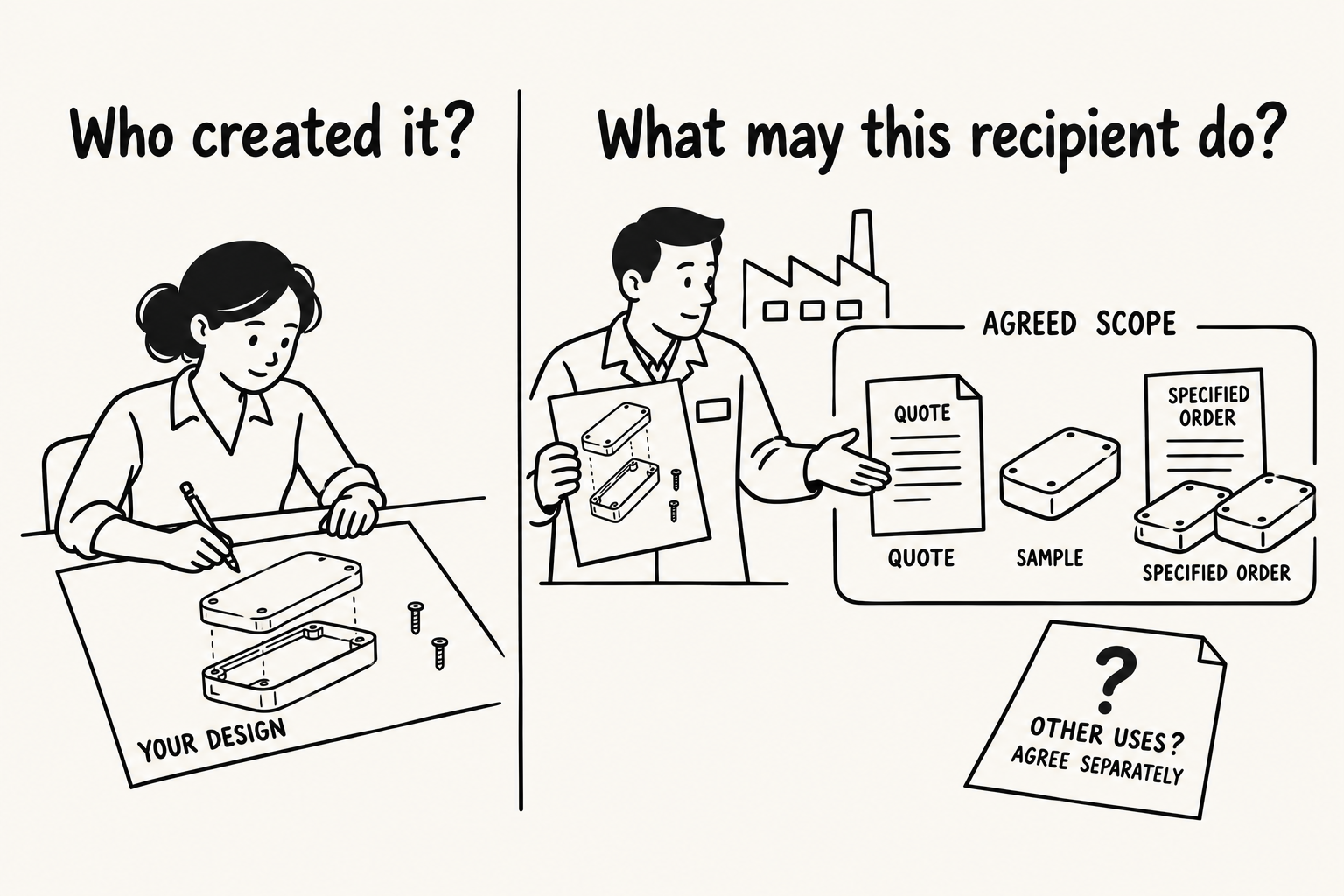
Because the moment you send the files, you’re letting the factory use them. It has to read them, flag manufacturing problems, maybe build a sample. The real question is where that permission stops.
Quoting from a drawing is one job. Making a prototype is another. Running your order is a third. None of them should leave you wondering whether the factory can reuse your design for another client, hand it to someone else, or put it in a patent application.
Your design files help show the work came from you. A well drafted NNN shows what this factory agreed to do with it. Those are two different things to prove.
With an NNN, you have something to hold the factory to later. Say you sent drawings for a quote, and months later the same part turns up in another customer’s order. You can point to the agreement: quote only. That’s a much stronger position than arguing about what everyone supposedly understood. Contractual obligations provide a basis for pursuing breach liability.PRC Civil Code, Article 577: Breach of ContractFailure to perform contractual obligations can give rise to breach liability.Cyberspace Administration of China, official republication
A Supreme People’s Court case shows how this plays out. A buyer gave a mold maker its technology for a skate that adjusts in both length and width. The technology ended up with another company, which used it in a utility model patent application.
The buyer lost at first instance. The court said the evidence didn’t prove the information was a trade secret.
On appeal, the result changed. The Supreme People’s Court read the confidentiality terms together with the mold work records. The contract said the information was confidential and could be used only for that contract. The defendants couldn’t show they got the technology lawfully or developed it themselves. The court confirmed the buyer owned the patent and awarded losses plus reasonable enforcement expenses. See the official case analysisipc.court.gov.cn合同保密条款对商业秘密构成要件及侵权举证责任的影响 - 最高人民法院知识产权法庭最高人民法院知识产权法庭网是人民群众了解和联系最高人民法院知识产权法庭的重要窗口,承载着司法公开、法治宣传、服务群众、接受监督等重要使命。是最高人民法院知识产权法庭的政务网站,是最高人民法院知识产权法庭在互联网上唯一的正式身份。ipc.court.gov.cn and judgment dated June 26, 2024ipc.court.gov.cn(2022)最高法知民终1981号 - 最高人民法院知识产权法庭最高人民法院知识产权法庭网是人民群众了解和联系最高人民法院知识产权法庭的重要窗口,承载着司法公开、法治宣传、服务群众、接受监督等重要使命。是最高人民法院知识产权法庭的政务网站,是最高人民法院知识产权法庭在互联网上唯一的正式身份。ipc.court.gov.cn.

Two things are worth noticing. The terms sat in a mold procurement contract, not a document called an NNN. And they didn’t win the case on their own. They worked because they matched the evidence, and the buyer still had to prove its claim.
So can an NNN protect your design? Yes. It gives you specific contract rights against the factory if it misuses your information. It can’t guarantee misuse won’t happen.
Signing is the easy part. Making the limits work day to day is harder.
You think you have an understanding. The factory may not see it the same way
You don’t have to suspect the factory of anything. Two honest businesses can read the same file differently.
Start with “confidential.” To you, it means your drawings are for your product, period. To the factory, it may mean the files stay inside the building. Whether its engineers can reuse what they learned on the next customer’s job may never come up.
Keeping a file inside the factory says nothing about how the factory can use it.
That’s why an NNN covers use, not just disclosure. Write down the work you’re authorizing, quoting and sampling included. Then say plainly that anything else is off limits.
Chinese trade secret law draws the same line: misuse can involve use in breach of confidentiality duties, as well as disclosurePRC Anti-Unfair Competition Law, Article 10 (2025 Revision)Disclosure, use, or permitting another's use in breach of confidentiality duties can infringe a trade secret. Statutory trade secret conditions must still be met.China National Intellectual Property Administration . Your contract tells the factory exactly which uses you’ve signed off on.
Engineering changes are the next gray area. The factory tweaks a feature to fit its machines or to make the part easier to build. Whose work is it now? Keep three things apart: what the factory already knew, what you gave it, and any genuinely new development.
A changed drawing isn’t a free pass. Using a modified or improved trade secret can still count as using it.SPC Trade Secret Judicial Interpretation (2020), Article 9Using a trade secret after modifying or improving it can still constitute use of that trade secret.Supreme People's Court
But a confidentiality clause won’t settle who owns genuinely new results. Commissioned development has its own rules for rights in the results.PRC Civil Code, Articles 859 and 861: Development ResultsCommissioned development has default rules for patent application rights and technical secret results.Cyberspace Administration of China, official republication If the factory is doing real development, agree on ownership and use in the development terms. They can go in the same contract as the NNN.
Then there’s subcontracting. Your factory may need a specialist mold shop for part of the job. Decide which files can go to whom, what protection goes with them, and who answers to you if something goes wrong. A flat “no subcontractors” clause that blocks work the factory actually needs doesn’t answer any of that.
Finally, noncircumvention. It protects specific customers, channels, or deals. Name them, and name the conduct you’re blocking. “Don’t cut me out of this deal” is reasonable. “Don’t work with anyone in my industry” is a much bigger ask, and it shouldn’t slip in by accident.
A good NNN leaves both sides clear on two things: the job the factory can do, and the opportunities it can’t take from your information. You need that clarity with every factory that sees your files, including the ones you never hire.
Don’t forget the factories you didn’t hire
Choosing a supplier usually means showing your drawings to several. A few factories quote, one makes a sample, you pick a winner.
The project moves on. The other conversations go quiet.
Your files don’t come back just because you hired someone else.
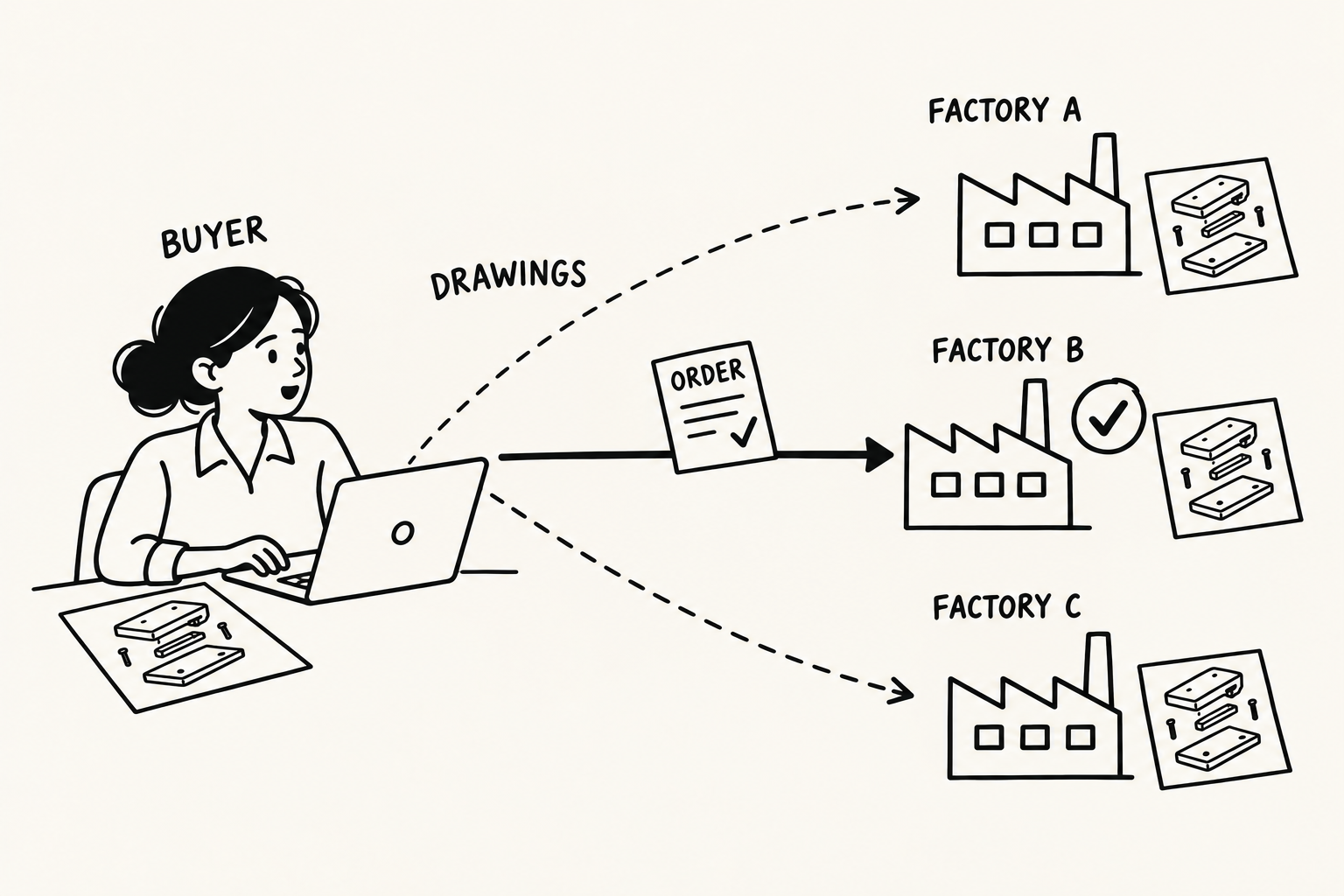
Your production contract binds the factory you hired. Don’t assume it binds the rest. A contract generally binds its parties.PRC Civil Code, Article 465: Parties Bound by a ContractA lawfully formed contract generally binds its parties, subject to statutory exceptions.Cyberspace Administration of China, official republication Each of the others needs its own commitment.
So tie protection to the disclosure, not the order. Whoever gets your core files should be covered before they get them. For how much to send at each stage, see what to send before a factory quote.
Use that early agreement to settle what happens when talks end:
- When does the factory’s permission to review the files run out?
- Which drawings, samples, and copies go back or get deleted?
- If it has to keep a copy for an agreed or legal reason, who can see it, and what restrictions still apply?
Answer each one separately. Permission to review ends. Confidentiality doesn’t. A record copy may stay on file. Kept apart, a retained copy is much harder to pass off as permission to keep using it.
Even with no order and no NNN, you aren’t unprotected. Article 501 protects trade secrets and other information subject to confidentiality learned during negotiations, whether or not the contract is formed.PRC Civil Code, Article 501: Confidential Information During NegotiationsInformation subject to confidentiality learned during negotiations must not be disclosed or improperly used, whether or not a contract forms.Cyberspace Administration of China, official republication An NNN makes it clear which information is covered and how it must be handled.
Agree on the limits before your core files go out
All three reasons lead to the same place. Owning the design doesn’t limit how others use it. The factory needs to read those limits the way you do. And every factory that sees your files needs to be covered, not just the one you hire.
Before your next sensitive send, check:
- which files and information are covered;
- what the factory may do with them, and whether it can pass them on;
- whether a customer or deal needs noncircumvention protection;
- that the company signing is the one actually receiving the files; and
- that you keep records of what you sent, and why.
When the project moves into development or production, carry the same terms into those contracts.
You don’t need a document called “NNN” for its own sake. If your NDA, development agreement, or manufacturing contract already covers these points, that may be enough. And if you’re ordering from a catalog without sharing anything sensitive, it’s a different conversation.
An NNN works alongside your IP and development terms. It doesn’t replace them. It can’t create a patent, decide by implication who owns every future invention, or make every copy of your files disappear.
About to send core product or business information to a factory? Our China NNN agreement service can check what protection you already have and fix the gaps before anything goes out.
References
- Cyberspace Administration of China, official republication of the PRC Civil Code, effective January 1, 2021, Articles 465, 501, 577, 859 and 861: https://www.cac.gov.cn/2020-06/01/c_15925617772683192.htmwww.cac.gov.cn中华人民共和国民法典_中央网络安全和信息化委员会办公室新华社北京6月1日电中华人民共和国民法典(2020年5月28日第十三届全国人民代表大会第三次会议通过)目录第一编 总则第一章 基本规定第二章 自然人第一节 民事权利能力和民事行为能力第二节 监护第三节 宣告失踪和宣告死亡第四节 个体工商户和农村承包经营户第三章 法人第一节 一般规定第二节 营利法人第三节 非营利法人第…www.cac.gov.cn
- Supreme People’s Court Intellectual Property Court, Judgment (2022) Zui Gao Fa Zhi Min Zhong No. 1981, dated June 26, 2024: https://ipc.court.gov.cn/zh-cn/news/view-4050.htmlipc.court.gov.cn(2022)最高法知民终1981号 - 最高人民法院知识产权法庭最高人民法院知识产权法庭网是人民群众了解和联系最高人民法院知识产权法庭的重要窗口,承载着司法公开、法治宣传、服务群众、接受监督等重要使命。是最高人民法院知识产权法庭的政务网站,是最高人民法院知识产权法庭在互联网上唯一的正式身份。ipc.court.gov.cn
- Supreme People’s Court Intellectual Property Court, The Effect of Contractual Confidentiality Clauses on Trade Secret Requirements and the Burden of Proof, published April 2, 2025: https://ipc.court.gov.cn/zh-cn/news/view-4122.htmlipc.court.gov.cn合同保密条款对商业秘密构成要件及侵权举证责任的影响 - 最高人民法院知识产权法庭最高人民法院知识产权法庭网是人民群众了解和联系最高人民法院知识产权法庭的重要窗口,承载着司法公开、法治宣传、服务群众、接受监督等重要使命。是最高人民法院知识产权法庭的政务网站,是最高人民法院知识产权法庭在互联网上唯一的正式身份。ipc.court.gov.cn
- China National Intellectual Property Administration, official republication of the PRC Anti-Unfair Competition Law (2025 Revision), effective October 15, 2025, Article 10: https://www.cnipa.gov.cn/art/2026/5/20/art_104_206437.htmlwww.cnipa.gov.cn国家知识产权局 法律 中华人民共和国反不正当竞争法(2025年修订)(1993年9月2日第八届全国人民代表大会常务委员会第三次会议通过 2017年11月4日第十二届全国人民代表大会常务委员会第三十次会议第一次修订 根据2019年4月23日第十三届全国人民代表大会常务委员会第十次会议《关于修改〈中华人民共和国建筑法〉等八部法律的决定》修正 2025年6月27日第十四届全国人民代表大会常…www.cnipa.gov.cn
- Supreme People’s Court, Provisions on Several Issues Concerning the Application of Law in Civil Cases Involving Trade Secret Infringement, effective September 12, 2020, Article 9: https://www.court.gov.cn/fabu/xiangqing/254751.htmlwww.court.gov.cn权威发布 - 中华人民共和国最高人民法院最高人民法院政务网站,最高人民法院网,最高人民法院,最高人民法院网是人民群众了解和联系最高人民法院的重要窗口,承载着司法公开、法治宣传、服务群众、接受监督等重要使命。是最高人民法院的政务网站,是最高人民法院在互联网上唯一的正式身份。www.court.gov.cn


Frequently Asked Questions
Do I need an NNN agreement if I already have an NDA?
In most cases, yes. A typical NDA is built around disclosure. It often says little about whether the factory may use your drawings for its own work, who else may receive them, or whether it may go around you to your customers. An NNN covers all three. If your NDA already does, a separate NNN adds little, so read what it actually prohibits, not its title.
Can an NNN protect my design before I have a Chinese patent?
Yes. An NNN is a contract, so it binds the factory that signs it whether or not you hold a Chinese patent. It won't give you a patent, though. Whether you also have trade secret or other IP protection depends on what the information is and on the facts.
Is it too late to sign an NNN after sending the drawings?
No. You can still agree on how the factory may use the files from now on, and both sides can expressly agree that the drawings you already sent are covered. Keep your original emails and delivery records, and list which files the agreement covers. What signing late can't do is undo a leak or misuse that has already happened.
Does a supplier's refusal to sign an NNN mean it plans to copy my design?
Not necessarily. Ask which terms it objects to. The reason may be ordinary: internal approval rules, terms that are too broad, or a subcontractor it genuinely needs. If you still can't agree on workable protection for your core files, stop sending sensitive material until you do, or look at another supplier.