On this page
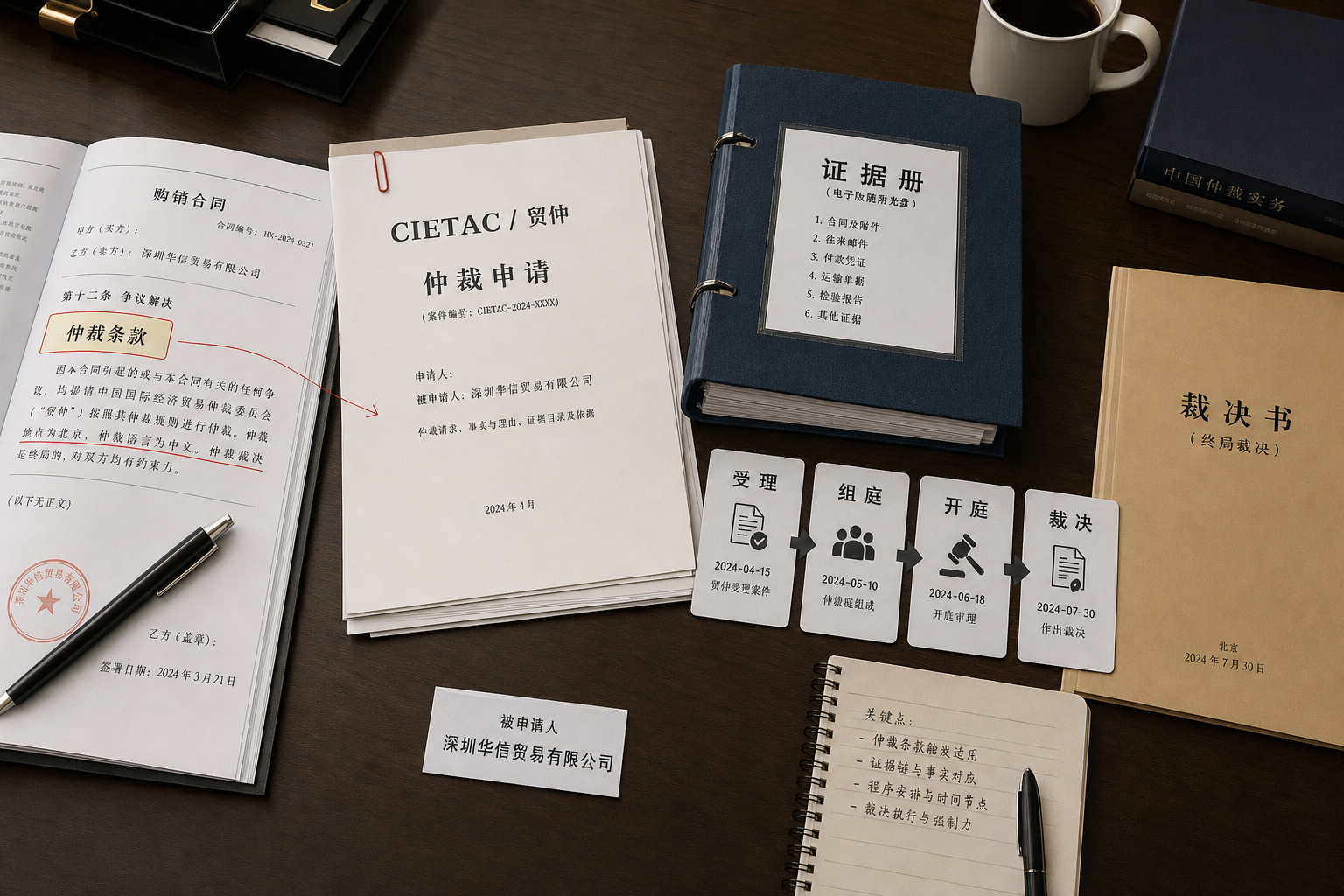
CIETAC stands for the China International Economic and Trade Arbitration Commission. It is one of China’s best-known commercial arbitration institutions and is frequently used in China-related contracts, including supply contracts, distribution agreements, joint ventures, service contracts, and other commercial disputes.
For a foreign buyer, CIETAC matters because a contract clause is only useful if it gives you a real path when the supplier refuses to perform. If the supplier and assets are in Mainland China, a CIETAC clause may be more practical than a foreign court clause that feels comfortable but cannot easily be enforced.
If the immediate issue is budget, compare CIETAC against ICC, SIAC and HKIAC with the arbitration cost comparator, then test the clause against the China supply chain dispute strategy.
That is the short answer. The harder part is drafting the clause and using it at the right time.
The basic definition
CIETAC is an arbitration institution, not a court. It administers arbitration proceedings under its rules. The parties submit claims, appoint or participate in appointing arbitrators, present evidence and arguments, and receive an arbitral award.
According to CIETAC’s published information, it was established in 1956. CIETAC’s official 2025 work reportwww.cietac.orgCIETAC 2025 Work Report-CIETACCHINA INTERNATIONAL ECONOMIC AND TRADE ARBITRATION COMMISSIONwww.cietac.org states that it accepted 5,736 new cases in 2025, including 806 foreign-related cases, and concluded 6,003 cases. Those numbers matter because they show that CIETAC is not a niche option. It is a major China arbitration forum.
Why it matters for foreign buyers
The most common contract mistake I see is not choosing CIETAC or not choosing CIETAC. It is choosing a dispute clause without asking what will happen if the Chinese counterparty ignores the decision.
A foreign buyer may feel safer choosing its home court. But if the supplier’s meaningful assets are in China, a home-court judgment may not be the fastest or most reliable pressure tool. A well-drafted arbitration clause can be more useful because arbitral awards have clearer cross-border enforcement routes than many court judgments .
CIETAC can be especially relevant where:
- the supplier is a Mainland Chinese company;
- the payment went to a Mainland company account;
- the goods, molds, or assets are in China;
- the parties want an institution familiar with China commercial disputes;
- the buyer wants a demand letter backed by a credible arbitration threat.
This does not mean CIETAC is always the right answer. HKIAC, SCIA, SHIAC, a Mainland court, or another forum may be better depending on the contract, value, language, assets, and counterparty. But CIETAC is one of the options that should be evaluated seriously.
What the clause should say
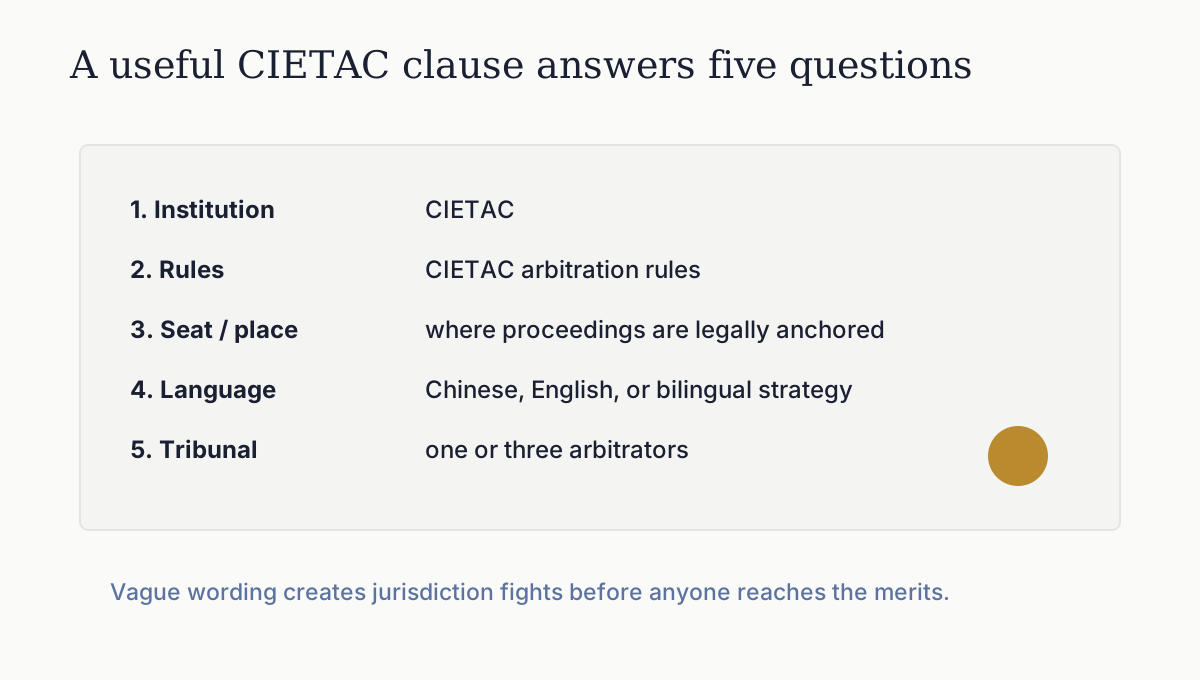
CIETAC publishes a model arbitration clausewww.cietac.orgModel Arbitration Clause-CIETACCHINA INTERNATIONAL ECONOMIC AND TRADE ARBITRATION COMMISSIONwww.cietac.org. The idea is simple: disputes arising from or in connection with the contract are submitted to CIETAC for arbitration, and the award is final and binding .
But the practical clause should usually go further. It should answer five questions:
- Which institution? CIETAC should be named clearly.
- Which rules? The clause should point to the CIETAC arbitration rules.
- What seat or place? The clause should avoid ambiguity about the legal anchor of the proceeding.
- What language? Chinese, English, or a bilingual strategy should be chosen deliberately.
- How many arbitrators? One arbitrator may be cheaper; three may be better for larger or more complex disputes.
Vague wording creates front-end fights. If the clause says only “arbitration in China” or names an institution incorrectly , the dispute may spend time on jurisdiction before anyone reaches the merits.
What a CIETAC case usually involves
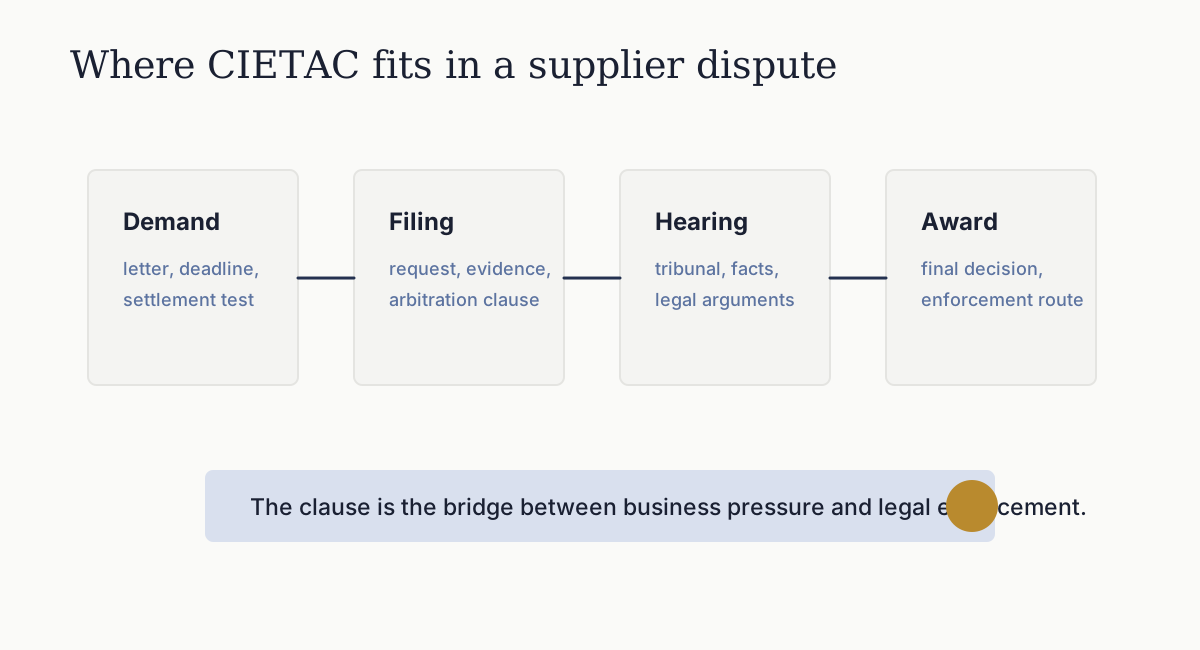
A typical case starts with the arbitration agreement. Without a valid arbitration clause or separate arbitration agreement, CIETAC will not become the forum just because one side wants it.
The claimant files a request for arbitration, identifies the parties, states the claims, attaches the arbitration agreement and key evidence, and pays the required fees. The respondent is notified and given a chance to respond. A tribunal is formed. Evidence is exchanged. The case may be decided after hearings, documents, expert evidence, or settlement discussions.
In a supplier dispute, the evidence package usually includes the contract or purchase order, company chop page, payment records, invoices, inspection reports, photos, delivery records, emails, WeChat messages , and any admissions or settlement offers.
CIETAC and demand letters
A lawyer letter is stronger when the next step is credible. If the contract contains a clean CIETAC clause, the letter can point to a real forum and a real procedural route. The supplier can see that the buyer is not just complaining.
But the letter should still be written carefully. It should identify the Chinese legal entity, state the facts, demand a specific remedy, set a deadline, and avoid threats that the buyer cannot carry out. If asset preservation is possible, timing should be reviewed before the letter is sent.
Common mistakes
One mistake is assuming CIETAC is automatically expensive or slow without checking the claim value and procedure . Some disputes justify the cost; small disputes may not.
Another mistake is assuming CIETAC is always pro-supplier because it is a Chinese institution. That is too crude. The more useful question is whether the clause, evidence, language, tribunal, and enforcement route fit the transaction.
A third mistake is choosing CIETAC but drafting the rest of the contract under a foreign template that does not work well in China. Arbitration cannot rescue a contract that never identifies the right Chinese legal party or has no clear delivery, inspection, warranty, payment, IP, or damages terms.
The bottom line
CIETAC is a major China arbitration institution. For foreign buyers, its practical value depends on the contract and the dispute strategy. A good CIETAC clause can make a demand letter more serious, create a path to arbitration, and support a realistic enforcement plan in China-related disputes.
But it must be drafted before the problem starts. Once the supplier has the money and the clause is vague, the buyer may have fewer options than expected.
If you are reviewing a China supply contract or deciding whether to rely on a CIETAC clause in a supplier dispute, contact me. I can assess the clause, evidence, preservation options, and likely arbitration path before you make the next move.
References
- National People’s Congress, PRC Arbitration Law (2025 revision, effective March 1, 2026), including Articles 10, 27-30, and 81: https://www.npc.gov.cn/npc/c2/c30834/202509/t20250912_447762.html全国人民代表大会中华人民共和国仲裁法全国人大发布的《仲裁法》官方文本(2026 年 3 月 1 日起施行)。www.npc.gov.cn
- UNCITRAL, Convention on the Recognition and Enforcement of Foreign Arbitral Awards (New York, 1958), 172 contracting states: https://uncitral.un.org/en/texts/arbitration/conventions/foreign_arbitral_awardsUnited Nations Commission on International Trade LawConvention on the Recognition and Enforcement of Foreign Arbitral Awards (New York, 1958) (the "New York Convention") | United Nations Commission on International Trade LawEntry into force: The Convention entered into force on 7 June 1959 (Article XII). Objectives Recognizing the growing importance of international arbitration as…uncitral.un.org
- CIETAC, Arbitration Rules 2024, including Article 59: https://www.cietac.org/sfs/cms/Uploads/202312/2024%20Arbitration%20Rules-EN.pdfCIETAC 中国国际经济贸易仲裁委员会CIETAC Arbitration Rules 2024 (English, PDF)贸仲 2024 年仲裁规则英文版 PDF。www.cietac.org
- CIETAC, Model Arbitration Clause: https://www.cietac.org/en/articles/25117www.cietac.orgModel Arbitration Clause-CIETACCHINA INTERNATIONAL ECONOMIC AND TRADE ARBITRATION COMMISSIONwww.cietac.org
- Supreme People’s Court, Provisions on Evidence in Civil Proceedings (2019 amendment), including Articles 14-15: https://ipc.court.gov.cn/zh-cn/news/view-393.htmlipc.court.gov.cn最高人民法院关于民事诉讼证据的若干规定(2019修正) - 最高人民法院知识产权法庭最高人民法院知识产权法庭网是人民群众了解和联系最高人民法院知识产权法庭的重要窗口,承载着司法公开、法治宣传、服务群众、接受监督等重要使命。是最高人民法院知识产权法庭的政务网站,是最高人民法院知识产权法庭在互联网上唯一的正式身份。ipc.court.gov.cn


This article is part of the China Legal Glossary series. Related reading: What Is HKIAC?, What Is Asset Preservation in China?, and That Contract Clause You Ignored Could Cost You Everything.
Frequently Asked Questions
What does CIETAC stand for?
CIETAC stands for China International Economic and Trade Arbitration Commission.
Is CIETAC a court?
No. CIETAC is an arbitration institution. Arbitrators decide the dispute, and CIETAC administers the procedure under its rules.
When should a foreign buyer consider a CIETAC clause?
A CIETAC clause can be practical when the Chinese supplier and its assets are in Mainland China and the buyer wants an arbitration route that can be taken seriously in China.
What should a CIETAC arbitration clause say?
It should clearly name CIETAC, identify the applicable rules, seat or place of arbitration, language, number of arbitrators, and avoid mixing arbitration with court jurisdiction.