On this page
China gives a trademark to whoever files first, not to whoever used it first. Your registration at home does not cover China. If you plan to sell, manufacture or even talk to distributors there, file in China first.
This guide follows the order in which you will meet each question:
- Which laws apply, and whether you may file at all
- What a foreign applicant must prepare
- What to register
- How the application moves from filing to certificate
- How to avoid the common mistakes
- What to do once the mark is registered
1. The legal framework
Four layers of law govern trademarks in China:
- The PRC Trademark Law (last amended 2019). It sets out what can be registered, how CNIPA examines applications, what rights a registration gives and how infringement is punished.
- The Implementing Regulations of the Trademark Law (revised 2014). They contain the operating rules: filing formats, examination steps, Madrid filings and procedural deadlines.
- Supreme People’s Court judicial interpretations. They bind the courts in trademark disputes.
- The Anti-Unfair Competition Law. It fills gaps, for example when someone uses your mark as their company name.
CNIPA also issues rules for specific areas. For instance, rules on collective and certification marks, including geographical indications, took effect on 1 February 2024.
2. Who may file, and how
The legal basis
Under Article 17 of the Trademark Law, a foreign company may apply in China on one of three bases:
- an agreement between its home country and China;
- an international treaty both countries have joined, such as the Paris Convention, which also gives you a priority right (see section 5); or
- reciprocity, meaning its home country gives Chinese companies the same treatment.
In practice, almost every foreign company qualifies.
You must use a Chinese trademark agency
Article 18 requires a foreign company with no habitual residence or business establishment in China to file through a trademark agency lawfully established in China. This applies to the application and to every later trademark matter.
Only two kinds of foreign applicant may file directly:
- a foreign company with a genuine, active business establishment in China; and
- a foreign individual with habitual residence in China, for example a holder of a permanent residence card or of a residence permit valid for at least one year.
Choose the agency with care. It holds your filings, receives your official notices and controls your deadlines.
3. What a foreign applicant must prepare
The documents
- The application form, signed or stamped by the applicant.
- A clear image of the mark.
- Proof of the applicant’s identity, normally a copy of your certificate of incorporation.
- A power of attorney appointing the agency. It must state your nationality.
The rules that apply only to foreign applicants
- Everything in Chinese. Any document in a foreign language must come with a Chinese translation. A document filed without one is treated as never filed (Implementing Regulations, Article 6).
- A recipient in China. The application must name a recipient in China who receives CNIPA’s later notices and decisions. This is usually your agency. Confirm it in writing.
- Notarisation, if required. The law applies reciprocity to notarising and legalising the power of attorney and corporate documents. For a new application, CNIPA usually accepts a signed power of attorney and a plain copy of your certificate of incorporation. Oppositions, invalidations and court cases will need notarised documents with an apostille or consular legalisation. China has applied the Apostille Convention since November 2023.
The Madrid alternative
China is a member of the Madrid Agreement and Protocol. If you already have an application or registration at home, you can designate China through WIPO instead of filing directly. It is cheaper to file. But if CNIPA objects, you will still need a Chinese agency to respond, and your list of goods must fit Chinese classification practice.
4. Decide what to register
Choose the type of mark
Article 8 of the Trademark Law lists the elements a trademark may be made of: words, devices, letters, numerals, three-dimensional signs, colour combinations and sounds, or any combination of them. That gives eight types of mark. English names vary by jurisdiction, so the table shows the Chinese term and the names you may know from home.
| Chinese term | Name used here | Also called |
|---|---|---|
| 文字商标 | Word mark | Standard character mark (US) |
| 图形商标 | Device mark | Design mark (US), figurative mark (EU) |
| 字母商标 | Letter mark | — |
| 数字商标 | Numeral mark | — |
| 三维标志商标 | Three-dimensional (3D) mark | Shape mark (EU) |
| 颜色组合商标 | Colour combination mark | — |
| 组合商标 | Composite mark | Combined mark |
| 声音商标 | Sound mark | — |
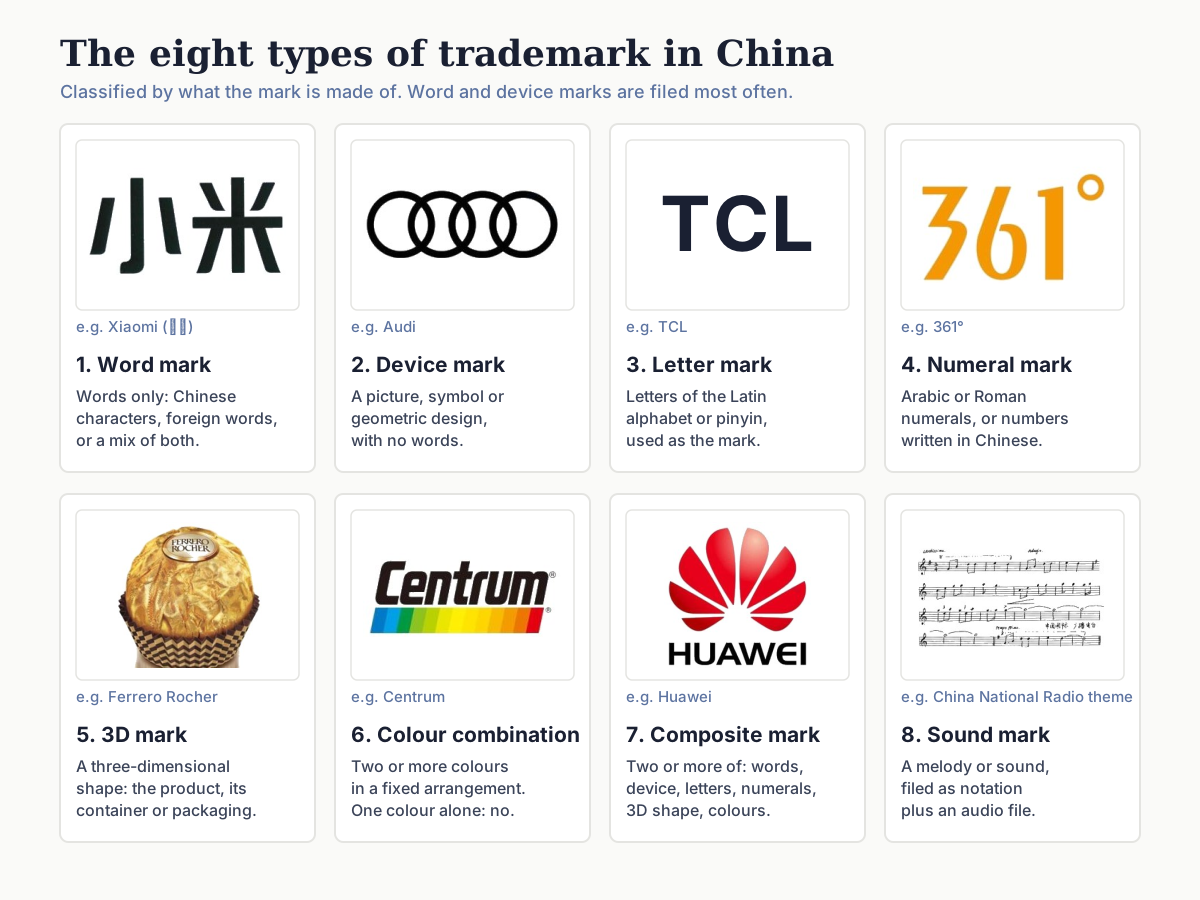
Word marks and device marks account for most filings.
- A word mark is made only of words. It is clear, easy to remember and easy to pass on.
- A device mark is a figure or design. It is easy to recognise and works across languages.
- A composite mark combines two or more elements, such as a logo with the brand name. It is vivid and recognisable as a whole.
The other types are narrower. Letter and numeral marks must be distinctive, so short strings are often refused. A 3D mark protects a shape or package. A colour combination needs at least two colours; China does not register a single colour. A sound mark is filed as musical notation with an audio file. China’s first, registered in 2016, is the opening theme of China National Radio.
My advice: file the word mark and the logo as two separate applications. If you redesign the logo later, the word mark still stands. If someone copies only your name, the word mark is the one that stops them.
Choose the classes and the goods
China uses the Nice Classification, but examines conflicts within narrower “similar groups” set out in CNIPA’s Similar Goods and Services Table. Two practical rules:
- List specific goods, not just a class number. Your protection covers only the goods you list.
- Use the official item names where you can. Non-standard wording slows examination and often leads to a correction notice.
Some classification rules surprise foreign applicants. Finished products are classified by function or use. A product with several functions goes by its main one. Dedicated packaging usually falls in the same class as the goods it holds.
5. The registration process
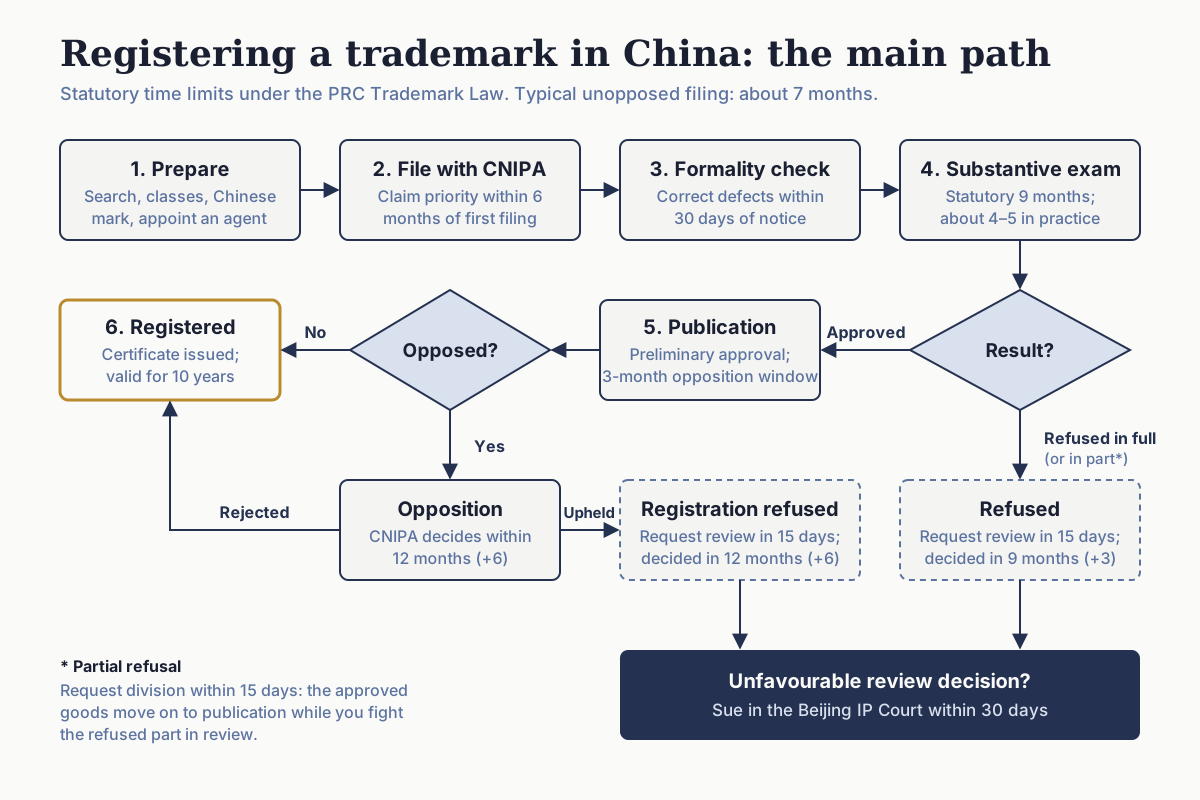
The steps are the same for Chinese and foreign applicants. The special requirements in section 3 apply at the filing stage.
Stage 1: File the application
Search first. Before filing, check the register for identical or similar marks in your classes and similar groups (see section 6).
Claim priority if you can. If you first filed the same mark for the same goods in a Paris Convention country within the last six months, claim priority when you file in China. Then submit a certified copy of the first application within three months (Article 25). Your Chinese filing date then goes back to your first foreign filing date.
Filing date. Applications are filed online or on paper. The filing date is the day CNIPA receives a complete application with the fees paid.
Stage 2: Examination
Formality examination. CNIPA checks that the documents are complete, the forms are filled in correctly, the goods are classified correctly and the fees are paid. If there is a fixable defect, you receive a correction notice. Correct it within 30 days and you keep your filing date. Miss the deadline and the application is rejected.
Substantive examination. CNIPA must finish within nine months of filing (Article 28). In practice it takes about four to five months. The examiner looks at two things:
- Absolute grounds: whether the sign itself is barred. For example, it lacks distinctiveness, copies a state name, or has a harmful social influence.
- Relative grounds: whether it conflicts with someone else. For example, it is identical or similar to an earlier mark for similar goods, it infringes a prior right such as copyright or a company name, or it unfairly pre-empts a mark someone else is already using with some reputation.
There are three possible results:
- Approved: the mark is published.
- Partly approved: the approved goods are published and the rest refused. You may request a division within 15 days, so the approved part moves ahead on its own.
- Refused: the mark is not published.
Stage 3: Publication and opposition
An approved mark is published in the Trademark Gazette for three months (Article 33). During that period:
- owners of prior rights and interested parties may oppose it on relative grounds, including bad-faith squatting; and
- anyone may oppose it on absolute grounds, such as lack of distinctiveness.
If someone opposes, CNIPA decides within 12 months of the end of the publication period, extendable by six months (Article 35).
Stage 4: Registration
A mark is registered when two conditions are met:
- it passed examination; and
- nobody opposed it within three months, or the opposition failed.
CNIPA then issues a registration certificate and publishes the registration. If the mark survived an opposition, your exclusive right runs from the end of the three-month publication period (Article 36).
| Situation | Typical time from filing to registration |
|---|---|
| No opposition | About 7 months (≈4.5 months of examination + 3 months of publication) |
| Opposition filed | 18 months to 2 years or more |
Stage 5: If the application is refused
| Decision | What you can do | Deadline | CNIPA decides within |
|---|---|---|---|
| Application refused | Request review by CNIPA | 15 days from receipt (Art. 34) | 9 months, extendable by 3 |
| Registration refused after opposition | Request review by CNIPA | 15 days from receipt (Art. 35) | 12 months, extendable by 6 |
| Unfavourable review decision | Sue in the Beijing IP Court | 30 days from receipt | — |
Fifteen days is short. The notice goes to your agency in China, needs translating and then waits for a decision at head office. Agree with your agency in advance who decides, and how fast.
6. Filing strategy and the risks to avoid
File before you enter the market
Because China is first-to-file, the only reliable defence against squatters is to file first. File before your first shipment, trade fair, distributor meeting or factory quote, in your core classes and the classes around them.
Build protection in layers
- Core: the goods and services you actually sell, listed precisely.
- Related: upstream and downstream goods, accessories, packaging, retail and after-sales services.
- Defensive: classes where squatting is common in your industry. Remember that every registered mark must be used (see section 7).
- Reserve: product lines or services you expect to add.
Decide who owns the mark
Filing in the name of the parent company or a dedicated IP company makes the portfolio easier to manage and cheaper to run. You then license your operating companies and must collect their evidence of use. Filing in each subsidiary’s name matches ownership to use, but control is weaker and the portfolio harder to manage.
Search before you file
- Similar marks: search identical and similar marks, registered or pending, in your classes and similar groups.
- Absolute bars: make sure the mark is not barred by Article 10 (prohibited signs) or lacks distinctiveness under Article 11, such as generic names, descriptive words, country names and flags.
- Foreign country names and place names: a mark containing a foreign country’s name is refused unless that government consents or the same mark is already registered in that country. A geographical indication is refused for goods that do not come from that place, if it could mislead the public.
- Other prior rights: check for conflicts with existing company names, copyright, design patents and personal names.
Own the copyright in your logo
If your mark uses a designed logo or custom lettering, get a written copyright assignment from the designer and check your font licences. A logo built on someone else’s copyright can be invalidated and lead to an infringement claim.
Put trademark ownership into every contract with a Chinese partner
Your distributors, agents and factories see your mark before anyone else in China. That makes them the most likely squatters. An NNN agreement restricts what they may do with your information, but only registration gives you the mark itself.
The Trademark Law lets you block an agent, a representative, or anyone who knew your mark through a business relationshipPRC Trademark Law: Article 15An agent or representative may not register the principal's mark in its own name without authorisation. A party with a contract or business relationship that knew of another's prior-used mark may not register an identical or similar mark for the same or similar goods. In both cases the mark is refused if the owner opposes.Official statutory text published by CNIPA from registering it. But the protection only works if you oppose the filing and prove the relationship. Do not rely on it alone.

Every distribution, agency and manufacturing agreement should say three things:
- You own the mark in China.
- The partner may not file the mark, or anything similar, in any class.
- Any filing the partner makes must be transferred to you at no cost.
Then watch the register for applications in their names.
7. After registration
A registration is the start of protection, not the end.
Use the mark and keep proof. The mark must be used genuinely, publicly and lawfully on the goods it covers. If it goes unused for three years in a row without a good reason, anyone can apply to cancel it. Keep dated contracts, invoices, advertising and packaging that show the mark.
Watch for conflicting marks. Check the Trademark Gazette and the market regularly. The three-month publication period is the cheapest moment to stop a copy.
Act against squatters and infringers. Pick the tool by where the other mark is:
| The other mark is… | Your tool |
|---|---|
| In its three-month publication period | Opposition |
| Registered, and conflicts with your earlier rights | Invalidation within 5 years of registration; no time limit against a bad-faith copy of a well-known mark |
| Registered by deception or improper means, such as mass filing without intent to use | Invalidation at any time |
| Registered but unused for three years | Non-use cancellation |
| Being used on goods in the market | Complaint to the market regulator, or an infringement suit in court |
Claim well-known status if you have the reputation. A mark that is well known in China is protected even against use on unrelated goods. Well-known status is decided case by case in oppositions, invalidations and lawsuits. It depends on evidence of sales, advertising and media coverage in China, so build that file from day one.
Renew on time. A registration lasts ten years. Renew in the 12 months before expiry. A six-month grace period follows. After that, the mark is cancelled.
8. What the cases show
- Evidence wins well-known status. MUJI and Michelin both had their marks recognised as well known after years of consistent use and promotion in China. Michelin’s protection even extended to “米芝莲”, the Cantonese-style Chinese name for its guide.
- Squatters can be removed. Tiffany invalidated a third party’s registration of “蒂凡尼”, a Chinese rendering of its name, on unrelated goods by proving how well known TIFFANY was.
- New evidence can reopen a lost case. Manolo Blahnik lost its opposition, then won a later invalidation with new evidence, including early media coverage certified by the National Library of China.
- Damages are real. In a Siemens case, the infringer refused to hand over its financial records. The court relied on media reports and awarded the full RMB 100 million claimed. Penfolds obtained punitive damages against deliberate infringers.
The short version
File early. Search before you file. Get the documents right. Use the mark. Watch the register. Act quickly.
None of the remedies above helps a brand that never filed. If you plan to register your trademark in China, see the China trademark protection service or contact me. I can help you decide what to register and in which classes, and see the application through to registration.
Frequently Asked Questions
Can a foreign company register a trademark in China without a local agent?
Only if it has a genuine business establishment in China. A foreign individual may also file directly if they have habitual residence in China, for example a permanent residence card or a residence permit valid for at least one year. Everyone else must appoint a trademark agency lawfully established in China (Article 18 of the PRC Trademark Law).
How long does it take to register a trademark in China?
About seven months if nobody opposes: around four to five months of examination, then a fixed three-month publication period. The legal ceiling for examination is nine months. If someone files an opposition, expect 18 months to two years or more.
Does my US, EU or UK trademark protect me in China?
No. China grants trademarks to whoever files first. A registration elsewhere gives you no rights in mainland China unless the mark is recognised as well known there, which is decided case by case and hard to prove. What a foreign filing does give you is a six-month priority window under the Paris Convention, and the option to extend it to China through the Madrid System.
How long does a Chinese trademark registration last?
Ten years from the date of registration, renewable for ten years at a time without limit. File the renewal in the 12 months before expiry; there is a six-month grace period after it. A mark that goes unused for three years in a row can be cancelled, so keep evidence of use.