On this page

Out of nowhere, your company tells you: don’t come back.
Maybe they gave you a reason, such as “restructuring,” “position eliminated,” or “business difficulties,” or maybe they didn’t. Maybe they handed you a Chinese-language document to sign, or maybe there was no paperwork at all. But the result is the same: your job in China just ended, effective immediately.
Now you’re facing two problems at once: how much compensation are you owed? And a more urgent one: your work permit is tied to this employer, so how long can you legally stay in China?
This happens every week. Whether it’s an international school, a tech company, a trading firm or a factory, almost every foreign employee’s first reaction is the same: “Do I even have rights here?”
Yes, you do. More than you probably think.
Do Chinese Labor Laws Protect Foreigners?
The short answer is yes, with some important nuances.
If you hold a valid work permit (外国人工作许可证) and work-type residence permit (工作类居留许可), you are legally employed in China. Your employment relationship is governed by:
- The Labor Contract Lawenglish.court.gov.cnLabor Contract Law of the People's Republic of ChinaThis Law is enacted in order to improve the labor contract system, define the rights and obligations of both parties to a labor contract, protect the legitimat…english.court.gov.cn (劳动合同法) — China’s primary employment statute
- The Regulations on the Administration of Employment of Foreigners in China (外国人在中国就业管理规定) — supplementary rules specific to foreign workers

The key principle: a legally employed foreigner enjoys substantially the same labor protections as a Chinese employee. This includes protections against wrongful termination, rights to severance pay, and access to labor arbitration.
There are some differences. Foreigners are generally on fixed-term contracts, for example, and the “open-ended contract” (无固定期限合同) rules that apply after consecutive fixed-term renewals for Chinese employees don’t always apply to foreigners in practice. But the core protections, especially on termination, are robust.
Common misconception: “Foreigners can’t use labor arbitration in China.” This is false. Foreign employees with valid work permits can — and regularly do — file labor arbitration claims. I’ve handled cases where foreign teachers, engineers, and executives have successfully obtained severance awards through Chinese labor arbitration.
Legal vs. Illegal Termination: Know the Difference
Chinese labor law provides limited, specific grounds for an employer to terminate an employment contract. Understanding these categories is critical.
When Your Employer CAN Legally Terminate You
1. Mutual Agreement (协商解除) Both parties agree to end the contract . If the employer initiates this, they must pay severance (economic compensation).
2. Employee At-Fault Termination (过错性解除, Article 39) The employer can terminate without severance if:
- You seriously violate company rules (and the rules were lawful and communicated to you)
- You cause significant damage to the company through gross negligence
- You simultaneously hold another job that materially affects your performance
- You were hired through fraud (falsified credentials, etc.)
3. No-Fault Termination (无过错解除, Article 40) The employer can terminate with 30 days’ notice or one month’s pay in lieu for:
- Medical condition — after your medical leave expires, you cannot perform the original or reassigned work
- Incompetence — you fail to meet job requirements after training or reassignment
- Substantial change in circumstances — the objective conditions under which the contract was signed have changed substantially, and no alternative arrangement can be agreed upon
4. Economic Layoffs (经济性裁员, Article 41) Mass layoffs (20+ employees or 10%+ of workforce) due to restructuring, serious business difficulties, or technological changes. Requires notification to the labor union and local labor authority.
When Your Employer CANNOT Legally Terminate You
Your employer cannot terminate your contract (except for gross misconduct under Article 39):
- During a medical treatment period for illness or non-work-related injury
- If you’ve suffered a work-related injury and have been confirmed with reduced labor capacity
- During pregnancy, maternity leave, or nursing period (for female employees)
The Critical Point
If your employer terminates you without fitting into any of the above categories, the termination is illegal (违法解除), and you are entitled to double the standard severance, often referred to as “2N.”
Wrongful Termination in China: The Three Questions That Matter
The keyword many foreign employees search is “wrongful termination China.” In a Chinese labor arbitration case, the question is more precise: did the employer have a statutory ground, evidence and procedure before it fired you?
Three issues usually decide the case:
- Ground: Did the termination fit one of the legal categories above? “Restructuring,” “performance issue” or “culture fit” are not enough by themselves.
- Evidence: Did the employer have documents, performance reviews, warnings, handbook rules and approval records before the termination date? Evidence created after the dispute starts is much weaker.
- Procedure: For layoffs, medical/incompetence termination, handbook-based misconduct and union consultation, did the employer follow the required steps?
For foreign employees, the work-permit system does not turn Chinese employment into at-will employment. The employer may control the work-permit sponsorship, but it still needs a legal basis to end the labor contract. That is why a termination letter that looks administratively final may still be legally challengeable.
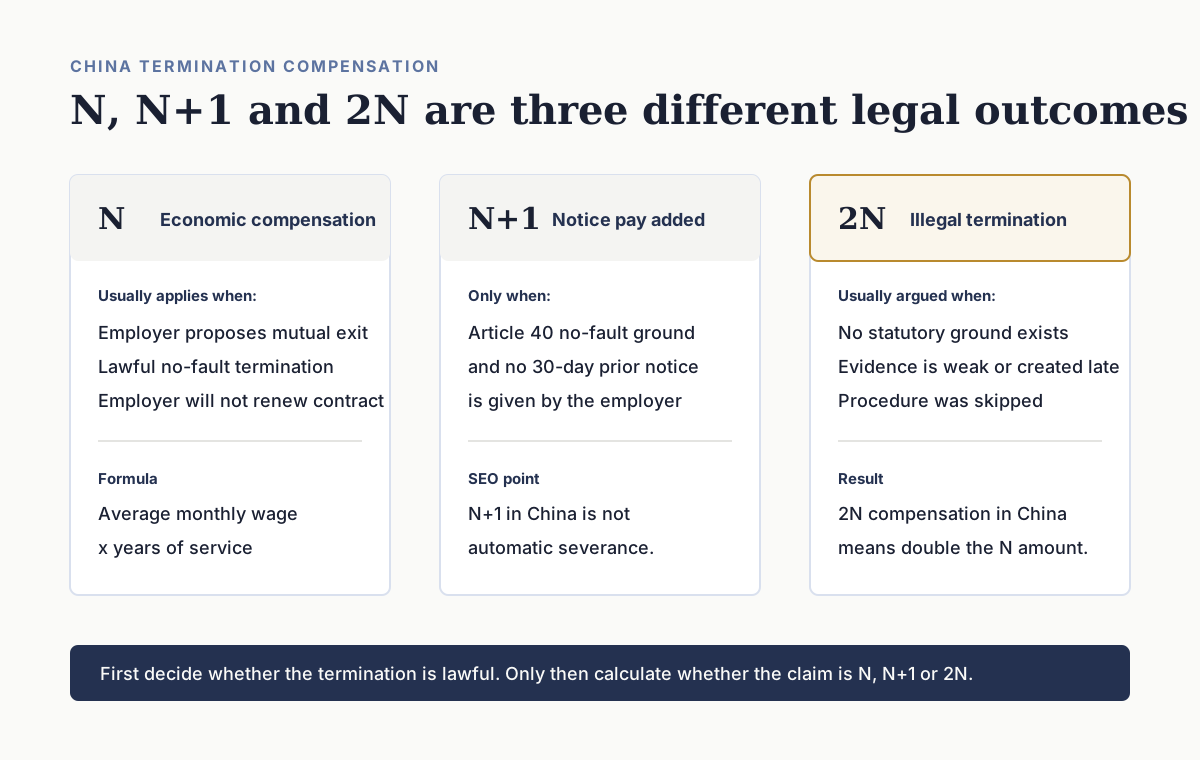
China Severance Pay: N, N+1, and 2N Compensation
Severance in China is calculated by a formula tied to your years of service:
The “N” Formula
N = one month’s average salary × years of service
- Years of service: each full year = 1 month of pay . 6+ months of a partial year = 1 month. Less than 6 months = 0.5 months.
- “Average salary” = your average monthly earnings over the 12 months preceding termination, including base salary, bonuses, allowances, and other regular compensation.
When You Get What
| Scenario | Compensation |
|---|---|
| Mutual agreement (employer-initiated) | N |
| No-fault termination (Art. 40) without 30 days’ notice | N + 1 (the “+1” is pay in lieu of notice) |
| No-fault termination (Art. 40) with 30 days’ notice | N |
| Illegal termination | 2N |
| Employee-at-fault termination (Art. 39) | 0 |
2N Compensation in China: When the Claim Doubles
2N compensation in China is the remedy for illegal termination under Article 87 of the Labor Contract Law. It is not a penalty you stack on top of every other claim; it is simply the double version of the statutory economic compensation that would otherwise be calculated under the N formula.
Typical 2N arguments include:
- The employer gave no termination reason at all.
- The employer used a vague reason like “business adjustment” without proving a lawful layoff or Article 40 ground.
- The employer accused you of misconduct but cannot show a valid handbook rule, prior communication and proportional discipline.
- The employer pressured you to sign a “voluntary resignation” after already telling you that you were fired.
In practice, the 2N issue often determines whether the case is worth fighting at all. A 3-year employee with a capped monthly severance base may still have a modest claim, while a senior foreign employee with 5 to 10 years of service may be looking at a material recovery.
N+1 in China: Useful, but Often Misused
Many HR departments use “N+1” in China as if it were the universal settlement formula. It is not.
The “+1” is usually one month’s salary in lieu of the 30-day prior written notice required for certain no-fault terminations under Article 40. If the employer cannot first prove a valid Article 40 ground, calling the offer “N+1” does not make the termination lawful. Conversely, if the employer gave proper 30 days’ notice and had a valid Article 40 basis, the extra “+1” may not be owed.
This distinction matters at the negotiating table: a company may offer N+1 because it sounds familiar and low-risk, yet your leverage comes from showing why the facts point to 2N, unpaid salary, unused annual leave, bonus or other claims.
Example
You’ve worked at the company for 3 years and 8 months. Your average monthly salary over the past 12 months (including base pay, housing allowance, and annual bonus pro-rated monthly) is ¥45,000.
- N = 4 months (3 full years + 8 months rounds up to 4)
- Standard severance (N) = ¥45,000 × 4 = ¥180,000
- Illegal termination (2N) = ¥360,000
Important for high earners: If your monthly salary exceeds 3× the local average salary, your severance base is capped at 3× the local average, and your years of service are capped at 12 years. For example, in Shanghai (2025 average approximately ¥12,000/month), the cap would be ¥36,000/month.
Want to run your own numbers? The calculator below applies the same N / N+1 / 2N rules, including the 3× high-earner cap:
The Visa Clock: Your Most Urgent Problem
Here’s what makes termination uniquely stressful for foreigners: your legal right to stay in China is tied to your employer.
After termination, the employer generally needs to report the end of the foreign employment relationship and process work-permit-related formalities. Local practice varies, but the practical point is the same: once the employer sponsorship ends, your work-type residence status becomes fragile. Do not assume you have a comfortable grace period without confirming the local rule.
You usually need to move quickly toward one of three outcomes:
- Find a new employer willing to transfer your work permit
- Convert to another visa type (e.g., tourist, business, or private affairs)
- Leave China
What to Do Immediately
- Do NOT let your employer cancel your work permit without a plan. In some cases, you can negotiate with the employer to delay the cancellation while you look for a new position. If you’re in a dispute, having an ongoing labor arbitration case can sometimes support an argument for maintaining your legal status — but this varies by city.
- Contact the local Exit-Entry Administration Bureau (出入境管理局) to understand your options. In practice, many foreign employees convert to an S2 (private affairs) or tourist visa to buy time.
- If you have school-aged children, their dependent visas are usually tied to yours. Factor this into every decision.
Pro tip: Some cities (Shanghai, Beijing, Shenzhen) have more flexible policies for foreign employees in transition. An experienced immigration lawyer can help you navigate the specific rules in your city.
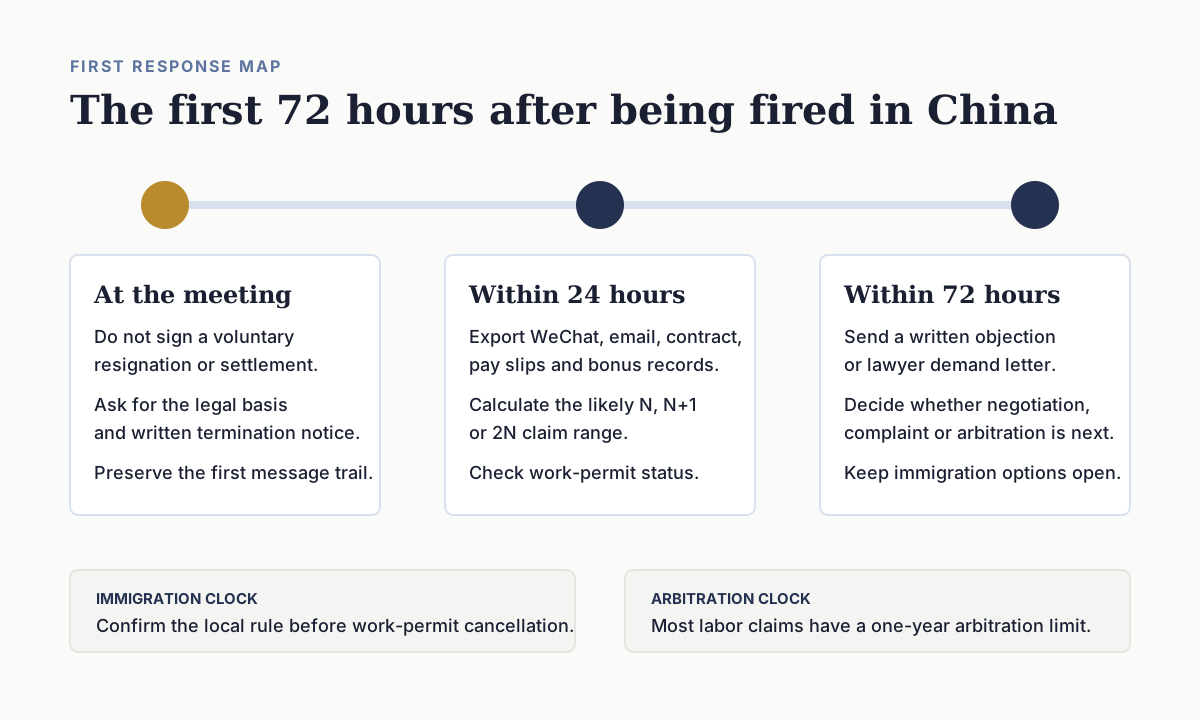
The first 72 hours — and your visa clock
-
Hours 0–24 Don't sign anything under pressure
You are not obligated to sign a settlement or waiver at the termination meeting. Ask for 3–5 business days to review, get Chinese-only documents translated, and request a written termination notice stating the legal ground. Never sign a "voluntary resignation" if you were fired. -
Hours 24–48 Preserve the evidence
Export WeChat threads with HR and your manager, and secure your employment contract, payslips, tax receipts, bank records, work emails and the employee handbook. Write down the circumstances of the termination meeting while your memory is fresh. -
Hours 48–72 Calculate your number and respond in writing
Work out whether the facts support N, N+1 or 2N, add unpaid salary, unused annual leave and bonus claims, then send a written response stating that you do not accept the termination as lawful and reserving your right to labor arbitration. -
Visa countdown Work-permit cancellation starts the clock
Once the employer ends the sponsorship and processes the work-permit formalities, your work-type residence status becomes fragile. Contact the local Exit-Entry Administration Bureau immediately — in practice many foreign employees convert to an S2 (private affairs) or tourist visa to buy time — and do not assume a comfortable grace period without confirming the local rule.
Step-by-Step: What to Do When You’re Fired
1. Don’t Sign Anything on the Spot
The most common mistake: agreeing to a termination settlement under pressure. You are not obligated to sign anything at the moment of termination.
- Ask for time to review the documents. A reasonable request is 3–5 business days.
- If the documents are in Chinese only, insist on an English translation or have them reviewed by a bilingual lawyer first.
- Never sign a document that says you “voluntarily resign” (自愿离职) if you were actually fired. This waives your right to severance.
2. Preserve Evidence
Sound familiar? Just like in supply chain disputes, evidence preservation is critical.
- Screenshot or export all WeChat messages with your manager, HR, and colleagues about the termination. WeChat records are standard evidence in Chinese labor arbitration.
- Save copies of your employment contract, salary slips, tax receipts, and bonus records. The contract clauses that decide severance are usually the ones flagged in That Employment Contract Is Full of Traps. If your salary was partially paid offshore or “off the books,” gather any proof (bank transfers, emails discussing compensation).
- Record the circumstances of the termination. Who was present? What was said? Was there written notice? What reason was given?
- Keep your employee handbook or company rules. If they claim you violated company rules, you’ll need the actual rulebook to challenge whether the rules were lawful, reasonable, and properly communicated.
3. Calculate What You’re Owed
Based on the section above, calculate your expected severance. Also check for:
- Unpaid salary (including the current month)
- Unused annual leave (must be paid out upon termination)
- Pro-rated annual bonus (if your contract or company policy provides for one)
- Outstanding reimbursements (business expenses, relocation costs, etc.)
4. Send a Written Response
Within a few days, send a formal written response (email is fine, but WeChat is also acceptable as evidence in China) stating:
- You do not accept that the termination is lawful
- You are requesting the specific legal basis for the termination
- You are claiming your full legal entitlements (severance, unpaid salary, unused leave, etc.)
- You reserve the right to pursue labor arbitration if the matter is not resolved
5. Consult a Labor Lawyer
A Chinese labor lawyer experienced in foreign employee cases can:
- Assess whether your termination is legal or illegal
- Calculate your precise entitlements
- Advise on the labor arbitration process and timeline
- Help you navigate the visa implications simultaneously
- Draft and file the arbitration application if needed
Cost reality: Many labor lawyers in China offer free or low-cost initial consultations, and filing a labor arbitration case is essentially free, since the nominal fee has been abolished in most jurisdictions. Attorney fees for a straightforward wrongful termination case typically range from ¥10,000 to ¥30,000 depending on the complexity and city.
Labor Arbitration: How It Works for Foreigners
If negotiation fails, labor arbitration is your primary remedy. Here’s the process:
Filing
You file an application with the Labor Dispute Arbitration Commission (劳动争议仲裁委员会) in the district where the employer is located or where the employment contract was performed. The statute of limitations is 1 year from the date you knew or should have known your rights were violated.
Timeline
- Acceptance: The commission decides whether to accept your case within 5 days of filing.
- Hearing: Typically scheduled within 30–60 days of acceptance.
- Award: The tribunal must issue an award within 45 days of accepting the case (extendable to 60 days for complex cases).
Total timeline: roughly 2 to 4 months from filing to award.
What to Expect
- Proceedings are conducted in Chinese. You’ll need a Chinese lawyer or a certified translator.
- The process is document-driven. Bring all contracts, pay slips, communications, and evidence of the termination.
- Arbitration awards for wrongful termination are directly enforceable — if the employer doesn’t comply, you can apply to the court for enforcement.
Can You File Even After Leaving China?
Yes. You can authorize a Chinese lawyer to represent you through a notarized power of attorney, and many foreign employees file labor arbitration after returning to their home country. The process works; it just requires a reliable lawyer on the ground.
The Bottom Line
Being fired in China as a foreigner is stressful, but it’s not the legal dead end many people assume. Here’s what to remember:
- You have rights. Chinese labor law protects legally employed foreigners — including the right to severance and access to labor arbitration.
- Don’t sign under pressure. Ask for time. Get documents translated. Never sign a “voluntary resignation” if you were fired.
- Preserve everything. WeChat messages, contracts, pay slips. Evidence wins arbitrations.
- Address the visa issue immediately. Your legal stay is tied to your employer. Start working on visa alternatives the same day.
- File within 1 year. The arbitration statute of limitations is strict.
- The cost of fighting is lower than you think. Arbitration filing is free. Lawyers are affordable. The potential recovery (especially 2N for illegal termination) makes it worthwhile.
If you’ve been terminated and need help understanding your options, feel free to get in touch. I can help you assess whether the termination was lawful, calculate your entitlements, and navigate both the labor arbitration and visa processes simultaneously.
References
- Ministry of Human Resources and Social Security, Labor Contract Law of the PRC (2012 amendment), including Articles 36, 39-42, 46-48, and 87: https://www.mohrss.gov.cn/xxgk2020/fdzdgknr/zcfg/fl/202011/t20201102_394622.htmlwww.mohrss.gov.cnwww.mohrss.gov.cn
- Supreme People’s Court, Labor Contract Law of the PRC (English translation): https://english.court.gov.cn/2015-08/17/c_761484.htmenglish.court.gov.cnLabor Contract Law of the People's Republic of ChinaThis Law is enacted in order to improve the labor contract system, define the rights and obligations of both parties to a labor contract, protect the legitimat…english.court.gov.cn
- Ministry of Human Resources and Social Security, Labor Dispute Mediation and Arbitration Law of the PRC, including Article 27 (one-year limitation period): https://www.mohrss.gov.cn/xxgk2020/fdzdgknr/zcfg/fl/202011/t20201102_394628.htmlwww.mohrss.gov.cnwww.mohrss.gov.cn
- National Immigration Administration, Exit-Entry Administration Law of the PRC, including Article 41 (work permit and work-type residence permit requirement): https://www.nia.gov.cn/n741440/n741547/c1013311/content.htmlwww.nia.gov.cn中华人民共和国出境入境管理法www.nia.gov.cn
- Regulations on the Administration of Employment of Foreigners in China (2017 revision): https://www.gov.cn/zhengce/2022-08/31/content_5711314.htmwww.gov.cn外国人在中国就业管理规定_人力资源和社会保障部_中国政府网www.gov.cn

This article is part of the series “Employment Disputes for Foreigners in China — Know Your Rights.” Next: Your Company Hasn’t Paid You in Months — Can Foreigners File Labor Arbitration in China?.
Frequently Asked Questions
Can a foreign employee claim wrongful termination in China?
Yes, if the foreign employee is legally employed in China with valid work authorization. The employer still needs a statutory ground and supporting evidence. If the termination is illegal, the employee may claim 2N compensation through labor arbitration.
What does 2N compensation mean in China?
2N means double the statutory economic compensation calculated under the Labor Contract Law. It is usually claimed when the employer illegally terminates or ends the employment contract.
Is N+1 automatic when an employer fires an employee in China?
No. N+1 generally applies when the employer relies on a lawful no-fault termination ground under Article 40 but does not give 30 days' prior written notice. It is not the default settlement formula for every termination.