On this page
Many foreign buyers place their first order with a Chinese supplier through Alibaba. The amount is modest, the product relatively standard. Communication happens on the platform, orders stay on the platform. The buyer pays through Alibaba.com, the platform displays Trade Assurance, and if something goes wrong, the buyer can file a refund request. Even if the buyer has never actually read the platform rules, they are at least inside a transaction environment surrounded by structured protection.
A few years later, the relationship appears mature. The supplier suggests switching to email or WhatsApp, with commercially reasonable justifications: platform fees are high, the process is cumbersome, long-standing customers do not need to route every order through the platform. The order value grows from $5,000 to $50,000, then to $500,000. The paperwork, however, has not upgraded in tandem. It is still a pro forma invoice, a thread of chat messages, a few sample photos, and a T/T wire transfer.
This is the most underestimated risk in Alibaba sourcing: the larger the order, the less legal protection the buyer may actually have.
This does not mean large orders should stay on Alibaba forever. On the contrary, long-term, customized, high-value purchases will eventually outgrow what platform mechanisms can handle. The real problem is that buyers cannot jump directly from platform protection to trust-based dealing. The correct path should be an upgrade from platform protection to contract protection.
1. When the Amount Grows, You Cannot Keep Relying on Small-Order Protection Logic
The risk control on small Alibaba platform orders comes partly from the platform itself, not from the supplier’s unilateral commercial promises. Alibaba’s official explanation of Trade Assurance is direct: Trade Assurance protects online orders when payment is made through Alibaba.com; product quality and shipping time are based on what the buyer and seller agreed to in the Trade Assurance online order. Alibaba’s current Trade Assurance pagetradeassurance.alibaba.comTrade Assurance protects your Alibaba.com ordersTrade Assurance protects your Alibaba.com orderstradeassurance.alibaba.com[1] summarizes this mechanism as secure payment, product or shipping issue protection, and buyer-seller dispute mediation; its Money-back policytradeassurance.alibaba.comTrade Assurance protects your Alibaba.com ordersTrade Assurance protects your Alibaba.com orderstradeassurance.alibaba.com[2] further specifies that non-shipment, lost goods, product defects, wrong products, damage, and other product issues can enter the refund mechanism.
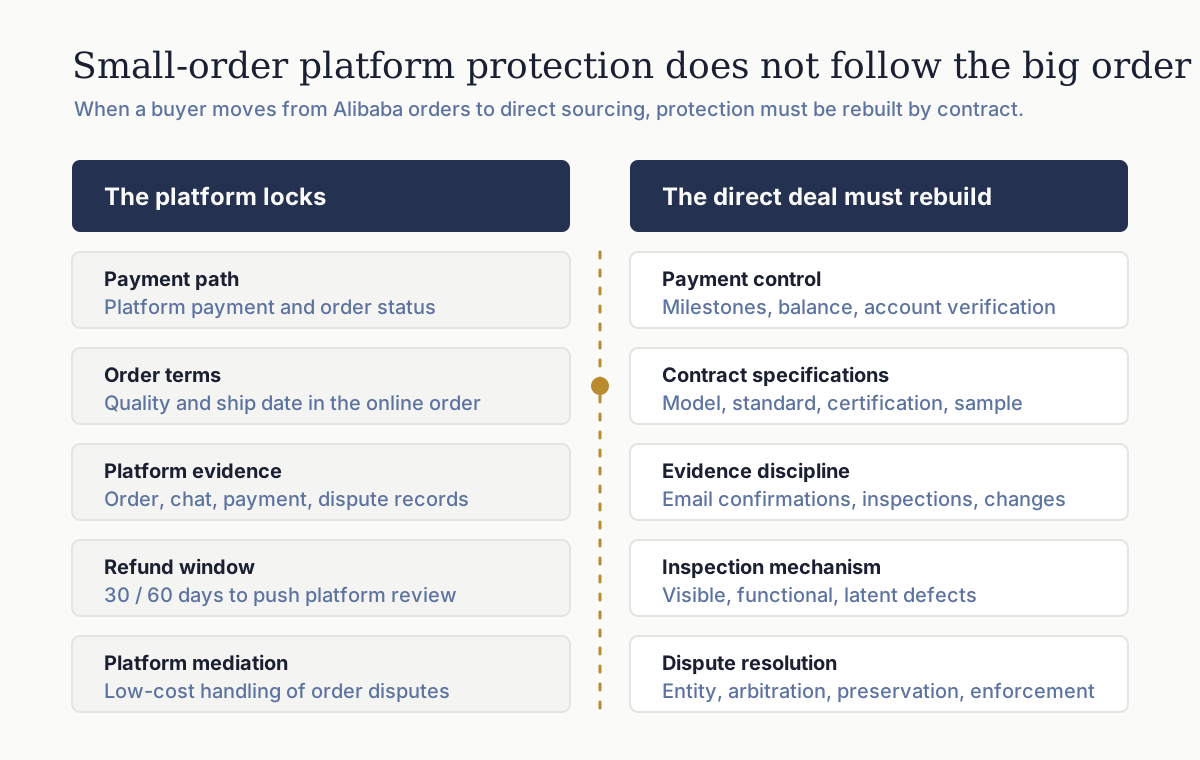
These rules are valuable for small, standardized, on-platform orders. The platform does at least four things on the buyer’s behalf: it locks in the payment path, locks in the order terms, preserves some transaction records, and provides a refund application window. Even if the supplier is not particularly reliable, the buyer still has a set of platform procedures to use.
The risk of a direct large deal is not that it bypasses Alibaba itself, but that the buyer often fails to replace these four layers of protection with a new legal structure. If a $500,000 order moves forward with only a PI, an English trade name, a few WhatsApp voice messages, and full upfront payment, the transaction has entered large-deal territory while the legal structure remains at the sample-order stage.
This is the core argument of this article: Alibaba is a safety net for small orders, not a legal architecture for large orders. Large direct deals need lawyer-designed contract protection, not more trust.
2. Platform Small Orders Are Safer Because the Platform Locks in Payment, Order Terms, Evidence, and a Refund Window
Trade Assurance’s value should be neither overstated nor underestimated. It is not insurance, does not guarantee supplier performance, and cannot cover all of the buyer’s commercial losses. But within platform transactions, it does create a relatively clear transaction framework.
First, the payment path is locked in. Alibaba’s buyer pagebuyer.alibaba.comTrade Assurance protects your Alibaba.com ordersTrade Assurance protects your Alibaba.com ordersbuyer.alibaba.com[3] explicitly bases protection on Alibaba.com online orders and payment through Alibaba.com. Payment methods can include credit cards, PayPal, T/T, and other forms, but the key is not the name of the payment instrument—it is whether the payment was completed within the platform system as part of a Trade Assurance order. When a supplier asks the buyer to wire funds to a bank account outside the platform, this is not simply a change of payment method but a change of risk location.
Second, the order terms are structured. The platform requires the buyer and seller to define product quality and shipping date in the online order. This requirement may appear administrative, but it carries real legal significance: when a dispute arises, the buyer can at least point to an order text recorded by the platform, rather than searching through scattered chats for “what the other party should have known I wanted.”
Third, some evidence is platform-ized. Platform chats, order modifications, payment statuses, and dispute submission materials form a set of records usable within the platform. China Justice Observer’s analysis of Alibaba’s dispute resolution mechanismwww.chinajusticeobserver.com4 Things You Have to Know on How to File a Dispute on Alibaba - CTD 101 Series - China Justice ObserverAlibaba provides Online Dispute Resolution (ODR) through its Complaint Center. It has built a complex dispute resolution. If you want to resolve disputes throu…www.chinajusticeobserver.com[4] notes that Alibaba’s dispute handling typically revolves around online mediation, platform decision, decision enforcement, and objection handling, and that platform communication records can be used as evidence within the platform system. But the analysis also cautions that the platform has no obligation to preserve all complaint-related information indefinitely on behalf of the parties—important records should still be downloaded and saved by the buyer independently.

Fourth, the refund window is made explicit. Alibaba’s Money-back policytradeassurance.alibaba.comTrade Assurance protects your Alibaba.com ordersTrade Assurance protects your Alibaba.com orderstradeassurance.alibaba.com[2] states that buyers can generally apply for a refund within 30 or 60 days of delivery . This window has practical significance for clear quality issues, shortages, damage, and model errors. It also forces the buyer to inspect goods promptly upon receipt, rather than waiting until downstream customer complaints have already spread before trying to reconstruct evidence.
These protections are not perfect, but they are enough to explain why a small platform order can actually be safer than a large direct order. Small-order safety comes not from the amount being small, but from the transaction structure being clear.
3. Direct Large Deals Are Not the Problem; Direct Large Deals Without Lawyer Design Are the Problem
Large orders eventually leaving the platform is normal commercial evolution. Custom products, long-term supply, mold development, split deliveries, annual framework pricing, downstream retail compliance, Amazon FBA requirements, warranty and recall arrangements—none of these are matters that a platform refund mechanism can fully address. For these transactions, what the buyer needs is not to keep squeezing every order back onto Alibaba, but a legal structure better suited to large direct deals.
The problem typically arises in the transition phase. The buyer has left the platform, but protection has not been upgraded. The supplier still communicates using an English trade name, and the buyer has not verified the Chinese name and Unified Social Credit Code on the business license. Payment has shifted from platform escrow to T/T wire transfer, but without account verification and staged payment arrangements. The product has gone from standard goods to custom items, but the contract still only says “same as sample.” The order amount is large enough to warrant arbitration or litigation assessment, but the documents contain no effective dispute resolution clause.
From a lawyer’s perspective, this is not a question of “whether to trust the supplier” but whether the transaction architecture matches the transaction size. Trust can support cooperation, but it cannot replace entity identification, payment conditions, quality standards, inspection procedures, and breach-of-contract liability. This is especially true in cross-border sourcing, where distance—in language, evidence, assets, and enforcement—separates buyer and supplier. Any link left unwritten becomes a cost if a dispute arises.
Direct dealing is certainly possible. You just cannot use the loose documents of a small platform order to carry the risk of a large direct deal.
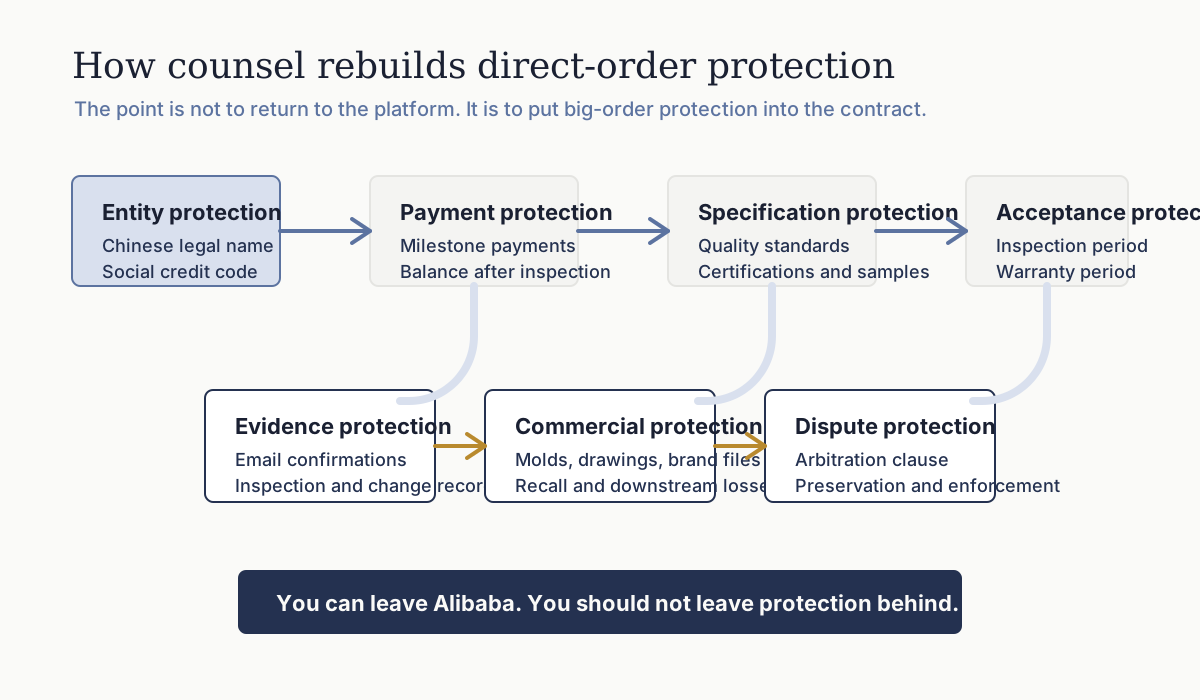
4. The Lawyer Must First Rebuild Payment Protection: Once Platform Escrow Disappears, Payment Milestones Must Become Leverage
The payment protection on platform orders comes partly from Alibaba’s transaction system. According to Alibaba’s introduction to Trade Assurancetradeassurance.alibaba.comTrade Assurance protects your Alibaba.com ordersTrade Assurance protects your Alibaba.com orderstradeassurance.alibaba.com[1], when the buyer pays through Alibaba.com, the platform intervenes for refunds and mediation when order problems arise. Once a direct order leaves the platform, this protection no longer exists. The moment payment enters a bank account controlled by the supplier, the buyer’s negotiating position changes substantially.
Therefore, contract design for large direct deals must first address payment milestones. Common practices include: the deposit ratio should not be too high; the balance should be tied to pre-shipment inspection, third-party reports, shipping documents, or sample confirmation; where molds and custom development are involved, distinguish mold fees, development fees, mass-production payment, and warranty retention funds; for higher-risk orders, arrange split deliveries with split payments rather than a single large upfront transfer. If a deposit has already been paid off-platform and the supplier has gone silent, the recovery sequence in Chinese Supplier Went Silent After Your Deposit applies.
Account verification is equally important. The FBI’s public guidance on Business Email CompromiseFederal Bureau of Investigation (FBI)Business Email CompromiseFBI guidance on business email compromise (BEC) scams and how to prevent them.www.fbi.gov[6] identifies “a familiar supplier sending updated payment instructions ” as a typical fraud scenario and recommends verifying payment requests through trusted contact methods before sending funds. The FBI’s press release on the 2025 IC3 ReportFederal Bureau of Investigation (FBI)Cryptocurrency and AI Scams Bilk Americans of BillionsFBI press release on the 2025 IC3 report: reported cybercrime losses approaching $21 billion.www.fbi.gov[7] shows reported cybercrime losses approaching $21 billion. In cross-border sourcing, a supplier’s email being compromised, a salesperson privately providing an account, or a fake finance department sending a new PI—these are not rare edge-case risks.
A lawyer’s role at this layer is not just to remind the buyer to “be careful when transferring money,” but to embed payment protection into documents and processes: the receiving account must match the contracting entity; any account change must be confirmed by the supplier under company chop; major payments should be verified through pre-existing independent contact channels before execution; if the receiving entity, contracting entity, and actual manufacturing entity are not the same, the legal relationships must be clarified before payment and a decision made on whether a guarantee, joint debt confirmation, or tripartite agreement is needed.
5. The Lawyer Must Also Rebuild Order Protection: Once Platform Order Fields Disappear, Specifications Must Enter the Contract Body
In on-platform transactions, Alibaba requires the buyer and seller to define product quality and shipping time in the online order. In direct dealing, once this structured field disappears, specifications often degenerate into chat records, sample photos, and the phrase “same as previous order.”
Under Chinese law, the starting point for quality issues remains the contract. Article 615 of the Civil Code provides that the seller shall deliver the subject matter in accordance with the agreed quality requirements ; Article 617 provides that where the subject matter does not conform to quality requirements, the buyer may seek remedies under the rules on breach-of-contract liability; Article 584 limits the scope of damages to include the benefit obtainable from performance of the contract, but not exceeding the losses that the breaching party foresaw or ought to have foreseen at the time of contracting. These provisions can be found in the English translationwww.chinajusticeobserver.comCivil Code of China: Book III Contract (2020) 民法典 第三编 合同 - China Laws Portal - CJOFull text in English: Civil Code of China: Book III Contract (2020)中华人民共和国民法典第三编合同www.chinajusticeobserver.com[5] of Book III (Contracts) of the Civil Code.
These provisions have very practical implications for large purchases. If the buyer wants to claim that the products do not conform to the agreement, they must first prove what the “agreement” was. If the buyer wants to claim Amazon store suspension, downstream customer claims, recall costs, or peak-season sales losses, they must also prove that these losses were foreseeable at the time of contracting and causally connected to the supplier’s breach.
Therefore, a large direct contract cannot merely state the product name and quantity. At a minimum, the following should be written into the contract or annexes: model, material, dimensions, tolerances, color, packaging, labeling, certification documents, applicable standards, testing methods, third-party inspection body, sampling ratio, sample number, production batch, delivery date, delay liability, and arrangements for rework, replacement, refund, price reduction, and compensation in case of non-conformity.
A platform order can help a small deal lock in basic terms; a large direct deal requires a lawyer to expand those terms into enforceable contract language.
6. The Lawyer Must Design an Inspection Mechanism: Once the 30/60-Day Platform Window Disappears, the Buyer Must Manage Quality Risk Through the Contract
Alibaba’s Money-back policy gives platform buyers a 30- or 60-day refund window. This window is not equivalent to the quality objection period under Chinese law, but it at least gives the buyer a clear operational deadline. Once a direct deal leaves the platform, if the contract has no inspection clause, quality disputes will fall back to the rules of the Civil Code.
Article 620 of the Civil Code requires the buyer to inspect the goods within the agreed inspection period; where no inspection period is agreed, the buyer shall inspect promptly. Article 621 further provides that where an inspection period is agreed, the buyer shall notify the seller of any non-conformity in quantity or quality within that period; where no inspection period is agreed, the buyer shall notify the seller within a reasonable period after discovering or when they ought to have discovered the non-conformity . If notice is not given in time, the goods may be deemed conforming. Article 622 addresses excessively short inspection periods: if the agreed inspection period is too short to allow a comprehensive inspection given the nature of the goods and trade practices, that period should generally be treated only as the objection period for apparent defects. These rules are also set out in Articles 620 through 622www.chinajusticeobserver.comCivil Code of China: Book III Contract (2020) 民法典 第三编 合同 - China Laws Portal - CJOFull text in English: Civil Code of China: Book III Contract (2020)中华人民共和国民法典第三编合同www.chinajusticeobserver.com[5] of Book III of the Civil Code.
These rules impose clear requirements on large procurement contracts: the inspection mechanism must distinguish between apparent defects, functional defects, laboratory testing, compliance documents, latent defects, and warranty periods. For categories such as electronics, medical supplies, food-contact materials, children’s products, and automotive parts, a visual check within days of receipt cannot cover the full scope of risk. The contract should specify pre-shipment inspection, post-arrival sampling, third-party testing, the method of notification upon discovery of latent defects, and the supplier’s repair, replacement, refund, or compensation obligations during the warranty period.
Without these clauses, a dispute will revolve around arguments over “reasonable period,” “ought to have discovered,” “whether notice was timely,” and “whether the defect existed at the time of delivery.” These arguments are not impossible to handle, but the evidentiary cost rises substantially.
7. The Lawyer Must Also Add Protection the Platform Cannot Provide: Molds, Intellectual Property, Downstream Losses, and Dispute Resolution
The platform refund mechanism is primarily built around the order itself. The real risks of a large direct deal often extend beyond the scope of order refunds.
For example: the buyer pays mold fees for custom products, but the contract does not specify mold ownership, custody obligations, handover conditions, or the consequences of the supplier withholding the molds; the buyer provides drawings and brand materials, but there is no NNN, confidentiality, non-circumvention, or IP clause; the buyer’s sales channel depends on Amazon or large retailers, but the contract does not assign responsibility for labeling, certification, compliance documents, and downstream claims; the buyer and supplier form an annual supply relationship, but there are no price adjustment, production scheduling, minimum purchase, termination, or inventory handling mechanisms.
These items are not the focus of platform rules, but they are the focus of a large procurement contract. A lawyer’s value lies precisely here: not in copying Trade Assurance into the contract, but in building more specific risk allocation where the platform cannot reach.
The dispute resolution clause is especially important. CIETAC’s 2025 Work Reportwww.cietac.orgCIETAC 2025 Work Report-CIETACCHINA INTERNATIONAL ECONOMIC AND TRADE ARBITRATION COMMISSIONwww.cietac.org[8] shows that CIETAC accepted 5,736 new cases that year, of which 806 were foreign-related cases, with foreign-related dispute amounts of RMB 88.075 billion, involving parties from 97 countries and regions; CIETAC’s statistics pagewww.cietac.orgStatistics-CIETACCHINA INTERNATIONAL ECONOMIC AND TRADE ARBITRATION COMMISSIONwww.cietac.org[9] also shows that foreign-related cases grew from 645 in 2023 to 806 in 2025. This data shows that commercial disputes between foreign buyers and Chinese suppliers entering China arbitration are not a theoretical extreme scenario.
A large direct contract should determine the dispute resolution path before payment: whether to select CIETAC, SCIA, SHIAC, HKIAC, or another institution ; how to agree on the seat of arbitration, governing law, and language; whether to preserve the possibility of asset preservation; where the supplier’s main assets are located; how an award or judgment will later be enforced. Without these clauses, the deterrent effect of a lawyer’s letter diminishes, and the cost of subsequent arbitration or litigation increases.
8. Graduating From the Platform Should Not Mean Graduating From Protection
Alibaba has real value for many foreign buyers. It lowers the transaction barrier for first contact with Chinese suppliers and provides, through Trade Assurance, a low-cost dispute resolution mechanism for on-platform orders. This article does not suggest that buyers should bypass the platform in all circumstances, nor that buyers should keep all large orders on the platform permanently.
The more accurate suggestion is: when the sourcing relationship is still at the small-volume, standardized, trial-order stage, make full use of platform protection; when the transaction enters the large-volume, long-term, customized stage, proactively complete the legal structure upgrade. Direct dealing is not the source of risk—direct dealing without contract protection is the source of risk.
Before payment, the buyer should confirm at least seven things:
- The supplier’s Chinese legal entity name and Unified Social Credit Code
- Whether the receiving bank account matches the contracting entity
- Whether product specifications and compliance documents are in the contract
- Whether the inspection period, warranty period, and latent defect handling are clear
- Whether payment milestones retain sufficient leverage
- Whether mold, drawing, brand material, and IP ownership are clearly defined
- Whether the dispute resolution clause can reach the supplier’s assets and create real pressure
If these matters have been addressed, leaving Alibaba does not mean losing protection. On the contrary, the buyer gains contract protection better suited to large transactions than platform rules.
If these matters have not been addressed, the larger the order, the more concentrated the risk. The reason the first $5,000 platform small order is safer is not that the amount is small, but that the protection is still in place. The reason the $500,000 direct large deal is dangerous is not that direct dealing itself is wrong, but that the buyer failed to take the protection with them when they left the platform.
If you are moving from Alibaba small orders to large direct purchases, or have already encountered issues such as supplier demands for off-platform payment, quality defects, mold withholding, non-compliant certification documents, or refusal to refund, review the China supplier demand letter service or contact me before escalation. I can first review the supplier’s entity, payment arrangements, order documents, evidence, and dispute resolution path, and then assess how this direct deal should be supplemented with contract protection.
References
- Alibaba.com, Trade Assurance, https://tradeassurance.alibaba.com/tradeassurance.alibaba.comTrade Assurance protects your Alibaba.com ordersTrade Assurance protects your Alibaba.com orderstradeassurance.alibaba.com
- Alibaba.com, Money-back Policy, https://tradeassurance.alibaba.com/ta/moneybackpolicy.htmtradeassurance.alibaba.comTrade Assurance protects your Alibaba.com ordersTrade Assurance protects your Alibaba.com orderstradeassurance.alibaba.com
- Alibaba.com, Buyer Protection Story, https://buyer.alibaba.com/page/tradeassurance/buyer/story.htmlbuyer.alibaba.comTrade Assurance protects your Alibaba.com ordersTrade Assurance protects your Alibaba.com ordersbuyer.alibaba.com
- China Justice Observer, 4 Things You Have to Know on How to File a Dispute on Alibaba, https://www.chinajusticeobserver.com/a/4-things-you-have-to-know-on-how-to-file-a-dispute-on-alibabawww.chinajusticeobserver.com4 Things You Have to Know on How to File a Dispute on Alibaba - CTD 101 Series - China Justice ObserverAlibaba provides Online Dispute Resolution (ODR) through its Complaint Center. It has built a complex dispute resolution. If you want to resolve disputes throu…www.chinajusticeobserver.com
- National People’s Congress, Civil Code of the People’s Republic of China, Book III: Contracts (English translation), China Justice Observer, https://www.chinajusticeobserver.com/law/x/civil-code-of-china-part-iii-contract-20200528www.chinajusticeobserver.comCivil Code of China: Book III Contract (2020) 民法典 第三编 合同 - China Laws Portal - CJOFull text in English: Civil Code of China: Book III Contract (2020)中华人民共和国民法典第三编合同www.chinajusticeobserver.com
- Federal Bureau of Investigation, Business Email Compromise, https://www.fbi.gov/how-we-can-help-you/scams-and-safety/common-frauds-and-scams/business-email-compromiseFederal Bureau of Investigation (FBI)Business Email CompromiseFBI guidance on business email compromise (BEC) scams and how to prevent them.www.fbi.gov
- Federal Bureau of Investigation, Cryptocurrency and AI Scams Bilk Americans of Billions (2025 IC3 Report), https://www.fbi.gov/news/press-releases/cryptocurrency-and-ai-scams-bilk-americans-of-billionsFederal Bureau of Investigation (FBI)Cryptocurrency and AI Scams Bilk Americans of BillionsFBI press release on the 2025 IC3 report: reported cybercrime losses approaching $21 billion.www.fbi.gov
- China International Economic and Trade Arbitration Commission (CIETAC), 2025 Work Report, https://www.cietac.org/en/articles/34572www.cietac.orgCIETAC 2025 Work Report-CIETACCHINA INTERNATIONAL ECONOMIC AND TRADE ARBITRATION COMMISSIONwww.cietac.org
- China International Economic and Trade Arbitration Commission (CIETAC), Statistics, https://www.cietac.org/en/category/statisticswww.cietac.orgStatistics-CIETACCHINA INTERNATIONAL ECONOMIC AND TRADE ARBITRATION COMMISSIONwww.cietac.org
This article is the first in the “Alibaba and China Sourcing Platform Disputes Series.” Related reading: Chinese Supplier Went Silent After Your Deposit, When a China Demand Letter Works — And When It Backfires, Can a Foreign Buyer Sue a Chinese Supplier? From Lawyer Letter and Arbitration to Asset Preservation and Enforcement, Legal Checklist Before Sourcing From a Chinese Supplier: 10 Things to Verify Before You Pay, China Supplier Demand Letter Service.
Frequently Asked Questions
Should large orders always stay on Alibaba?
Not necessarily. Large, long-term, customized purchases eventually leaving the platform is a common commercial choice. The question is not whether you leave Alibaba, but whether you rebuild protection through contract, inspection, payment control, entity verification, and dispute resolution clauses when you leave.
What does Alibaba Trade Assurance primarily protect?
Alibaba's official explanation bases Trade Assurance on orders placed on the platform and payments made through Alibaba.com. It mainly addresses issues such as non-shipment, lost goods, product defects, wrong products, and damage, with a 30- or 60-day refund window. It is not commercial insurance, nor is it a court or arbitration ruling.
What protection can a lawyer provide in a large direct deal?
A lawyer's value is not copying platform rules but designing a more suitable protection structure for large orders: verifying the Chinese legal entity, setting payment milestones and inspection mechanisms, defining quality standards and compliance documents, agreeing on mold and IP ownership, arranging arbitration or litigation paths, and preserving the option of asset preservation and enforcement when necessary.